
Difference between 1-month and 3-month SOFR, and the relationship between them


I want to better understand the difference between the 1-month and 3-month SOFR rate, and when to use each for cash flow discounting.
For example - I have a 5 year project, and someone has decided to use the 3-month SOFR rate. My question is why? What does this assume about the movement of cash flows?
Furthermore, I would like to know if there's a mathematical relationship between the two (1-month vs 3-month).
Some Googling led to the following definition
Three-Month Term SOFR means the rate for Term SOFR for a tenor of three months that is published by the Term SOFR Administrator at the Reference Time for any interest period, as determined by the Calculation Agent after giving effect to the Three-Month Term SOFR Conventions.
Does this definition provide any leads? Can I define the 3-month SOFR as F(t,T) to be the forward rate of the 3-month SOFR at some forward time t?, and T=3 is fixed?
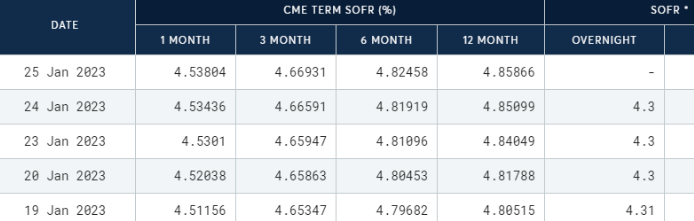
Are the forward curves then shown in the columns below?
Thank you very much






Ratione necessitatibus numquam nobis dolorem similique mollitia et. Facere dignissimos possimus omnis recusandae qui. Repudiandae amet explicabo sed odit commodi quo incidunt ea.
Dolores ut quo rerum iure fuga mollitia. Placeat consequatur consequatur quam et distinctio sunt. Ut porro delectus perferendis aut. Iure quod vel inventore et eveniet quo. Blanditiis id necessitatibus similique est quia repellat.
See All Comments - 100% Free
WSO depends on everyone being able to pitch in when they know something. Unlock with your email and get bonus: 6 financial modeling lessons free ($199 value)
or Unlock with your social account...