


Trending Content - Investing, Markets & Macroeconomics Forum
Career Resources
Career Resources

Get instant access to lessons taught by experienced private equity pros and bulge bracket investment bankers including financial statement modeling, DCF, M&A, LBO, Comps and Excel Modeling.





Based on the most helpful WSO content, here are some general guidelines for critiquing and optimizing a portfolio:
Diversification: Ensure the portfolio is well-diversified across asset classes, industries, and geographies. Over-concentration in a single sector or asset type can increase risk.
Alignment with Goals: Assess whether the portfolio aligns with your financial goals, risk tolerance, and investment horizon. For example, if you're nearing retirement, a more conservative allocation might be appropriate.
Performance Monitoring: Regularly review the performance of individual assets and the portfolio as a whole. Identify underperforming assets and evaluate whether they should be replaced or held for potential recovery.
Liquidity Needs: Consider the liquidity of the portfolio. If you anticipate needing cash in the short term, ensure a portion of the portfolio is allocated to liquid assets.
Cost Efficiency: Evaluate the expense ratios, management fees, and transaction costs associated with the portfolio. High costs can erode returns over time.
Tax Implications: Be mindful of the tax consequences of any changes to the portfolio. For inherited portfolios, consider the step-up in basis for capital gains tax purposes.
Rebalancing: Periodically rebalance the portfolio to maintain the desired asset allocation. This helps manage risk and ensures the portfolio remains aligned with your investment strategy.
If you can provide more specific details about the portfolio (e.g., asset allocation, individual holdings, investment goals), I can offer more tailored advice.
Sources: Incoming Buyside Equity Analyst - Seeking Advice, Real Estate Asset/Portfolio Management Tips and Tools, A controversial “portfolio theory” of career planning, Reflections from year 4 as an equity analyst, Family Office Private Equity
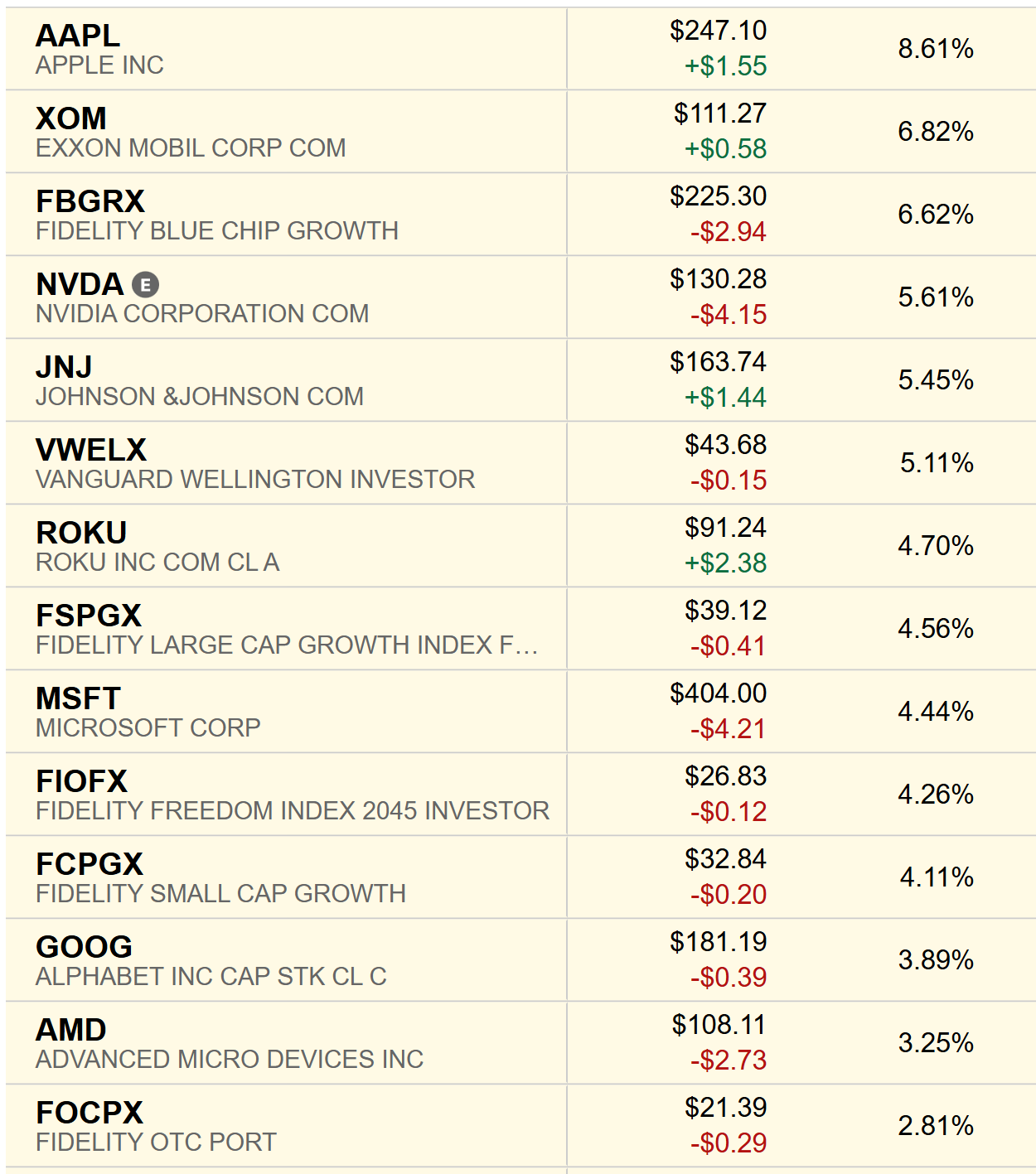
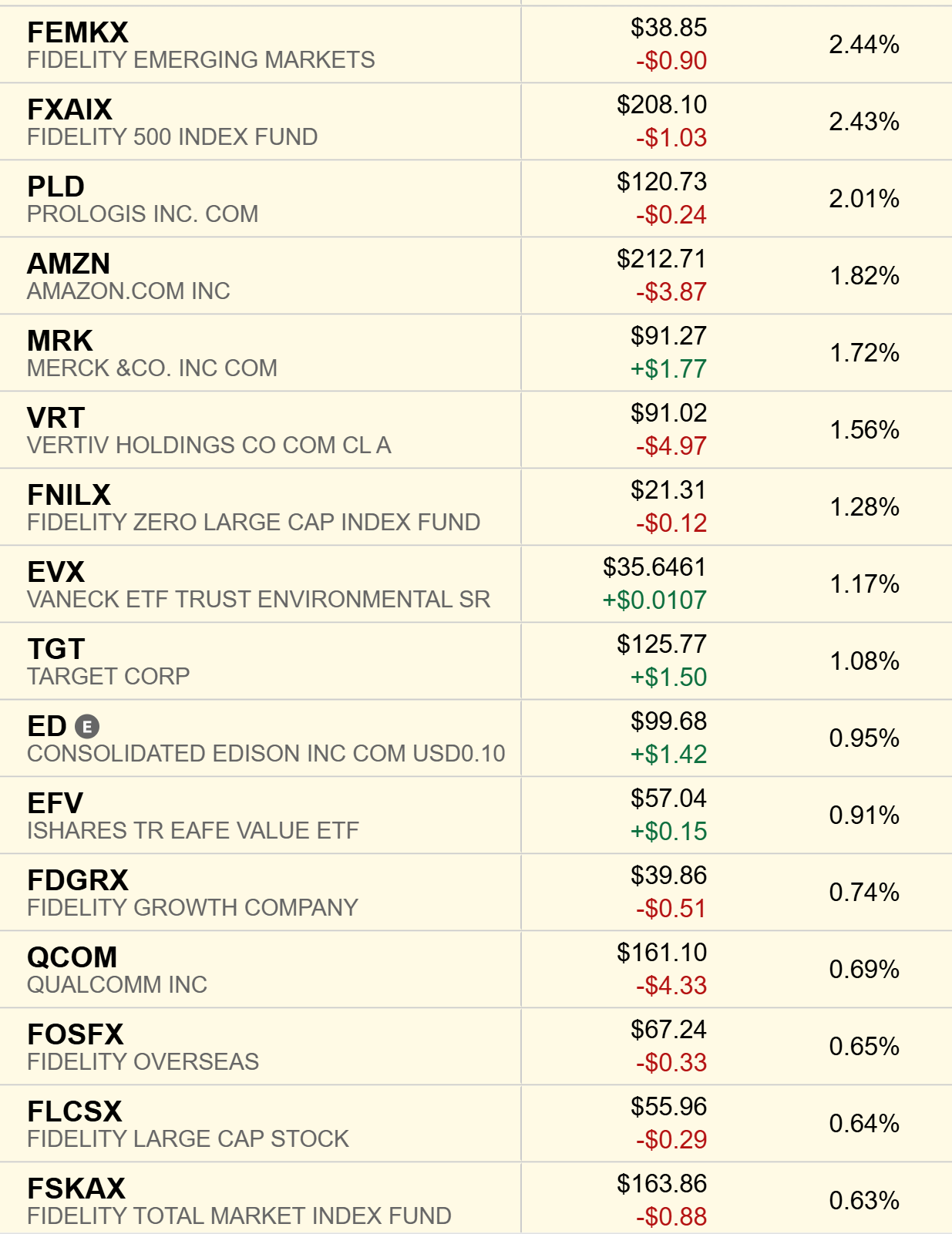
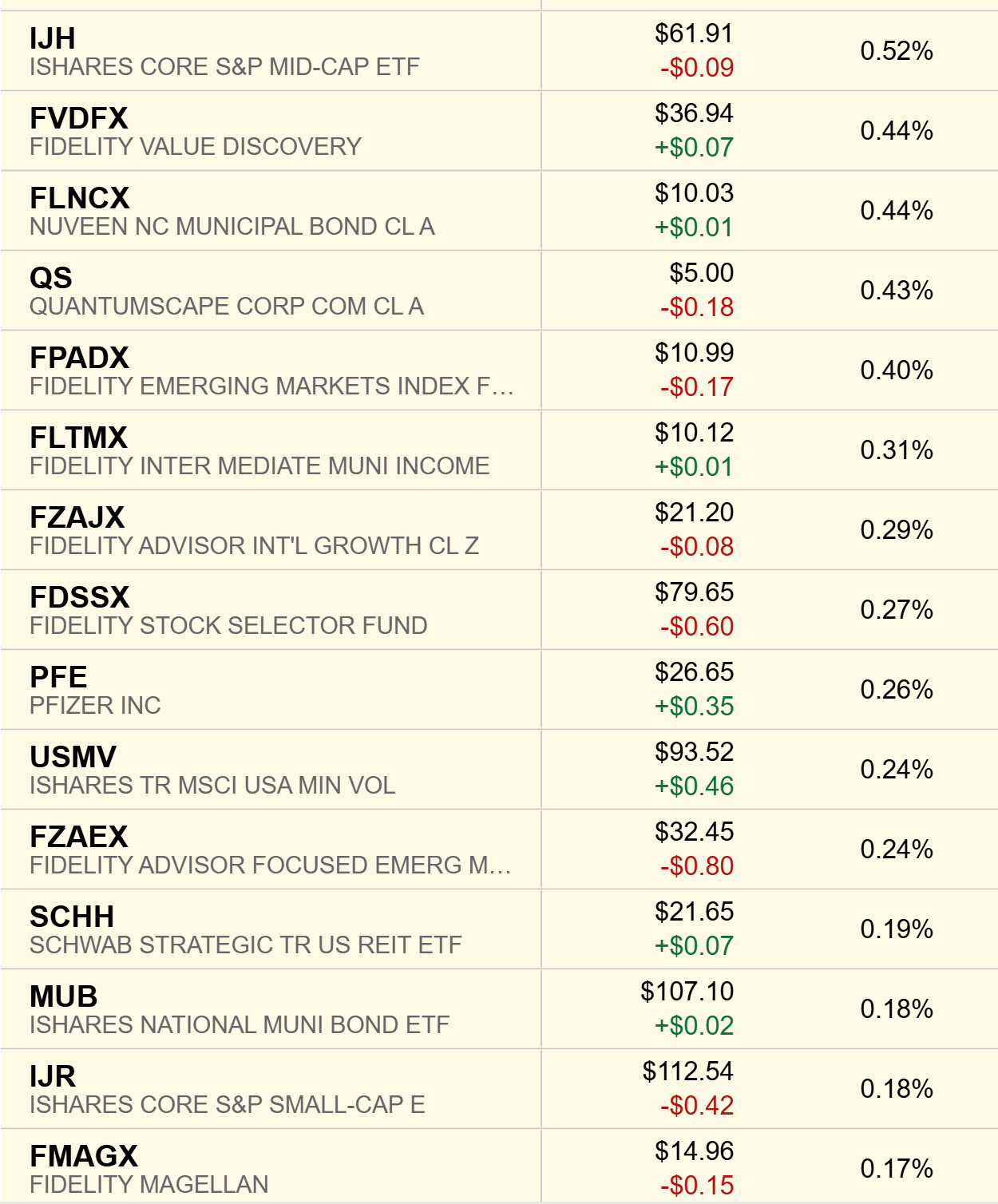
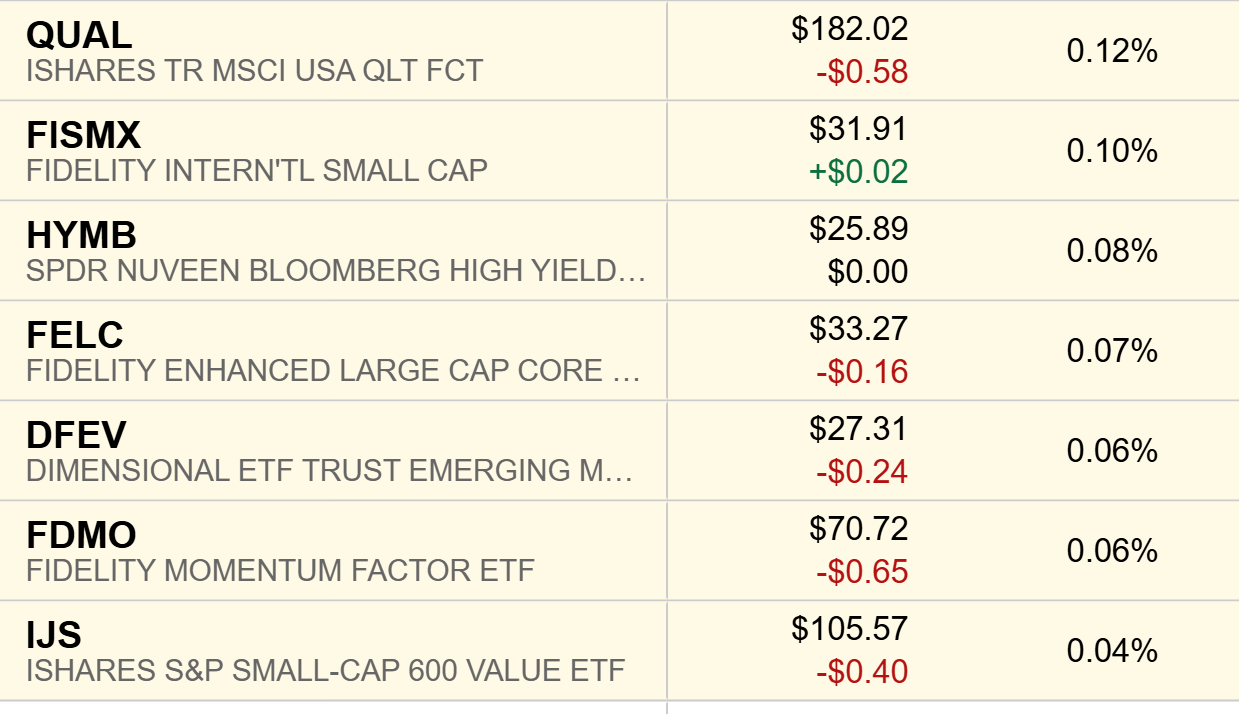
It's overly diversified. My opinion is that there are way too many line items and that many are duplicates. I prefer to be more concentrated as it is not possible to closely monitor that many. My preference is to hold an index fund for whatever buckets of exposure that you want (S&P 500, mid- cap, small-cap, REITs, EM, International, Bonds) then hold max 10 individual stocks that I can closely monitor and manage. Look at the top holdings for FBGRX, FNILX, FLCSX, FXAIX, FMAGX, FDGRX, FELC etc. They are essentially the same and include many of the same names you hold directly, Apple, Google, Nvidia, Amazon, JNJ, etc. Some of the mutual funds have high expense ratios. FLCSX is 0.79% and it is essentially an S&P 500 Index fund. My advise would be to get rid of the high-cost funds and consolidate into one S&P 500 Index (FXAIX). There are also multiple small-cap funds that can likely be consolidated to the lowest cost option, same for EM, international, munis, etc.
Agreed, at this point OP is diluting any returns from all the cross-pollinated names within the index funds.
As others above have mentioned, your portfolio is way too diversified for any single names to have meaningful impact on returns.
Once you clean up your portfolio, you should try creating a general asset allocation (stock/bonds mix, stock/bonds/real assets, etc). But say you decided to do a 60/40 portfolio in classic stocks and bonds.
For 40% bonds, I would recommend just buying the AGG (Bloomberg Aggregate Bond Index, which has both duration and credit risk). If you want a more specialized portfolio and no credit risk, just select a mix of treasury etfs so that you can achieve a target duration & yield.
For the 60% equities, I would just buy SPY. However, if you want to track the market while also generating alpha, then I would follow an active risk approach. The quick, easy, and dirty way to achieve that would be to concentrate in a couple of stocks (>5% allocation for each stock) and then buy the rest in SPY. If you want a cleaner approach (the institutional approach which is 100x more tedious), then you would have to decompose SPY sector weights, select a couple of tickers for each sector, then optimize the portfolio for active risk. A blend between the two methods would be to decompose SPY sector weights, concentrate on a couple of stocks, then allocate the rest into sector etfs so that the SPY sector composition stays consistent with the portfolio. For instance, if you are 60% allocated to SPY and SPY has the following sector weights: 20% tech, 20% financials, 20% healthcare (made up these weights for simplicity sake). If you allocate 5% to NVDA and 10% to GS, then the rest of your equity portfolio should be 15% tech etf, 10% financials etf, and 20% healthcare etf. Ofc expenses will add up for the individual sector ETFs on the downside vs a single SPY allocation.
As for factor etfs, don't bother investing unless you have a conviction for factor timing, in which you would rotate out SPY for whatever factor etf you want.
International stocks, I'd honestly have mix feelings given historical underperformance but recent outperformance due to the shift in the macro environment. If you want that exposure, I'd allocate 20% minimum for any Europe or China etf.
Your portfolio looks solid, but you’re pretty heavy on tech with stocks like AAPL, NVDA, and MSFT. If you want to reduce risk, consider adding more stable stocks or sectors. Also, individual stocks like Roku and Qualcomm can be volatile, so shifting some into broader ETFs could help. You’ve got some emerging market exposure, but adding a bit more could diversify things further. Just be mindful of rebalancing as markets shift. Overall, it’s looking good, just make sure it fits your long-term goals.
Numquam est quas est dolorem porro qui repudiandae. Eos sit voluptate voluptatum culpa. Non quae soluta veniam dicta aliquam illo in.
Molestiae reiciendis repellendus in ea dolore et. Illum repellendus incidunt qui. Est repudiandae quia dolores numquam ipsa.
See All Comments - 100% Free
WSO depends on everyone being able to pitch in when they know something. Unlock with your email and get bonus: 6 financial modeling lessons free ($199 value)
or Unlock with your social account...