
ROAS (Return on Ad Spend)
A metric for any business looking to measure the effectiveness of its advertising campaigns.


What Is Return On Ad Spend (ROAS)?
Return on ad spend (ROAS) is a critical metric for any business looking to measure the effectiveness of its advertising campaigns. It is a key performance indicator that measures the revenue generated from advertising campaigns relative to the cost of running those campaigns.

The ratio calculates how much money a company makes off each dollar utilized for advertising. For instance, if a company spent $10,000 on advertising and received $ 50,000 in sales, its ratio would be 5 to 1 (or 500%). This indicates that the company makes $5 in profit for every dollar it spends on advertising.
It is an important measure since it helps companies to plan their advertising spending based on data. In addition, businesses may determine which of their advertising initiatives are functioning successfully by looking at the return on investment of such campaigns.
The ability to allocate more resources to ads that yield a higher ratio while reducing or eliminating expenditure on efforts that are not working effectively enables companies to optimize their advertising spend.
In digital advertising strategies, the ROAS ratio plays a significant role by allowing businesses to track the performance of their advertisements. This allows them to adjust their advertising spend to maximize their ROI quickly.
Suppose a business runs a Facebook advertising campaign and notices that one ad generates a higher ratio than others. In that case, it can allocate more of its budget to that ad and reduce spend on the lower-performing ads.
- Return on Ad Spend (ROAS) measures the revenue generated for every dollar spent on advertising, serving as a key performance indicator for the effectiveness and profitability of marketing campaigns.
- ROAS is calculated by dividing the revenue generated from ads by the total ad spend: ROAS = Revenue from Ads / Cost of Ads. A higher ROAS indicates a more effective ad campaign.
- ROAS helps advertisers evaluate the financial success of their advertising efforts, allowing them to optimize their marketing strategies and allocate budgets more efficiently.
- Various factors, including ad quality, target audience relevance, ad placement, and overall marketing strategy, can impact ROAS, highlighting areas for potential improvement.
Understanding Return on Ad Spend
To calculate this ratio, businesses need to track two key metrics: revenue and advertising cost. Revenue can come from various sources, such as product sales, lead generation, or website traffic.

Advertising costs include all expenses related to advertising campaigns, such as
- Ad placement fees
- Creative production costs
- Ad management fees
Once these metrics are tracked, this ratio can be calculated by dividing the revenue generated by advertising costs. ROI assesses a company's total profitability by accounting for all sales and costs, not only marketing-related ones.
ROAS solely focuses on the revenue generated from advertising campaigns relative to the cost of running those campaigns. While ROI is an essential metric, ROAS is a critical KPI for businesses looking to optimize their advertising spend.
The ideal ratio varies depending on the type of business, industry, and advertising goals. For instance, a company selling high-priced goods may have a lower ratio but can still be successful because of the high-profit margins. Conversely, a company offering inexpensive goods could require a greater ratio to remain profitable.

It is a crucial parameter for any company wishing to gauge the success of its marketing initiatives.
Businesses may make data-driven choices about their advertising budgets and optimize their ad expenditure for optimum return on investment by measuring the income produced by advertising campaigns compared to the cost of executing such ads.
Note
Businesses must remember that the ideal ratio varies depending on their industry, advertising goals, and profit margins.
Each business and industry may have unique factors that influence the ideal ratio, including
- Industry profit margins
- Product types
- Target audiences
- Seasonality
- Advertising goals
These factors should be considered when determining and setting goals.
Factors Influencing Return On Ad Spend
Several factors influence the ideal business metric. The ideal ratio varies depending on the type of business, industry, advertising goals, and profit margins. Here are some of the factors that can impact the ideal ratio:
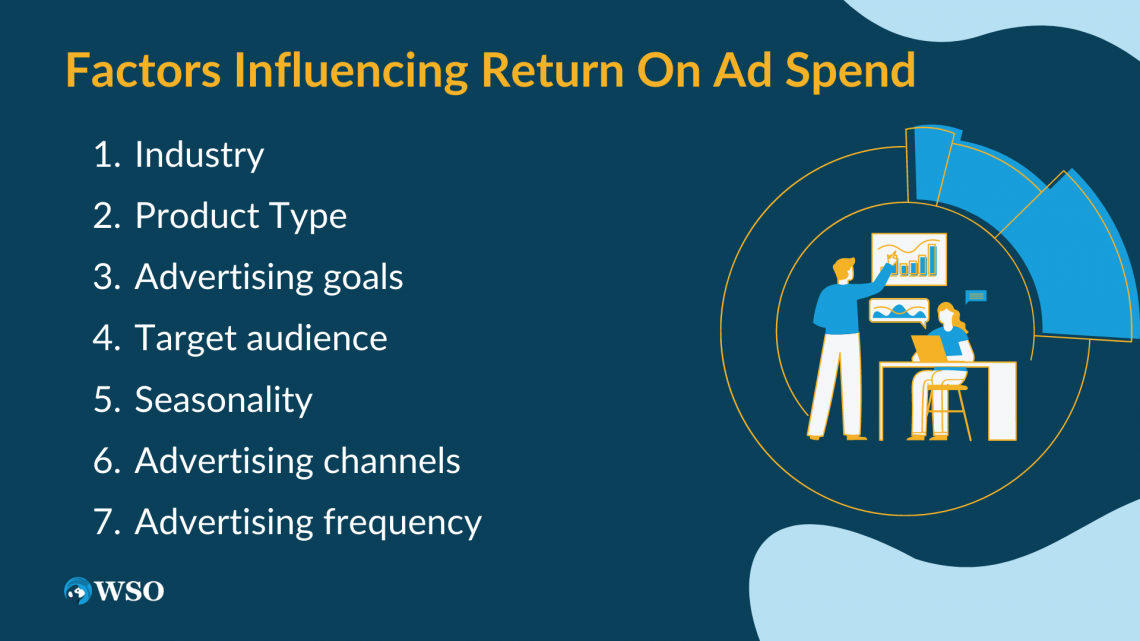
1. Industry
Different industries have different profit margins and varying levels of competition.
Premium businesses may have larger profit margins but might also have to contend with increased competition from other premium goods. As a result, their ideal ratio may be lower than a business with lower profit margins and less competition.
2. Product Type
The type of product a business sells can also impact its ideal ratio. Businesses that offer expensive goods, like luxury vehicles, could, for instance, have a lower ideal ratio but still be profitable because of the large profit margins.
In contrast, businesses offering inexpensive goods, such as food or home supplies, may require a greater ratio.
3. Advertising goals
Different advertising goals require different levels of this ratio. For example, a company may be ready to tolerate a lower ratio if it runs an awareness campaign to boost brand recognition instead of one intended to drive quick sales.
4. Target audience
The target audience can also impact the ideal ratio. For example, a company may require a larger ratio than it would if it were targeting an older demographic.
Note
Younger audiences, for example, may be less receptive to advertisements and more skeptical, requiring a higher ratio to generate desired results.
5. Seasonality
The time of year can impact the ideal ratio. For example, businesses that sell products or services in high demand during certain seasons, such as holiday decorations or travel, may have a higher ideal ratio.
6. Advertising channels
Different advertising channels have different benchmarks. For example, search advertising typically has a higher ratio than display advertising, but the ideal ratio for each channel will vary depending on the business and advertising goals.
7. Advertising frequency
The frequency of advertising can also impact the ideal ratio. Overexposure to ads can lead to ad fatigue, which can reduce the effectiveness of the ads and result in a lower ratio.
Businesses should consider all of these factors when determining their ideal ratio.

It's essential for businesses to regularly analyze their advertising campaigns and adjust their ratio goals based on changing market dynamics.
It's also important to consider the relationship between this ratio and customer lifetime value (CLV). While a business may have a low ROAS on its initial ad spend, the overall ROI may still be positive if it can generate a high CLV from that customer.
Therefore, businesses should not solely rely on this metric as a measure of advertising effectiveness and should also consider CLV.
Several factors influence the ideal ratio for businesses. For example, industry, product type, advertising goals, target audience, seasonality, advertising channels, and advertising frequency can all impact the ideal ROAS.
Businesses should consider these factors when setting their goals and regularly analyze their advertising campaigns to ensure they achieve their desired ROI.
Calculation of Return On Ad Spend with an Example
ROAS is calculated by assessing the difference between the revenue generated from advertising and the expense incurred. Here's an example:

Let us say that A company spends $ 10,000 on advertising and generates $ 50,000. To calculate this, we would divide the revenue by the cost:
ROAS = Revenue / Cost
ROAS = $50,000 / $10,000 = 5
This indicates that the company made $5 in profit for every dollar invested in the advertising campaign. Therefore, a ratio of five is seen as favorable since it shows that the company makes more money than it spends on advertising.
It can be calculated for individual advertising campaigns or all combined advertising efforts over a specific time. For example, a business may calculate the metric for a specific social media advertising campaign or all social media advertising efforts over the past quarter.
The income in the calculation should only include money from Facebook advertisements, not revenue from other marketing channels or sources; for instance, if a company determines this ratio for a Facebook ad campaign.
Note
It's important to note that the revenue used in the calculation should only include revenue generated from the specific advertising efforts being measured.
Considering the cost of goods sold is important when calculating this ratio. The cost of goods sold includes all costs related to producing and delivering a commodity or service.
If the cost of goods sold is high, the ratio may be lower even if the revenue generated from advertising is high.
Let us say there is a business that invests $ 10,000 in a digital marketing campaign and makes $ 50,000 as a consequence. However, the campaign incurs a cost of goods sold amounting to $30,000.
Before dividing by the cost of advertising, we must deduct the cost of products sold from the revenue:
ROAS = (Revenue - Cost of Goods Sold) / Cost
ROAS = ($50,000 - $30,000) / $10,000 = 2
The ratio here came out to be 2. But, again, this is because the cost of goods sold was higher, reducing the net revenue generated from the campaign.

It is a useful metric for measuring the effectiveness of advertising campaigns and optimizing advertising spend.
By calculating this for individual campaigns or all advertising efforts, businesses can determine which campaigns generate the highest return on investment and adjust their advertising strategy accordingly.
Differences between ROAS and ROI
Return on ad spend and return on investment are both indicators used to assess the effectiveness of corporate investments, but they are not synonymous.

We'll examine the differences between the two as well as their computations.
Definition
The term return on ad spend measures the revenue from advertising in relation to the expense of such advertising.
Return on investment, on the other hand, is a wider statistic that gauges an investment's profitability. It is computed by dividing an investment's net profit by the cost of that investment.
Differences in Calculation
While both involve calculating revenue or profit from investment costs, some key differences exist in how these metrics are calculated.
Divide net profit by investment cost to calculate return on investment; divide revenue by advertising expense to calculate return on advertising spend.
In other words, it only considers the revenue generated from advertising, while return on investment considers all costs and revenue associated with the investment.
Return on ad spend is often used to evaluate the success of specific advertising campaigns or marketing channels. In contrast, return on investment is used to evaluate the overall profitability of the business investment.
Differences in Application
Return on ad spend is often used to optimize advertising spend and identify which campaigns or marketing channels generate the highest return on investment.

By calculating the return on ad spend for individual campaigns or all advertising efforts, businesses can determine which campaigns generate the highest return on investment and adjust their advertising strategy accordingly.
Return on investment is utilized to assess the total profitability of a company investment, such as introducing a new product line or entering a new market.
Return on investment is commonly used as a standard for evaluating the success of long-term investments and determining future investment decisions.
Limitations
While Return on ad spend and return on investment are useful metrics for evaluating business investments, they also have limitations.
Return on ad spend can be misleading if it does not consider the cost of goods sold (COGS). If the COGS is high, the Return on ad spend may be lower even if the revenue generated from advertising is high.

Return on investment can also be misleading if it does not consider the time value for money. The time value of money is the concept that money now is valued more than a comparable amount in the future because of the possibility of investing that money and earning a return.
To accurately calculate return on investment, businesses must consider the time value of money and adjust for inflation and the cost of capital.
Both are important metrics for evaluating business investments, but they are different.
Return On Ad Spend FAQs

The ideal ratio varies depending on the business and the industry. However, a ratio of 4 to 1 or greater is favorable; the company should make $4 or more in revenue for every dollar spent on advertising.
Businesses may use a variety of tactics to increase their ratio, including focusing on audiences and keywords that convert well, improving ad copy and landing pages, and cutting back on spending on underperforming campaigns.
It can be misleading if it does not consider the cost of goods sold. For example, if the COGS is high, the ratio may be lower, even if the revenue generated from advertising is high.
It measures the revenue generated from advertising compared to the cost of that advertising, while ROI is a broader metric that measures the profitability of an investment.
ROI considers all costs and revenue associated with the investment, while ROAS only considers the revenue generated from advertising.
It can be used to gauge the effectiveness of most advertising channels. However, it might be less useful for those prioritizing raising brand recognition above generating quick sales, such as display or social media advertising.
For these channels, metrics such as reach and engagement may be more relevant.

Free Resources
To continue learning and advancing your career, check out these additional helpful WSO resources:


or Want to Sign up with your social account?