
ROIC
Return on Invested Capital provides investors (stockholders and bondholders) with an overview of a company’s management performance and value-creation strategy.


What Is Return on Invested Capital (ROIC)?
Return on Invested Capital (ROIC) is a financial metric that measures how efficiently a corporation allocates its cash. It evaluates how much value a company produces for every dollar invested.
A positive ROIC reflects the quality of a business. It is evidence of a company's regular transactions that result in value creation for the business.
A low or negative return on investment demonstrates a company’s poor management of capital and can cause investors to shy away from investing in such a company. That company’s share price could drop as a result.
- Return on Invested Capital provides investors (stockholders and bondholders) with an overview of a company’s management performance and value-creation strategy.
- ROIC is an annual percentage calculation that many consider strong if above 2 % or weak if below that benchmark.
- ROIC can be interpreted as the amount of money generated for every dollar invested in a specific company.
- Apart from ROIC, Investors use other metrics and information to gain insight about a company and make investment decisions. They may compare a specific company’s ROIC with the industry average or research recent events that impact its performance.
Understanding Return on Invested Capital
Investors (stockholders and bondholders) consider ROIC to determine how well a company uses its capital to generate more income.
Return on invested Capital helps investors make investment decisions by providing an overview of a company’s management.
Key Items to Understand:
- Return on invested capital does not specify a company's cash allocation. Instead, ROIC only captures the aggregate returns generated from that company’s investments.
- Return on Invested Capital is usually presented as an annual percentage.
Formula and Calculation of Return on Invested Capital (ROIC)
ROIC = (Net Income - Dividends) / Invested Capital
Although the formula above is used most often, some opt to write the numerator a bit differently in the following format:
ROIC = NOPAT / Invested Capital
Keep in mind that NOPAT simply means Net Operating Profit after Tax. Both formulas should give the same result.
Here,
NOPAT = Net Operating Profit after Tax: Net Operating profit after tax is all the income a company generates after covering its operating direct and indirect costs, along with any interest on debt owed and after paying taxes.
Invested Capital: Invested Capital, the denominator of the ROIC formula, represents how the assets a company uses to generate value are funded. Equity and debt are typically the two main ways a company’s assets are funded.
Calculate NOPAT
EBITDA - cash paid in taxes
Add back Depreciation and Amortization to EBIT (Operating Income) and subtract taxes. (All this information can be found in the company’s income statement).
Some interpret invested capital as the value of a company’s assets at a specific period in time. Others prefer to add the total value of equity and debt to arrive at invested capital.
Remember the fundamental accounting equation:
Assets = Liabilities (Debt) + Shareholder’s equity
You might ask how ROIC is derived. We start with net income, found on the company’s income statement, and subtract dividends from it. To find invested capital, add the company’s total equity plus all the debt on its balance sheet.
Positive ROIC Example
Assume a company generated $375,000 in net income in 2023. It paid $250,000 in dividends. Its total debt was $300,000, and its shareholder’s equity totaled $400,000.
ROIC = ($375,000 - $250,000) / ($300,000 + $400,000)
ROIC = $125,000 / $700,000
ROIC = 17.86 %
A 17.86 % ROIC means that this specific company generated 17.86 cents for every dollar invested in this company.
Low ROIC Example
Gabriel Mattress, a local mattress store, sold 500 mattresses in 2022 for a price of $400 each, i.e., revenue generated is $200,000. After accounting for expenses and interest, Gabriel Mattress generated $50,000 in net income.
Assume Gabriel Mattress does not pay dividends. Equity totals $400,000, while debt totals $500,000.
ROIC = $50,000 / ($400,000 + $500,000)
ROIC = $50,000 / $900,000
ROIC = 5.55 %
Another way to interpret this concept is by understanding that for every dollar invested in this company, 94.5 cents cover expenses, and the remaining 5.5 cents generate value for the business.
In essence, a lower return on invested capital means a business has either more expenses to cover or a poor value-creation strategy.
Example of How to Use Return on Invested Capital (ROIC)
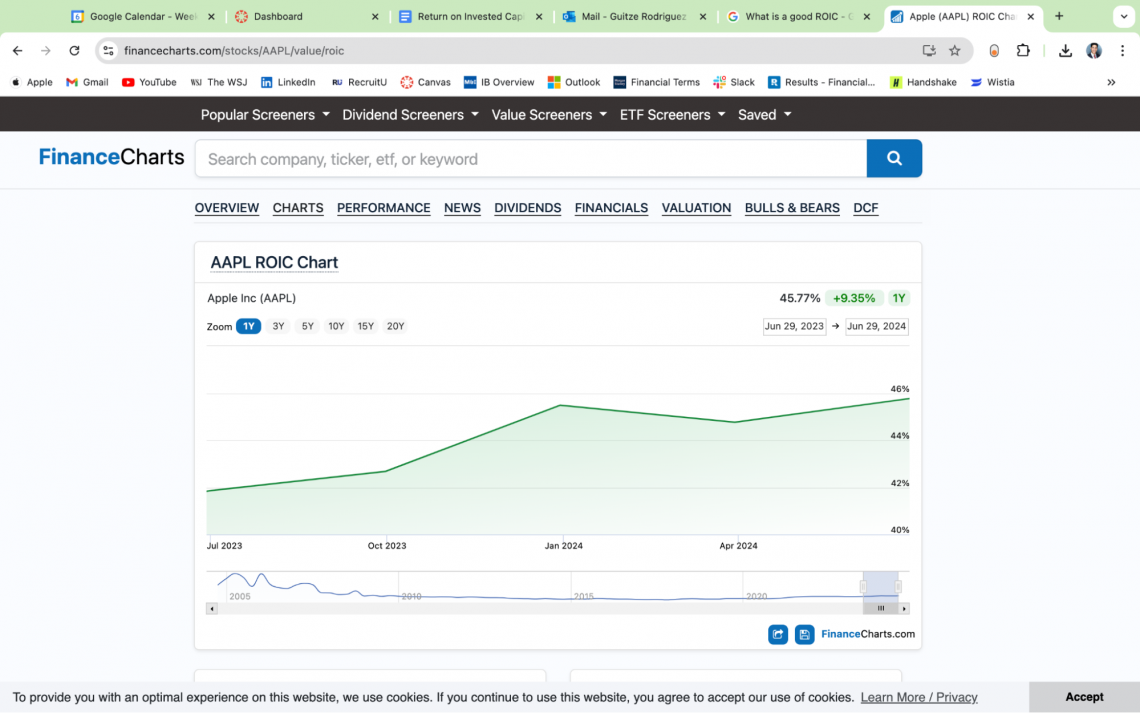
As you can see on the graph above, Apple has added 45% more value to its name in a year, establishing itself as one of the leading companies in the technology industry. Apple’s elite management team, efficient use of debt and excess cash, marketing competitiveness, and strong customer retention rates led to the creation of value for its shareholders.
External factors and ROIC
Some of the external factors affecting ROIC calculations are below:
- Industry context: Industry context serves as a benchmark for investors. It gives an idea of what similar companies’ ROICs are to determine the company's state in question.
- Cost of Capital: After examining the industry context, one should consider the weighted average cost of capital (commonly referred to as the WACC). If the money invested in the business exceeds the liabilities, then it is profitable. In other words, if the returns on invested capital are greater than the WACC, the company has a positive ROIC.
- Recent events related to the industry: Before using ROIC to make any assumptions about a certain business, one should do research on recent market events that might affect the business's day-to-day operations. Recent events might push a company’s ROIC higher or lower.
Return on Invested Capital (ROIC) FAQs
Although there is no right or wrong answer to this question, many have considered an ROIC greater than 2% to be a “strong ROIC” and anything below that to be a “weak ROIC,” where the business is at risk of losing value.
When a company has a positive ROIC, it becomes, “How much value is the company producing?” and “Is it worth investing in this business?”
A weak return on invested capital might scare investors, resulting in less investment activity (less cash flow) and fewer profits. This can cause the stock price to decline and reduce dividend payouts.



Free Resources
To continue learning and advancing your career, check out these additional helpful WSO resources:


or Want to Sign up with your social account?