
What Is Blockchain? A Beginner-Friendly Explanation for Finance Professionals Understanding Blockchain Beyond the Cryptocurrency Hype


Blockchain is often associated with Bitcoin, cryptocurrencies, and digital assets. However, blockchain technology is broader than any individual cryptocurrency. At its core, blockchain is a system for recording, storing, and verifying information across a network of computers.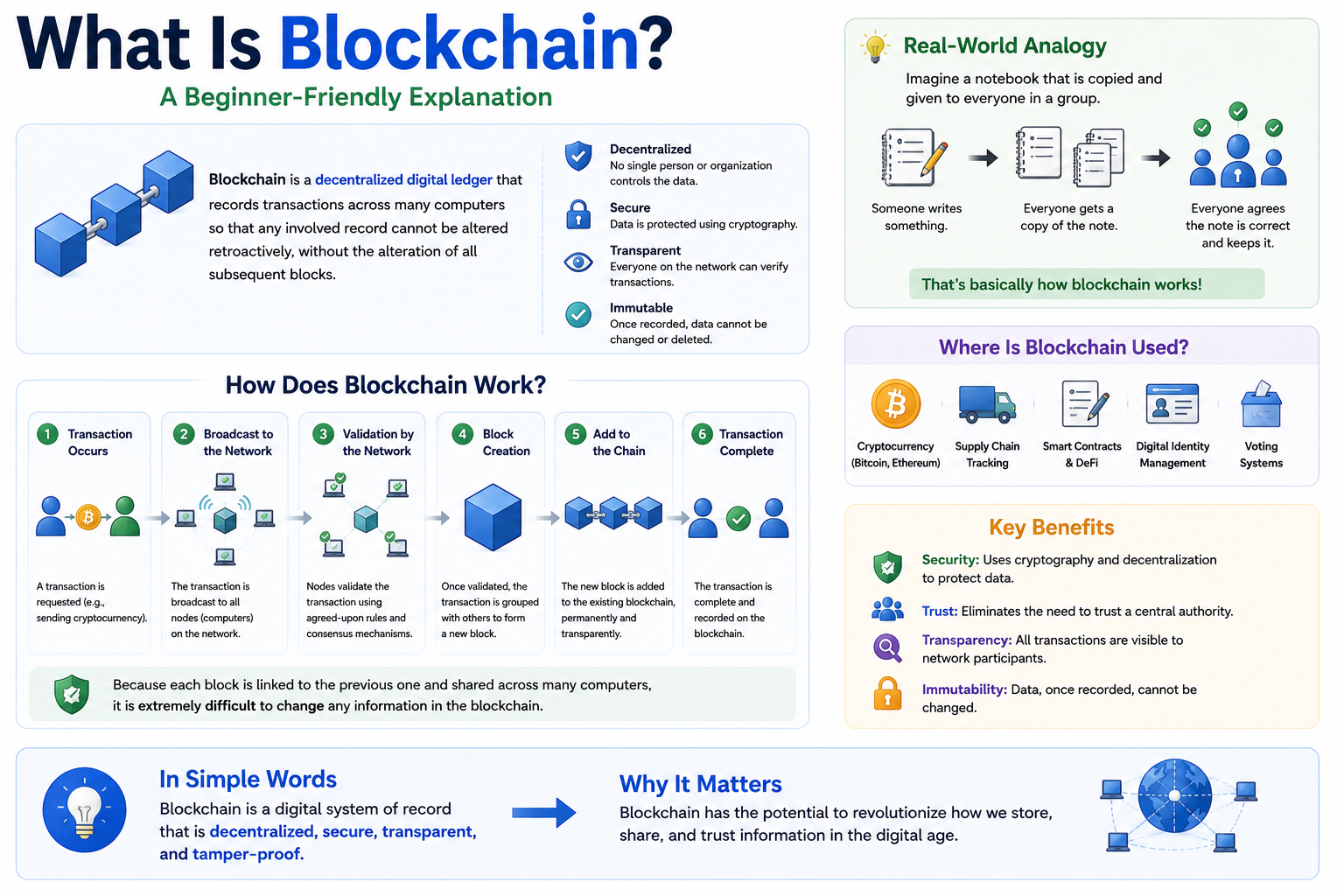
Unlike a traditional database that is usually controlled by a single organization, a blockchain can distribute copies of the same record across multiple participants. This structure can reduce dependence on a central intermediary and make historical records more difficult to alter.
For financial professionals, blockchain is increasingly relevant because it introduces new ways to record ownership, transfer value, settle transactions, and coordinate financial activity.
What Is a Blockchain?
A blockchain is a digital ledger composed of individual records called blocks.
Each block typically contains information about transactions or other recorded activities. Once information is validated and added to the blockchain, the block becomes connected to previous blocks through cryptographic techniques.
This creates a chronological chain of records.
A simplified structure looks like this:
Block 1 → Block 2 → Block 3 → Block 4
Each new block is linked to the previous history. Changing an earlier record would therefore create inconsistencies that the network can detect.
This structure is one reason blockchain technology is often associated with transparency and data integrity.
How Does Blockchain Work?
Although different blockchain networks use different technical designs, the basic process usually follows several steps.
First, a transaction or piece of information is submitted to the network.
Second, participating computers verify whether the transaction follows the network's rules.
Third, valid transactions are grouped into a block.
Fourth, the network reaches agreement on adding that block to the existing chain.
Finally, the updated ledger is shared across the network.
The mechanism used to reach agreement is generally known as a consensus mechanism.
The important concept is that the validity of records does not necessarily depend on a single central institution maintaining the database.
Blockchain Compared With Traditional Financial Systems
Traditional financial infrastructure relies heavily on trusted intermediaries.
Banks maintain account records. Clearinghouses coordinate transaction settlement. Custodians hold assets. Payment networks process transfers between institutions.
Blockchain technology does not automatically eliminate these functions, but it can change how they are organized.
For example, a blockchain-based system may allow multiple institutions to access a synchronized version of transaction records. In theory, this could reduce reconciliation requirements and improve the speed of certain processes.
The potential impact is particularly relevant in areas such as:
- Cross-border payments
- Securities settlement
- Asset tokenization
- Digital identity
- Trade finance
- Digital asset custody
However, practical implementation remains dependent on regulation, network design, security, and institutional adoption.
Bitcoin Is an Application of Blockchain
One common misunderstanding is that blockchain and Bitcoin are the same thing.
Bitcoin is a digital asset that operates using blockchain technology.
The Bitcoin blockchain records transactions and allows participants to verify ownership and transfers without relying on a traditional central bank or payment processor to maintain the transaction ledger.
However, blockchain technology can also be used for purposes unrelated to Bitcoin.
Other blockchain networks support programmable transactions, digital tokens, decentralized applications, and other forms of digital infrastructure.
Why Is Blockchain Considered Valuable?
The potential value of blockchain generally comes from several characteristics.
Shared Records
Multiple authorized participants can maintain access to the same transaction history.
Transparency
Depending on the blockchain design, transaction data may be visible to participants or publicly available.
Cryptographic Security
Cryptography helps protect transaction integrity and connects records within the chain.
Reduced Reliance on Central Intermediaries
Some blockchain networks allow participants to transact directly according to predefined network rules.
Programmability
Certain blockchains can execute predefined instructions automatically, creating opportunities for programmable financial products and processes.
These advantages are not universal. The usefulness of blockchain depends heavily on whether a decentralized or shared database provides a meaningful advantage over existing infrastructure.
A Simple Financial Example
Consider the transfer of a traditional financial asset.
The process may involve brokers, custodians, clearing systems, exchanges, and settlement institutions. Each organization may maintain its own internal records.
A blockchain-based system could potentially allow authorized participants to reference a synchronized record of ownership and transactions.
This does not necessarily remove all intermediaries. Instead, it may change how institutions coordinate information and settlement.
This concept has contributed to growing interest in blockchain-based tokenization, where financial or real-world assets are represented digitally on a blockchain.
What Blockchain Does Not Guarantee
Blockchain technology is sometimes presented as a solution to every problem involving data or finance. This is misleading.
A blockchain does not automatically guarantee:
- Accurate information
- Safe investments
- Regulatory compliance
- Privacy
- High transaction speed
- Low costs
- Protection from fraud
For example, if inaccurate information is entered into a blockchain, the technology itself cannot determine whether the original information was true.
Similarly, cryptocurrency markets built on blockchain technology can remain highly volatile and involve significant financial risk.
The technology should therefore be evaluated based on its specific use case rather than treated as inherently superior to traditional systems.
The Bottom Line
Blockchain is best understood as a method of maintaining shared digital records in a way that uses cryptography and network-based verification.
Its importance extends beyond cryptocurrencies. Blockchain technology may influence how assets are issued, transferred, recorded, and settled across financial markets.
For finance professionals, the key question is not whether blockchain will replace every existing system. The more relevant question is where blockchain-based infrastructure can provide measurable improvements in efficiency, transparency, settlement, or asset ownership.
As institutional interest in digital assets, tokenization, and blockchain-based financial infrastructure continues to develop, understanding the basic principles of blockchain has become increasingly relevant to the broader financial industry.






Suscipit eos eum aut voluptas reiciendis quidem. Veniam modi eveniet cupiditate quisquam aut esse autem adipisci.
Quidem sunt officia et labore. Culpa ut quibusdam et veniam quo illum et minima. Officiis blanditiis facere dicta omnis impedit. Rerum consequatur voluptatem repellendus sapiente.
Sit veniam iste assumenda in et fugit. Earum voluptate totam consectetur est. Quia possimus quis hic tempora tenetur. Ad autem voluptatem cum.
See All Comments - 100% Free
WSO depends on everyone being able to pitch in when they know something. Unlock with your email and get bonus: 6 financial modeling lessons free ($199 value)
or Unlock with your social account...