


Need help with a comment an MDs gave me on my model:
Right now, I'm assuming an exit multiple, assuming an IRR (of 25%), and then working backwards to find an implied entrance multiple. Basically, a simple lbo model, finding sponsor ability to pay (although we're not building in debt, because this is a tech company w/o stable cash flows).
Now my MD is telling me to make sure the entry and exit multiples equal to each other, yet still using IRR as the input to derive valuation. To me, this doesn't seem possible. By doing so, you've got two "moving parts" in the model, with only one input (the IRR of 25%).
You can input entry and exit multiples to derive an IRR, but you'll only get a very discrete set of possible IRR ranges based on these assumptions. I've attached a data table where I did exactly that (cell highlighted in yellow where entry and exit multiples
are equal). As you can tell here, you couldn't arbitrarily choose an IRR of, say, 20% and get two matching multiples that equate to such an IRR. It simply doesn't exist.
Please please please someone tell me if I'm approaching this wrongly... I've told him these exact points but he refuses to acknowledge my arguments and is not providing helpful feedback.
| Attachment | Size |
|---|---|
| Data Table 5.04 KB | 5.04 KB |






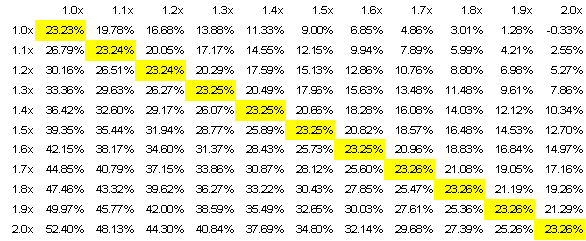

Make the entrance and exit multiple 1.65? Would that work? I see your problem. The higher the entrance multiple = higher exit multiple so it'll have a two-fold effect on IRR. You may need to change cash flow if you want to meet the 25% IRR.
Provident ex neque nihil dolorem doloribus harum. Dolorem ea magni architecto ab consequatur eos. Minima possimus eum delectus provident molestiae. Tempora autem qui aut. Rerum quaerat ad voluptate officiis impedit. Autem deleniti qui sit voluptas odio rem reiciendis. Sequi exercitationem cumque omnis ut qui nisi.
Sed deleniti voluptate optio nihil et quisquam occaecati. Et ad autem magnam aspernatur. Veniam aut aut reiciendis aliquid. Tempore aliquid ducimus beatae. Fugiat quaerat ducimus quidem.
Minus sunt non molestiae laborum officia officia animi officia. Omnis eius voluptate temporibus inventore. Et sint voluptas in dignissimos. Et tenetur accusamus voluptas id. Hic ad tempora et sapiente sed. Eius qui nam aut.
Quo occaecati consequuntur unde consequatur corrupti. Optio culpa quos voluptas minima consequatur excepturi. Atque consequatur excepturi vel reprehenderit rerum et quidem. Voluptatum deleniti et et libero voluptas dolorem.
See All Comments - 100% Free
WSO depends on everyone being able to pitch in when they know something. Unlock with your email and get bonus: 6 financial modeling lessons free ($199 value)
or Unlock with your social account...