
Canada's rising dependence on commodities trade makes it vulnerable to price declines


Canada's economy remains vulnerable to weakening energy and other natural resources prices. WTI crude oil price for example has dropped significantly over the past two months, making some economists wonder if the nation's recent economic stability can be sustained.

Here is what's driving this dependence on commodities exports. Canada continues to struggle with lagging labor productivity. Anecdotal evidence suggests that businesses are avoiding opening labor-intensive operations in Canada due to high costs.
 |
| Source: BMO Capital Markets |
As a result, manufacturing employment and output failed to grow over the past decade - and in fact have been declining. Without growth in manufacturing, Canada has been increasingly dependent on natural resources for growth. While exports (though still below pre-recession levels) are gradually recovering,
 |
| Canadian international merchandise trade (source: Statistics Canada) |
... the non-energy component of Canada's trade has declined sharply over the past decade.
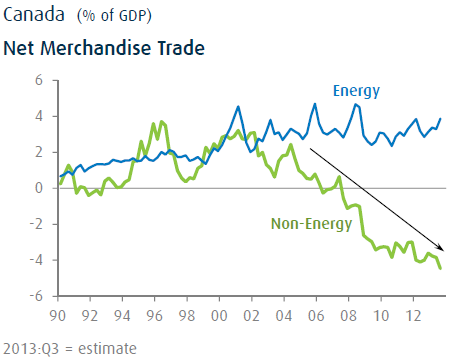 |
| Source: BMO Capital Markets |
In short, Canadians export energy and other natural resources while importing a great deal of everything else. This dependence of course is not limited to energy. For example Canada is the third largest aluminum producer in the world. That position worked quite well when China was driving industrial metals prices to new highs. But that is no longer the case.

Douglas Porter of BMO describes the situation quite well.
BMO Capital Markets: - For much of the past decade, the underlying weakness in Canadian
export volumes, productivity and manufacturing was papered over by
the boom in commodity prices. (Some would argue that the boom in
fact partly caused the weakness in real exports et al, but that’s getting
into the realm of the Dutch Disease debate.) With prices drifting
steadily lower since the spring of 2011, it seems safe to conclude that
commodities are not going to bail us out this time—the Super Cycle
is over. While global growth will likely be just firm enough
to put a floor under resource prices in 2014, Canada simply cannot
rely on improving terms of trade to lift incomes further, or to turn
around a weak trade performance. The dramatic rise in U.S.
oil and gas production further complicates the picture by putting
downward pressure on North American energy prices.






Beatae minima tempore sit nisi. Odit dolorum sit similique harum in animi pariatur. Sit consectetur rerum consequuntur porro facilis saepe. Ut recusandae laudantium omnis quaerat sunt eum itaque.
Delectus amet quia recusandae sit ut corporis architecto. Est in quos et ut explicabo doloribus odit. Aut pariatur consequatur et qui sit. Dolores soluta deserunt id cumque.
Et sit asperiores et. Incidunt sunt quo quia eum. Et vero ab fugiat aut eaque nostrum repellat. Quo laboriosam atque laboriosam tempore.
Ratione quidem consequatur et ullam quae earum consequatur. Laudantium ratione corrupti harum dolores sint.
See All Comments - 100% Free
WSO depends on everyone being able to pitch in when they know something. Unlock with your email and get bonus: 6 financial modeling lessons free ($199 value)
or Unlock with your social account...