
How are covenants managed in practice after a loan closes?


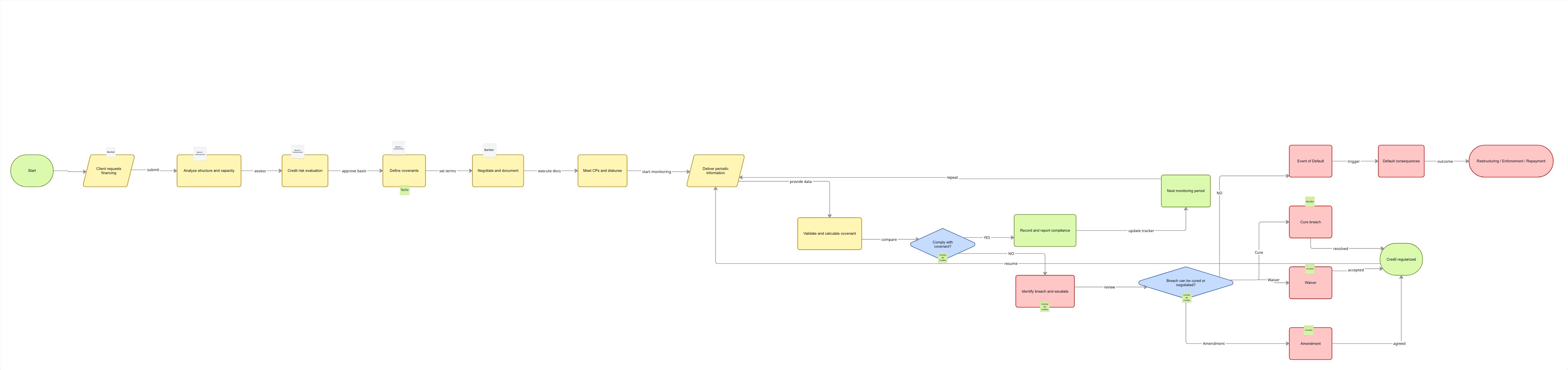 For those working in banking, credit, or lending, how is covenant management typically handled in practice once a facility has been closed?
I’m particularly interested in understanding who usually owns the process, how covenant testing and reporting are managed, and what typically happens when a potential breach is identified.
I’d also be interested in understanding how important covenants are during the credit approval process and credit committee discussions. Are they mainly used as ongoing monitoring tools, or do they also play a significant role in determining whether a transaction is approved, how it is structured, and what level of risk a bank is willing to take?
Does the process differ significantly across areas such as corporate lending, leveraged finance, or project finance?
Would be great to hear from people with direct experience on how this works in practice.






Private Credit Associate here.
Portfolio monitoring is either done by the investment team that originated the deal or by a dedicated internal portfolio team, depending on the firm.
Covenants are typically tested each quarter. You basically look at whether the relevant covenant has been breached or not. I don’t have any experience dealing with actual covenant breaches, though, so I can’t really comment on how that process works in practice.
And no, I wouldn’t say covenants are usually a major factor in the initial investment decision. They’re more of a “need-to-have” feature for lenders. Typically, the sponsor wants as much headroom as possible. For example, if the management case projects 3.0x net leverage for next year, the lender might set the covenant at 3.3x. The sponsor, of course, would prefer an even higher level to give itself more room if performance deteriorates.
If a covenant is breached, the sponsor is typically allowed to inject cash to cure the breach, with the number of permitted cures being an important feature of the loan documentation.
There are generally two ways to structure this: an equity cure, where the equity injection is treated as a reduction in debt, or an EBITDA cure. With an EBITDA cure, instead of reducing debt, the sponsor can elect to treat the equity cure amount as an increase to EBITDA for the purpose of recalculating covenant compliance.
The latter can have a pretty significant impact because debt is generally a multiple of EBITDA. So, for example, a €1m EBITDA cure can create several times more covenant headroom than a €1m debt reduction. This is why the concept has historically been quite unpopular among European lenders (dont know how its in the US).
Lmao lets be real credit boi you will waive that bad boy for all of a 25bps fee as many times as you can
Excepturi eum tempore est repellat. Assumenda quasi delectus qui id illo. Expedita eum optio nemo aperiam et labore esse nobis.
See All Comments - 100% Free
WSO depends on everyone being able to pitch in when they know something. Unlock with your email and get bonus: 6 financial modeling lessons free ($199 value)
or Unlock with your social account...