
Evaluating Recent Executive Open-Market Transactions in the Ad-Tech Sector


The programmatic advertising landscape has experienced notable multiple compression over the trailing twelve months, driven by shifts in consumer privacy frameworks and macroeconomic tightening. Recently, an anomalous open-market transaction occurred involving a nine-figure deployment by a sitting CEO into his own equity. From a structural standpoint, discretionary block purchases of this magnitude by insiders are statistically infrequent and warrant clinical analysis regarding their impact on free float and perceived terminal value. Rather than interpreting this purely through the lens of market sentiment, it serves as a quantifiable input for institutional valuation models.
[Data Observation] Form 4 Filing Divergence
When contextualizing this specific transaction, it is necessary to benchmark it against broader macroeconomic behavior within the sector.
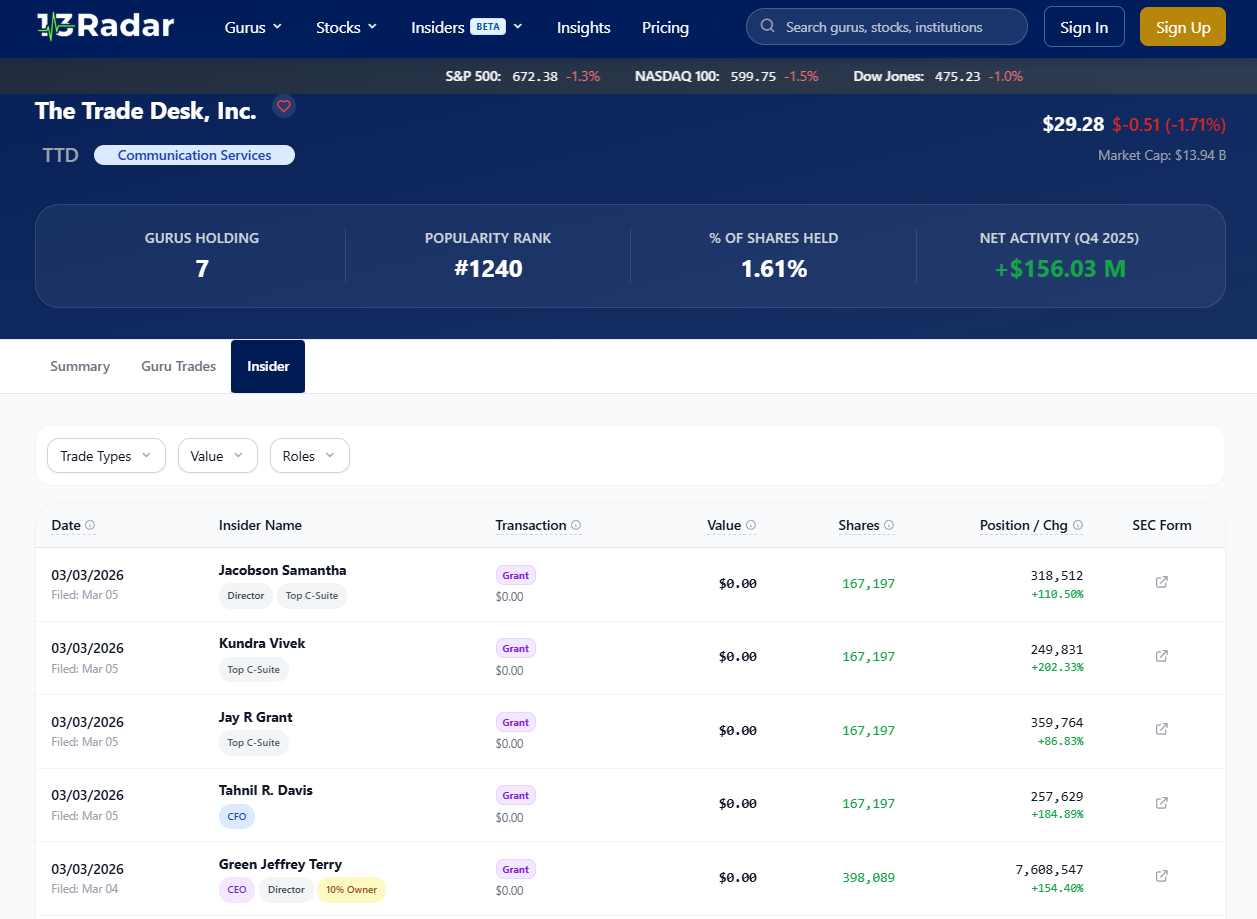
Recent Form 4 filings show a noticeable increase in executive sales across major tech companies, primarily related to automated 10b5-1 tax obligations and portfolio rebalancing during recent index highs. The decision by a founder to execute a discretionary, $148 million open-market purchase contrasts sharply with this sector-wide distribution trend. This behavioral divergence provides a measurable data point indicating that internal management may model future cash flows and enterprise value significantly higher than current consensus estimates.
Assessing Potential Catalysts and Strategic Integrations
The timing of this capital deployment aligns with unconfirmed but widely circulated market reports regarding potential infrastructure partnerships, specifically exploratory discussions with artificial intelligence developers such as OpenAI. From an equity research perspective, if a demand-side platform were to successfully integrate with emerging LLM ecosystems, it could structurally alter the company's Total Addressable Market (TAM). The volume of the executive purchase suggests that leadership may be pricing in the probability of these exogenous catalysts materializing before they are fully reflected in public market forward multiples.
Incorporating Trade Execution into Valuation Models
In systematic and fundamental analysis, tracking the specific execution mechanics of corporate leadership is a standard methodology for gauging internal conviction. Reviewing the execution volume and pricing tiers found in the TTD insider buying disclosures allows analysts to quantify the specific price levels where management identifies a margin of safety. Rather than treating these regulatory filings as standalone speculative events, incorporating this liquidity data into broader discounted cash flow (DCF) models provides a more robust framework for evaluating the asset's risk-reward profile, independent of short-term algorithmic volatility.






Numquam et illum fugit veniam dolor et. Doloremque ut ipsam inventore unde maxime quidem aut sed.
See All Comments - 100% Free
WSO depends on everyone being able to pitch in when they know something. Unlock with your email and get bonus: 6 financial modeling lessons free ($199 value)
or Unlock with your social account...