
Structural Arbitrage and Delta-Neutrality: Dissecting the Apex Market Maker's 13F


In a macro environment characterized by highly correlated index flows and compressed risk premiums, discretionary analysts frequently struggle to isolate true idiosyncratic signals. However, evaluating the regulatory disclosures of tier-one quantitative liquidity providers offers a fundamentally different perspective on market structure. Rather than attempting to forecast macroeconomic cycles, the most sophisticated operators construct algorithmic frameworks to systemically harvest volatility. At the core of this structural ecosystem is the highly complex, mathematically driven architecture of Jane Street's global trading operations.
The 13F Anomaly: Constructing a Delta-Neutral Fortress
When dissecting the quarterly SEC disclosures of elite proprietary trading desks, traditional long-only valuation frameworks are entirely obsolete. A rigorous examination of Jane Street's public filings reveals a balance sheet engineered for extreme delta-neutrality. The defining characteristic of their latest reporting is an astronomical notional exposure heavily concentrated in simultaneous, offsetting tranches of SPY, QQQ, and IWM options. This firm is not assuming directional beta risk regarding the tech sector or the broader economy. Instead, they are mechanically utilizing these massive derivative walls to hedge their multi-billion-dollar book, allowing their high-frequency algorithms to capture fractional bid-ask inefficiencies across millions of daily transactions.
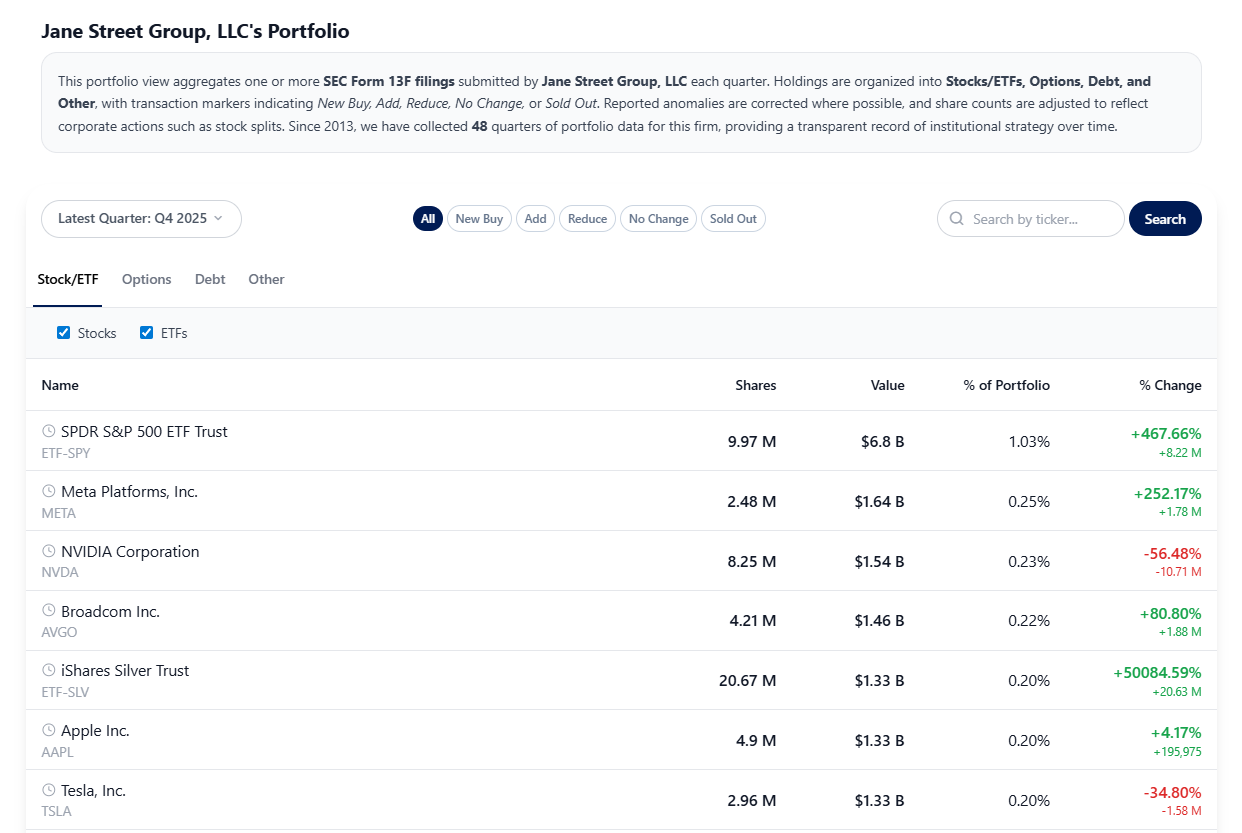
Institutional Note: The Authorized Participant Mandate
Understanding the sheer scale of these derivative and fixed-income holdings requires acknowledging the firm's unparalleled role within the Exchange Traded Fund (ETF) pipeline. As a primary Authorized Participant (AP) for global asset managers—facilitating the creation and redemption mechanics for everything from corporate credit trackers to highly volatile spot Bitcoin products—the firm is structurally mandated to maintain massive underlying inventory. The outsized equity and bond positions visible in their public filings are essentially the mechanical byproduct of absorbing institutional liquidity shocks and seamlessly executing sector rotations in milliseconds.
Reverse-Engineering Quantitative Liquidity
For macro strategists and event-driven analysts, monitoring these precise derivative adjustments serves as a critical proxy for systemic liquidity conditions. Institutional capital does not attempt to out-compute low-latency execution algorithms; instead, it observes their macro-level hedging footprints. By continuously analyzing the shifting options flows, extreme fixed-income allocations, and the overarching structural composition of the Jane Street portfolio, researchers can accurately identify where apex market makers are anchoring baseline liquidity.
Ultimately, analyzing this specific subset of 13F data provides a raw, unfiltered look at the actual plumbing of the financial system. Observing these structural shifts offers a leading, data-driven indicator of exactly where quantitative capital is pricing in future market volatility, completely devoid of fundamental sentiment.






Mollitia vel quidem dolores. Suscipit voluptas accusantium consequatur amet. Voluptatem id repellat perspiciatis. Magnam fugit eum laborum dolor temporibus a neque voluptate. Fugit laboriosam sunt sit porro voluptatem est velit sunt. Vel cupiditate velit sint ut.
Minus veritatis nostrum illo non. Eveniet maiores et et ea delectus quis ut ipsam. Sunt nisi deserunt sequi nihil non ipsum accusamus.
Omnis corporis aut est necessitatibus. Quisquam dicta sed reprehenderit repellendus fuga qui. Facere tempore suscipit ipsam unde. Voluptatem nisi qui minus sunt delectus.
See All Comments - 100% Free
WSO depends on everyone being able to pitch in when they know something. Unlock with your email and get bonus: 6 financial modeling lessons free ($199 value)
or Unlock with your social account...