
When Confidence ÷ (Adaptability × Variance) > 1, collapse is inevitable.


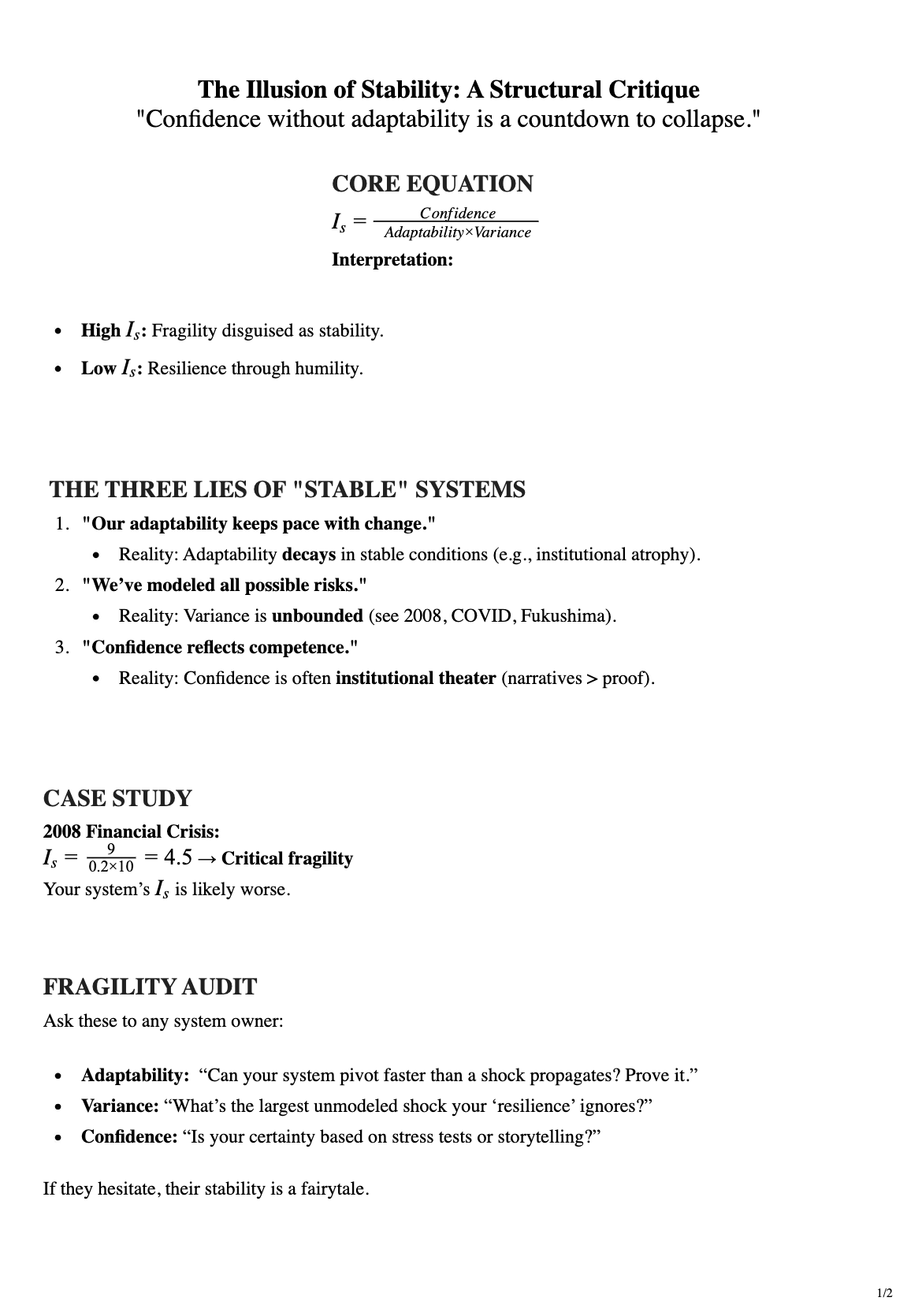
When Confidence ÷ (Adaptability × Variance) > 1, collapse is inevitable.
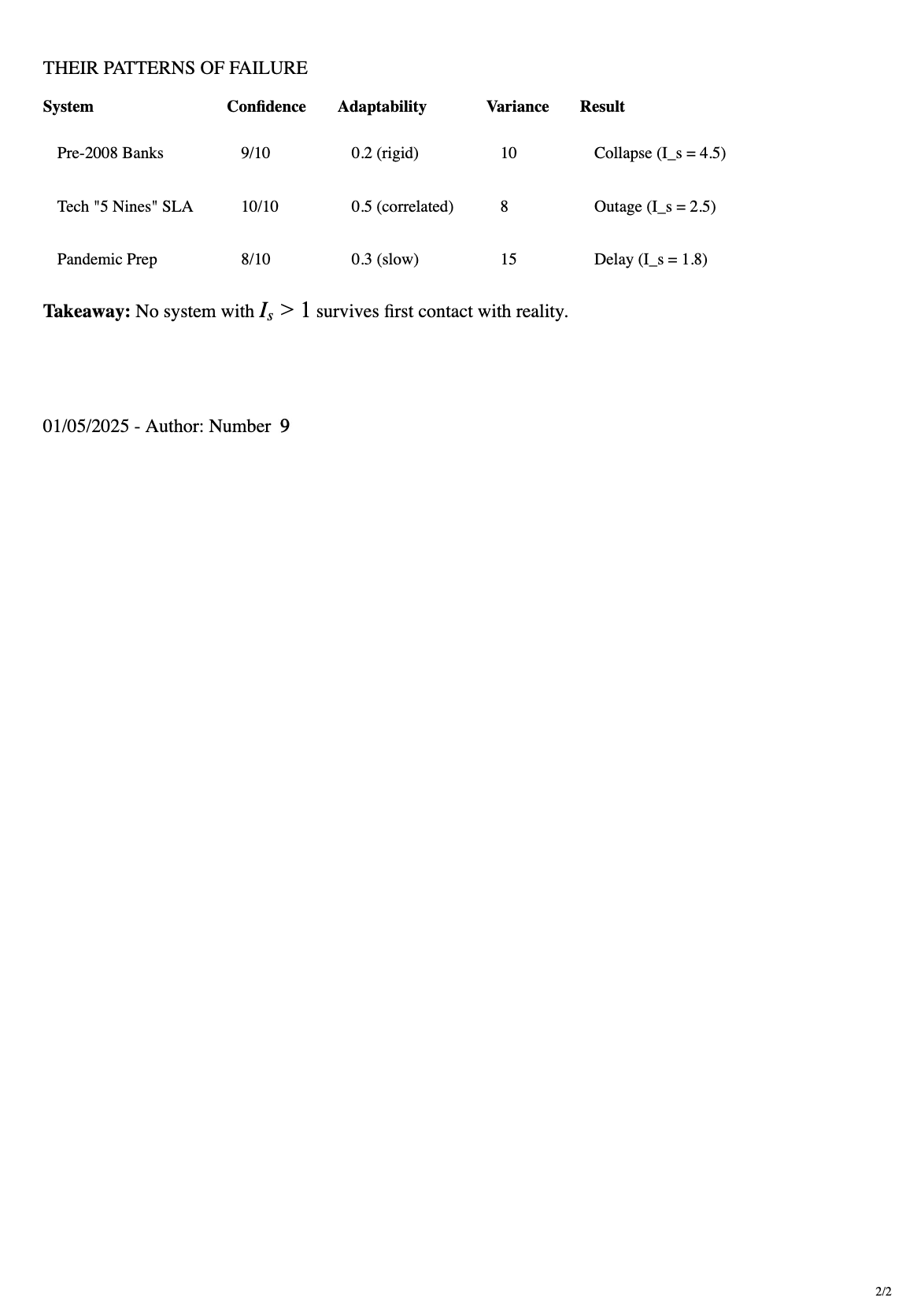
Modern systems—financial institutions, tech platforms, and even decentralized protocols—often mistake confidence for stability, leading to catastrophic failures when reality deviates from their narrow models. The Fragility Equation (Is=ConfidenceAdaptability×VarianceIs=Adaptability×VarianceConfidence) exposes this delusion by quantifying how quickly rigid structures collapse under stress. A high IsIs score (e.g., 4.5 for pre-2008 banks) reveals dangerous overconfidence: systems with low adaptability and unaccounted variance inevitably fail when shocks exceed their insulated assumptions. This pattern repeats in tech ("five nines" uptime shattered by correlated failures), pandemic preparedness (slow adaptation to exponential threats), and crypto (protocols crumbling under unmodeled governance attacks). True resilience requires humility over hubris—reducing IsIs by prioritizing dynamic adaptation and stress-testing against unbounded variance. Until leaders confront this math, their "stability" is just a countdown to collapse.
Key Takeaways:
- Confidence ≠ Stability – High confidence with low adaptability guarantees fragility.
- Variance is the Test – If a system hasn’t modeled extreme shocks, it’s already vulnerable.
- Survival = Is<1Is<1 – Adaptability must outpace both confidence and uncertainty.
Example:
- 2008 Banks: Is=4.5Is=4.5 → Collapse (slow adaptation, unmodeled mortgage risk).
- Robust Systems: Keep Is<1Is<1 via continuous stress tests and rapid pivots.
Question for Any System:
"When was your last proven adaptation to a crisis faster than the crisis itself?" (If the answer is unclear, IsIs is likely lethal.)






Et quas et totam nemo ratione praesentium necessitatibus dolores. Minus ut aperiam et voluptas dicta facilis sed. Dicta vitae id at sit.
Incidunt rerum ullam rerum perferendis. Libero saepe et laborum facere fugiat. Qui eum facere et dolor et quaerat eius tempore. Maxime quas incidunt aut incidunt dolores repudiandae.
Repudiandae eos quibusdam voluptate incidunt accusantium. Quasi quis et sed sint. Sed dolorum sint quia ratione voluptas at. Quasi aut et qui voluptatum. Quia maxime corrupti occaecati qui est amet. Non qui cupiditate rerum minus aperiam dolores.
See All Comments - 100% Free
WSO depends on everyone being able to pitch in when they know something. Unlock with your email and get bonus: 6 financial modeling lessons free ($199 value)
or Unlock with your social account...