


It’s been awhile since I’ve checked in on WSO. I hope 2016 has treated you all well and you’re now settling in for some well deserved rest and relaxation time over the course of the holidays.
It may just be selection bias given I’m starting to get a little older myself (I just turned 34), but I’ve noticed a certain theme emerging in quite a few threads here on WSO and on some of the other tech / programming boards I frequent. It seems a lot of people out there are worried about the career implications of growing “older”. I put “older” in quotes because in many cases I’m not just talking about people approaching retirement age. I’m talking about people for whom the junior tenure of their career is in the rearview mirror. Typically this includes anyone in their early to mid 30s and older.
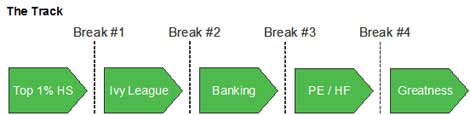
By this time you’ve likely completed any post grad educational requirements, you’ve spent a few years in the trenches working some crazy hours, you have a decent number of deals / projects under your belt, and you’ve more or less mastered the core technical skills necessary to succeed in your chosen field. In other words, you’ve been successfully following The Track to a T. And by your watch, since you’ve done everything right, your train should be pulling up to the Greatness station right about...now.
But instead pulling into some gilded wonderland with golden gates, it seems like The Track just…ends. The familiar steel rails that kept your train on course eventually give way to wilderness. For any veteran of The Track, this is quite unsettling. We’ve all been told that if we went to X college, worked at Y investment bank, and then Z PE firm we’d be set for life. So what gives? Why is there “no country for old I bankers”? Why instead of being welcomed into the gilded gates of Greatness are we seemingly being put out to pasture?
To any Track veteran, the first reaction is to assume it’s because you’re just on the wrong track. Maybe if I had done my analyst stint at firm Z instead of firm Y things would be different… or maybe if I had gotten into school C.... You can perform these little thought experiments all day, but my read is that beyond a certain threshold, none of that matters. Whether you did your banking stint at Goldman Sachs or BAML, worked at a megafund or a middle market firm, got an MBA from HBS or Kellogg, you would likely end up in the same place. Even changing industries wouldn't help. Techies often complain about rampant ageism and a short conversation with any 7th or 8th year law associate should be enough to convince you that things aren’t any different in law. In short, no matter your industry, no matter your credentials and pedigree, you are going to find there are fewer and fewer people willing to take you on as an employee as you get older and more experienced.
People might say it’s because you are more expensive, have more obligations, are set in your ways, etc. These all may be true, but I don’t think they are the main reasons companies seem reluctant to take on more experienced hires. I think the main reason companies don’t want to hire you is because as you get older, wiser, and more experienced, you become more of a threat. It’s kind of like lion prides. When male cubs get to be about 2 or 3 years old, they get kicked out of the pride because the incumbent males know that if those cubs stick around much longer, there’s a good chance they’ll try to take over. And any cubs that don't have the ambition or skill required to attempt such a coup probably wouldn’t help the pride’s chances of survival much, so no use keeping them around either.
If you’ve been in the industry for 10+ years and you’ve been doing things right, there’s probably no real compelling reason why you couldn’t be calling the shots instead of your boss. That makes you a less desirable employee. Because even if you tell yourself you can suck it up and report to someone who really should be your peer for the sake of financial stability, there’s still a part of you that wants to run the pride. Your boss can’t have this. So out you go.
This may seem harsh, but I think it’s a blessing in disguise. Think about it. When you’re 40 or 50, do you really want to be doing all the legwork for a quasi checked out senior partner in exchange for the few crumbs of carry he deigned to throw your way? Do you really want to be cramming yourself into airplanes flying all around the country prospecting and executing deals while your boss “manages relationships”? Do you really want to have to ask for approval to execute that trade you’ve been researching for months? Probably not.
So if you’re in your 30s or 40s and you’re having a harder time finding attractive employment opportunities, maybe the market is telling you something. Maybe it’s telling you that it’s time to stop implementing other people’s ideas and it's time to start implementing your own. Go build your pride.
Mod Note (Andy): top 50 posts of 2017, this one ranks #31 (based on # of silver bananas)







you're as mobile as you want to be. some of the most successful people I know moved their families around during the early years. yes, it's hard on the kids, but the career advancement you get by raising your hand and taking risks I think is worth it. every client I have in their 40s who's already at a walkaway number took risks, and this meant moving with young kids, probably forcing the other spouse to find new work, and so on, so don't think being mobile and having a family are mutually exclusive.
They may not be mutually exclusive but it's pretty damn close in my opinion. Kids make these kinds of moves exponentially harder.
As someone who'll be staring down the barrel of this decision very soon, you are exactly right. I'm not a banker, but I have the potential some pretty great jobs that require relo soon. If I was a single guy there would be NO hesitation.
With a wife, 2 boys and a 3rd on the way it is very hard. Although we could afford my wife to stop working if we moved, the decision is about a lot more than money now. My kids are young enough that it won't impact them too much, but if we eventually want to be in this area again it will require another move at a later date.
I guess I don't have much of a point except that you're right, kids make these decisions awful.
I was in a similar situation so I can relate. We moved to France when my boys were 3 and 4, and we'd just adopted them, so chaos was basically all they knew and it had little impact on them. It was the right move for us at the time. Leaving France six years later to come back to the States had a bigger impact on them, they were settled in their lives, had long term friends, etc.
We've been back two years and, frankly, our eyes are to the horizon again. After 2016, I'm less enthused about living here and you can take from that what you will. We're giving Panama a hard look. Of course, my boys are settled again, with long term friends, etc, and now one of them is in high school and the other will be shortly. Even if we made a decision to move today, it would probably take at least a year to put all the pieces in place. That's a lot to ask of a kid in high school, any kid really.
You have to do what's going to result in the biggest long term benefit for the family, but that doesn't make it an easy decision. Moving with kids is super complicated.
I always thought the "traditional" path was so applauded on these forums because it delayed charting ones own course but appeased the immediate demand of conventional success.
Great post sir. I've never followed any aspect of the traditional path...all wilderness for me. In a way that has been liberating, also a little terrifying, vs many others on this forum
I think your analogy of lion prides is pretty accurate. Once a cub has reached an age that it is considered a full blown lion, it can't go back to the limited responsibility state of a younger cub, even if it wanted to
labanker I could not agree more. I have been thinking about this alot in the past year. Why did I choose banking, private equity, or business school? As I prepare for the next stage of my career, I feel for the first time, I am able to shake the "path," and truly focus on my own decisions and controlling my own future. This is kind of a stream of consciousness, but I think to truly understand why and who we are, we have to look critically at our own decisions, and analyze how we made them.
The traditional path is designed to remove the decision making process from our lives. By following the path, we are forgoing conscious and active decision-making, and assigning faint control over our own destinies via choosing specific firms and/or schools. This allows us to believe we are truly in control, but alas we are not.
This speaks well to our generation (e.g., millenials) because we have grown accustomed to immediate feedback, instant gratification, and positive reinforcement. As a result, we have sought out this path that deprives us of 100% personal responsibility for our professional journeys, and instead places the emphasis on the institutions to help train us before sending us off to another organization, which will then train us again before sending us off to school, where the cycle continues.
By doing this, we are fail safe, if we do not succeed we can blame the system, the industry, culture, or a number of impersonal factors for our lack of success. The reason we cannot admit failure is because of the cult of the industry that has slowly built us into cocky, arrogant, narcissistic motherfuckers.
Young, brightly educated individuals are told by their peers and educators that the finance and investment banking route is the most prestigious and elite path possible. A stereotype that is only reinforced by the high selectivity of the investment banks, which choose only the brightest and well connected students for prominent internships and entry level positions. Not to mention there is safety in numbers, and no one can get hurt "following the pack," but slowly the pack begins to bleed.
During these "grunt years," we are hazed and repeatedly told by our more senior Analysts and Associates that the sacrifice is a badge of honor, just like your pledge master told you when you were a seventeen year-old freshman. The self-sacrifice speaks to our desire to feel welcome, to be a deserving member of a team, a family. We remind ourselves that the "pain is temporary," and it's just a few years until we get to PE or Hedge Funds, where the hours will be better. We convince ourselves that staying late for Seamless is "free money," and that it would be stupid to head home if that once in a lifetime chance presented itself. When we get hammered with last minute work on a pitch book, we convince ourselves we are playing an important role in the machine that is Wall Street, but we are truly just the weakest and mostly easily replaced cog, but at least we’re learning.
To counteract our feeling of worthlessness of not feeling "valued," we surround ourselves with our fellow pleebs. This is important, as our analyst "class" drinks the same KoolAid. Slowly, we build each other up, convincing each other that we're the best and that the girls will soon realize that, maybe they do.
When we get to Private Equity or Hedge Funds, we are forced to begin to acknowledge our own mortality. We realize maybe we are not the best, or at least according to the GMAT and Business Schools, whom now dictate our value. However, we are just excited to take “two years off” and rack up thousands of dollars in debt, because no, you’re not getting a need based scholarship after 4-5 years of IB and PE comp. I’m at this stage now, so I can’t speak to what comes next, but time will tell.
This may sound like a negative portrayal, that it is not. In order to become the best version of ourselves, we must critically evaluate our decisions. By looking back at our thought process and the factors that influenced our decisions, we can continue to improve how we make decisions and gain control of our destiny. I would not trade the path for anything else, maybe it’s the KoolAid, but it could have been worse. If you disagree with my comments above, feel free to voice them, feedback is great gift.
I wish every "Summer Analyst" or "Incoming IBD Analyst" on this website was forced to read this. I've seen far too many cattle following the herd without a real sense of where they're going