
MIT Sloan and Columbia >>>>> Booth and Kellog


So I've been reading a lot of the posts on this forum, and noticed that a good number of people (or at least the trend) seemed to perceive Booth and Kellog as a solid top 5 schools over MIT Sloan and Columbia. My post is going to focus mainly about these 4 schools I just mentioned and provides some thoughts on why, based on some objective reasoning and data, I think Booth and Kellogg are hugely overrated compared to MIT/Columbia (as in the quality of business schools overall, not in any specific area such as HF/PE/VC..), both academically and prestigious wise. Don't get me wrong, I think Booth/Kellog are fantastic business schools, and their parent institutions at the undergrad and grad level are top-notch too, but as a BA from the top consulting firm (M/B/B) graduated from a top 10 undergrad, I'm just having a really hard time placing them ahead of MIT/Columbia. I will also touch on my thoughts (backed by some simple admissions data) on the ranking of M7+Tuck/Hass/Stern, or the solid top 10 U.S Business Schools
The biggest reasons I've seen so far that put the 2 Chicago schools ahead of MIT and Columbia are:
1: Booth is great for finance blah blah blah
2. Kellog is a great marketing school blah blah blah
kk, i get that UChicago's got a huge reputation/ranking boost after its alumni David Booth donated 300M to the business school and renamed itself to Booth in 2008. I also admit that Kellog has been a strong player in the business school education for an even longer time. But I want to just elaborate on 3 points to back my argument that MIT Sloan and Columbia simply dominate Kellogg, and to a lesser extend, Booth, as business schools, and also on the parent institution level
First - the huge brand dilution due to Booth's and Kellogg's part-time MBA programs. Geez, don't even get me started on counting the types of part-time MBAs there are in these 2 schools.
Booth: Evening MBA, and Weekend MBA
Kellogg (even worse): Evening MBA, Weekend MBA, and 1-year accelerated MBA!
I believe from the school's perspective, it's perfectly ok and makes sound business sense to have these part time programs, and they do serve a market where full-time working professionals want the additional knowledge while staying on payrolls. However, for the purpose of ranking bchools based on its academic merit and overall perception, part time programs have a significant negative effect on the overall qualities of the business schools (to a more extend, the flagship MBA program of the school), because the less impressive students now have the chance to be branded with Booth or Kellogg MBA, which is great for them, but not for the full timers. There's a simple reason why Harvard is indisputably the best business school no matter how you look at it: it protects its MBA brand like no others. I know people will argue that the part-timers at Booth and Kellogg don't really socialize with the full-timers, and they are effectively 2 separate communities who do things on their own, and that part-timers don't have OCR blah blah blah. However, it doesn't rid the fact that part-time programs make the school simply less selective (without even mixing into the full-time problem admission stats, which I will get into later), and dilute the school's full-time program brand. I'm sure all the part timers will have no problem saying they got their MBAs from Booth or Kellogg once they graduated (without ever implying or mentioning that they did part-time), and most of the employers won't even be able to distinguish the differences from full-time folks, and frankly I don't know why companies would even care at that point. However, the truth holds that part-time programs make the caliber of the students at Booth/Kellogg a lot weaker, and in the long run will hurt their brand.
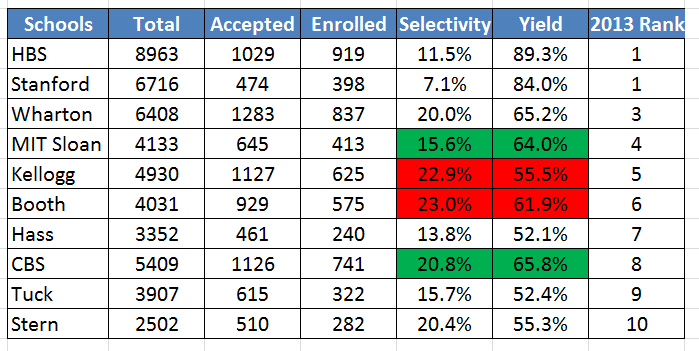
2. Selectivity (only based on the full time MBA data, will be even worse for Booth/Kellogg if one were to blend in the part-time admissions data). I pulled the admission data from each of the top 10 schools off the latest USNews BSchool ranking (2013). I think it does a really really great job ranking these schools this year, and the data itself is really self-explanatory: Harvard is the king of the jungle and stands on its own league, with the largest number of applicants (the popular highschool prom queen), highest yield (strongest interests and commitment to go regardless of admission decisions anywhere else), and second highest selectivity (Stanford beats it, but only due to the terribly small class size).
Now, Hass/Tuck/Stern I think nicely round up the top 10 schools, and they kinda compete with themselves (please, no Ross/Darden/Fuqua etc. talk here, they are not top 10, and Ross's over 40% acceptance rate nicely fits its public school status. Darden and Fuqua with 27%ish acceptance rate just don't make them elite at all).
Now for the MIT Sloan/Columbia v.s. Booth/Kellogg topics. I'm gonna pick on Kellogg here first just because it's got the worst "admission stats" among the 4. The almost 50/50 yield simply DESTROYS its brand/competitiveness. With a selectivity stands roughly at 1/4, i can't even imagine the kind of people going to Kellogg if you factor in the stats from Kellogg's 3 part-time MBA programs. Remember, the 50/50 yield is for its full-time MBA program (oops for Kellogg). The data clearly signals that Kellogg is STRUGGLING in attracting top talents and retaining admitted students. It also suggests what the market (students) is thinking.
I didn't pull similar admission data from previous years but i have high-degree of confidence that the situation would be similar for the M7s, unless someone can prove otherwise.
(Full-time MBA data)
Schools Total Accepted Enrolled Selectivity Yield USNews
HBS 8963 1029 919 11.5% 89.3% 1
Stanford 6716 474 398 7.1% 84.0% 1
Wharton 6408 1283 837 20.0% 65.2% 3
MIT Sloan 4133 645 413 15.6% 64.0% 4
Kellogg 4930 1127 625 22.9% 55.5% 5
Booth 4031 929 575 23.0% 61.9% 6
Hass 3352 461 240 13.8% 52.1% 7
CBS 5409 1126 741 20.8% 65.8% 8
Tuck 3907 615 322 15.7% 52.4% 9
Stern 2502 510 282 20.4% 55.3% 10
(Edit: i just realized the table formatting is messed up after submitting. I attached a snapshot of this table to this post)
Now the same problem isn't as bad for Booth, though still trailing behind MIT and to a less extend, Columbia: MIT's 15.6% acceptance rate stands as the 3rd most selective school among MBA business schools">M7, and its 64.0% yield is only slightly behind Columbia's 65.8%.
To put it simply, MIT and Columbia dominate Booth among all criteria: Compared to the 2 schools, Booth has fewer # of applicants, nearly 8% less selective compared to MIT, and the lowest yield among the 3. MIT and Columbia dominate Kellogg even more in this regards
Someone might argue that all these admissions data don't directly translate to ranking or prestige of these business schools. However, these admissions data directly reflect the sentiment of the market and how the participants of the market (students) are shopping for their be-loved business schools. It's really simple: the better students go to the better and more selective schools, more often the case to offset some occasional outliners (family/location preference issues blah).
Lastly, I want to briefly touch on the academics aspect. After talking about caliber of students, i want to mention the caliber of the faculty at each school.
MIT Sloan: academically speaking, the faculty at Sloan, and to a broader extend, MIT, probably has the brain electricity to power the entire 50 states of America. (ok fine, i exaggerated there a bit). Modern finance, for example, sees MIT Sloan as its birth place: Fischer Black, John Cox, Robert Merton, Franco Modigliani, Stewart Myers, and Myron Scholes, to name a few names, are all affiliated with MIT via education or being on the faculty. As a result, many breakthroughs in financial economics are associated with MIT faculty, including: the Black-Scholes/Merton option-pricing model; the Modigliani-Miller theorems; continuous-time models of consumption and portfolio choice etc.
I don't even need to talk about the Econ department at MIT (Robert Merton, Ben Bernanke got their PhDs in econ at MIT, to name a few). It's arguably THE best on the planet. Granted, UChicago Econ is in the similar league too, along with Harvard/Stanford/Princeton Econ.
Now, please note that I'm simply talking about the finance academic strength of Sloan, which doesn't necessarily translate to finance placement in the industry due to various reasons (Harvard, Wharton, I'm looking at you). Though I believe MIT Sloan graduates who choose to be finance practitioners are doing great.
In other major areas of business such as traditional corporate jobs/tech/consulting etc., MIT Sloan is simply the best among the 4 schools we are talking about here.
Columbia: Again, another great business school with long tradition and heavy focus on Finance research ( Benjamin Graham and David Dodd, along with current faculty members such as Robert Mundell, Joseph Stiglitz and Edmund Phelps). Its overall academic capability and reputation in the financial industry are top-notch (Warren Buffet anyone? Henry Kravis? Vikram Pandit?), .Plus its Ivy League status and great undergrad reputation will be a BIG bonus point if you ever change your mind on finance and want to do something more "traditional".
UChicago: fantastic econ department ,overrated business school (only compared to MIT, to a lesser extend, Columbia)
Kellogg: so........what's Kellogg known for again? marketing? is that a thing you study at school? what??? lol.
In my humble opinion, what makes a business school strong and better, in a sustainable way, are:
1. The overall caliber of your peers (who you spend 99.999% of the time with in school, and who grow careers with you): MIT/Columbia > Booth/Kellogg
2. The overall caliber of your alums (the quality of alums depend on the quality of current students, who become alums upon graduation). Hence selectivity of admissions is IMPORTANT.: MIT/Columbia > Booth/Kellogg
3. The overall caliber of the faculty (this matters more on the institutional level for those who value intelligence and knowledge development, less so for those who simply want to hit it and quit it (with a better job)). I'm sure most people would like to claim that they go to a smart school too: MIT/Columbia >= Booth >>>> Kellogg
4. Career service; important factor, but is marginal in terms of driving the quality of a business school education. In terms of finding jobs, the school's brand, your OWN networking/interview abilities, alums (who, at the end of days, decide where to recruit and how many spots to allocate) are far more important. Career service can help you better prepare for your own school's OCR, but it's not a big differentiator that can significantly impact the quality and ranking of different schools. If you are in MIT Sloan, your Career service can help you be a better candidate against your OTHER MIT Sloan buddy for the same OCR interview, not the guy from Columbia or Booth: MIT = CBS = Booth = Kellogg
5. Besides the above 4 factors that in my humble opinion have the most weight on judging the quality of a business school, all other factors such as geographical preference/family issue things in that nature, while important on an individual level, should have marginal/minimal impact on the overall perceived quality of business schools.
With all that being said through out my post, i think it's relatively easy to conclude that, as a business school OVERALL, in additional to the reputation/academic strength of the parent institution, MIT Sloan/Columbia >>>>>>>>>> Booth/Kellogg
I welcome thoughts and comments.
| Attachment | Size |
|---|---|
| Bschools Data.PNG 12.88 KB | 12.88 KB |







Ok. When I first saw this post title, I cringed and thought "oh god, another immature college jackass making a dumb argument." After reading this, however, i must admit that it is fairly well written although i don't agree with a few of the points.
In full disclosure, I'm a HYP ug alum, econ major, who work in BB trading in NYC and recently got into wharton, booth, and columbia (DAMM YOU HBS!!!). And i have a ton of friends at top schools, so i have a pretty good pulse on this topic as well. Since i'm a finance guy i did not apply to kellogg but seriously looked at mit sloan. I ultimately decided against it because of its lack of grade non-disclosure and the cutthroat environment i witnessed during my visit.
Now onto your arguments. I do agree that the presence of part-time MBA programs somewhat dilute the booth/kellogg brand, but i don't see that having a long-term impact on those schools' name brand and market power. Furthermore, I think you underestimate how much of a game changer David Booth's $300 million donation was. Aside from the name change, the money allowed the school to hire better faculty, expand resources in every area including marketing and entrepreneurship and revamp its career services. By all accounts, Booth probably has the best career services after perhaps HBS. Booth's Chicago location and high rankings (you may disagree with the rankings, but they are what they are) have further added to the school's luster. Simply put, I think Booth is the hottest b-school right now, analogous to Stanford at the undergrad level. Even here in NYC, lot of the people in my circle see Booth as the best b-school for finance jobs after hbs and wharton. I think Booth has surpassed Columbia, a school i see as old, past its prime, stale, and in decline. The ivy league brand? Who freaking cares. The school is overly dependent on NYC finance and has gotten slaughtered in the last few years with placement. It's one-dimensional and like Stern and London Business, relies WAY too much on location to bolster its status. Also, Columbia's low acceptance rate and high yield is almost entirely due to early decision, which is a freaking joke.
Onto MIT Sloan. I like the school a lot. Its cerebral culture, rigorous curriculum, Boston location, and unique essays/cover letter appeal to me. But something is missing here. They're strong in tech and consulting, but it has much to be desired in other areas. Even in finance, a supposed strength, it doesn't place as nearly as well as booth and columbia with coveted hedge funds and investment management jobs. And I think it loses out to even tuck in private equity. Of course, there is more to a school than finance placement, but Sloan is not as well rounded as Booth. It also loses points for being in the same area as a certain business school across the river, hence leading to many Sloanies' inferiority complex. At least in Chicago, Booth and Kellogg are the kings of the hill.
In addition, these schools don't necessarily have the same applicant overlap, so i don't think you can infer that much about selectivity or quality of the students. For instance, a finance guy who wants to stay in the east coast may apply to columbia but not booth. A diehard chicago person may apply to booth and kellogg but not columbia or sloan. A techie may apply to sloan but not the others, and so forth. I think you oversimplify what the acceptance rate is telling you.
Finally, I think booth/kellogg/sloan more or less have the same caliber of students (maybe columbia if you take out the early decision admits), and people's preference between those will vary depending on their career goals, personality, interests, etc.