
Top 15 ranked USNWR universities: Master degree bubble at the top?


Hi Guys, so came across this interesting article (link below) talking about the inflation of Master programs (both research-based and professional) and the number of Master degrees that colleges and universities in the US are churning out every year for the past decade. They also included a pretty comprehensive list of schools and the number of master degrees produced by each of them. I'm aware, to a certain extent, that this bubble is fueled largely by lower-tier schools and various online programs. So I basically took the list and extracted the top 15 schools and wanted to see if there's any interesting trend about how our top elite schools in this nation are reacting to this perceived education bubble. The purpose of this thread is mainly about sharing this with you guys and get discussions started about the future of Master (including MBA) programs/how it would impact us in terms of career development and job searching. Personally, I'm a bit concerned about the insane and absurd growth of master programs, even at top schools. But i guess the invisible hand and market force is really what sets the rule here.. Anyhow, below is my findings and i attached the 2 relevant tables to this thread.
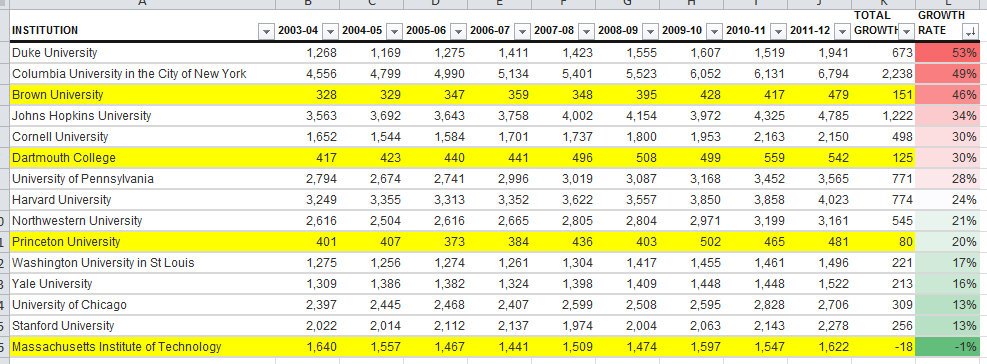
Table 1: it is sorted by Master program's growth rate from 2002 to 2012. Some interesting observations I concluded from this...
1. I highlighted Brown/Dartmouth/Princeton because each of these schools award less than 500 Master a year, on average...significantly lower than their other peer schools...I think this makes sense because these 3 schools are largely considered to be heavily research-oriented, and not really interested in capitalizing or commercializing their intellectual assets. I know Dartmouth has Tuck, which produces buck of its Master degrees, but it is still relatively small #.
I also highlighted MIT because i was surprised to see its almost %0 growth rate for its master degrees, but then i realized MIT is also really research-focused and Sloan, which probably contributes half of the master degrees, is not that big in terms of headcounts either.
Besides the 4 schools i mentioned above, all other major players in the top 15 have enjoyed a huge growth rate for its master programs based on the numbers we have. Notably, i wanted to say that Columbia has arguably been one of the most aggressive schools in terms of capitalizing on and commercializing their various assets (both intangible and real). Nothing wrong with that because they have a great market for its degrees. I think it's also the NYC vibe and the general business-savvy of the school that contribute to this huge growth rate. I could be wrong though.
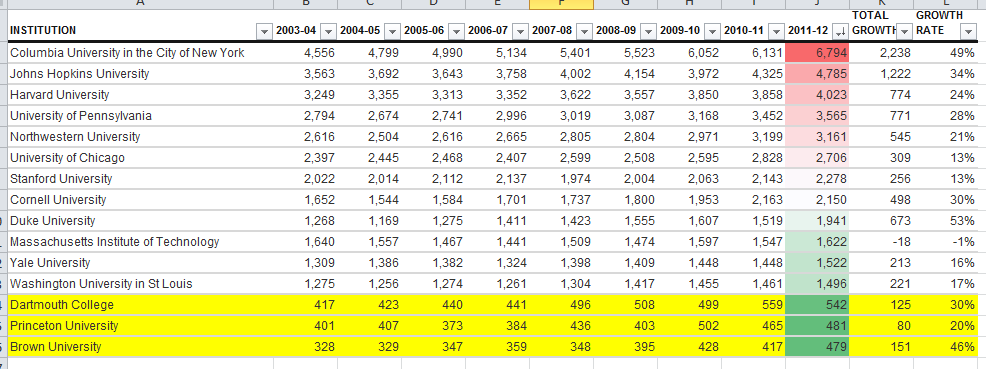
Table 2: it is sorted by total number of Master degrees awarded by each school. So again Columbia is top in terms of producing the most number of master degrees and really outnumber the rest by a big (why am i not surprised...). It is interesting to see Harvard is #3 in terms of producing the most number of master degrees. This could be due to its Extension school though.
It's also interesting to note that Columbia or any other top schools here with big master programs are producing the same number, if not more than sometimes the entire undergraduate population of an average-sized private universities. And this is done every year. Soon, i think it will reach to a point of critical mass where things can be either of the below:
1. Master/Graduate eduaction because mandotory for a sucessful career
2. Bubble is burst, and everyone crash and burn!
http://www.washingtonpost.com/local/education/masters-degree-programs-s…
| Attachment | Size |
|---|---|
| Table 1- By Growth Rate.PNG 26.65 KB | 26.65 KB |
| Table 2 - By Total Number of M Degrees Awarded.PNG 27.5 KB | 27.5 KB |








Brown and Dartmouth are not heavily research oriented. Although I believe they are attempting to change that.
Columbia has been especially egregious in this area. For example, they now offer a masters in financial engineering, operations research, mathematics of finance, and finance&economics. The students in all of these programs are essentially competing for the same jobs. It makes you wonder how many of these non-mba masters programs are legit and how many are cash cows.
Chinese demand. All these programs are loaded with Chinese students.
Molestias nihil cumque sint neque natus dicta. Natus quia voluptatem sit est consequatur voluptas provident.
See All Comments - 100% Free
WSO depends on everyone being able to pitch in when they know something. Unlock with your email and get bonus: 6 financial modeling lessons free ($199 value)
or Unlock with your social account...