
Incoterms - Glencore/Trafigura Interview Prep

Just wanted to clarify my understanding on the following incoterms: FOB (Destination), CFR/CIF, DAP.
FOB (Destination): The seller undertakes all transportation costs, damage/risks associated with goods (until port of destination), and handles export clearance. Once the goods arrive and are unloaded at port, transfer of ownership is conferred to buyer who then handles the respective risks and costs of the goods until their final destination (includes import clearance).
CFR/CIF: Seller - like FOB destination - is liable for transportation costs and export clearance but the transfer of risks/damages in-transit falls on the buyer as soon as the goods are loaded on to the transport. Title transfer occurs with goods being unloaded at buyer's port. (CIF is basically CFR but involves the seller also incurring minimum insurance costs for the goods in-transit).
DAP: Seller bears all transportation costs, damage/risks, and handles export clearance. Title transfer occurs when the goods are ready for unloading at the agreed location where this can be at the buyer's port, terminal, or warehouse. Any further freight costs incurred beyond the port to the buyer's warehouse, for instance, are to be covered by the seller. Buyer then assumes all risk and costs (including import costs).
I pieced this information from a few online sources but wanted to make sure the specifics are right. Would this be an accurate understanding of these incoterms? Thanks!






Suggest you keep reading and refer to ICC’s rules. What you summarised is damn wrong - 30% is passable.
FOB:
Seller deals with export formalities, places the goods on board the vessel, but gives no guarantee that the goods will arrive at destination.
Buyer arranges a contract of carriage, insures the goods (or chooses not to), discharge at destination at their time/risk/expense, deals with import matters
Risk transfers from seller to buyer as the goods are loaded on board.
CFR:
Seller deals with export formalities, arranges a suitable contract of carriage, places the goods on board the vessel, makes sure that the goods arrive at destination.
Buyer insures the goods, discharge at destination at their time/risk/expense, deals with import matters.
Risk transfers from seller to buyer as the goods are loaded on board.
Under CIF, the seller must insure the goods. Usually the buyer will make additional insurance arrangements
DAP:
Seller is basically responsible for export/loading/carriage/insurance/unloading plus having the goods delivered but not unloaded at the named place of destination
Risk transfers from seller to buyer as the goods are unloaded at the named place.
Thank you for your detailed response. I just want to ask a couple of follow-up questions:
- What I tried to outline in my original post was FOB destination and your description seems to fall in line with FOB shipping point / origin (https://www.bdc.ca/en/articles-tools/entrepreneur-toolkit/templates-bus…). For FOB, is FOB origin just way more commonplace and, thus, the standard description? I assume this would be the general answer to give in interviews.
- From my understanding, as per the Deloitte excerpt below, DAP does not involve the seller covering import clearance or unloading costs as the goods are the buyer's responsibility once they are ready for unloading at the agreed location. DDP would see the seller cover all the costs you mentioned as the seller covers essentially all costs, risk, and duties. Am I wrong in this?
Any help would be appreciated! Thank you!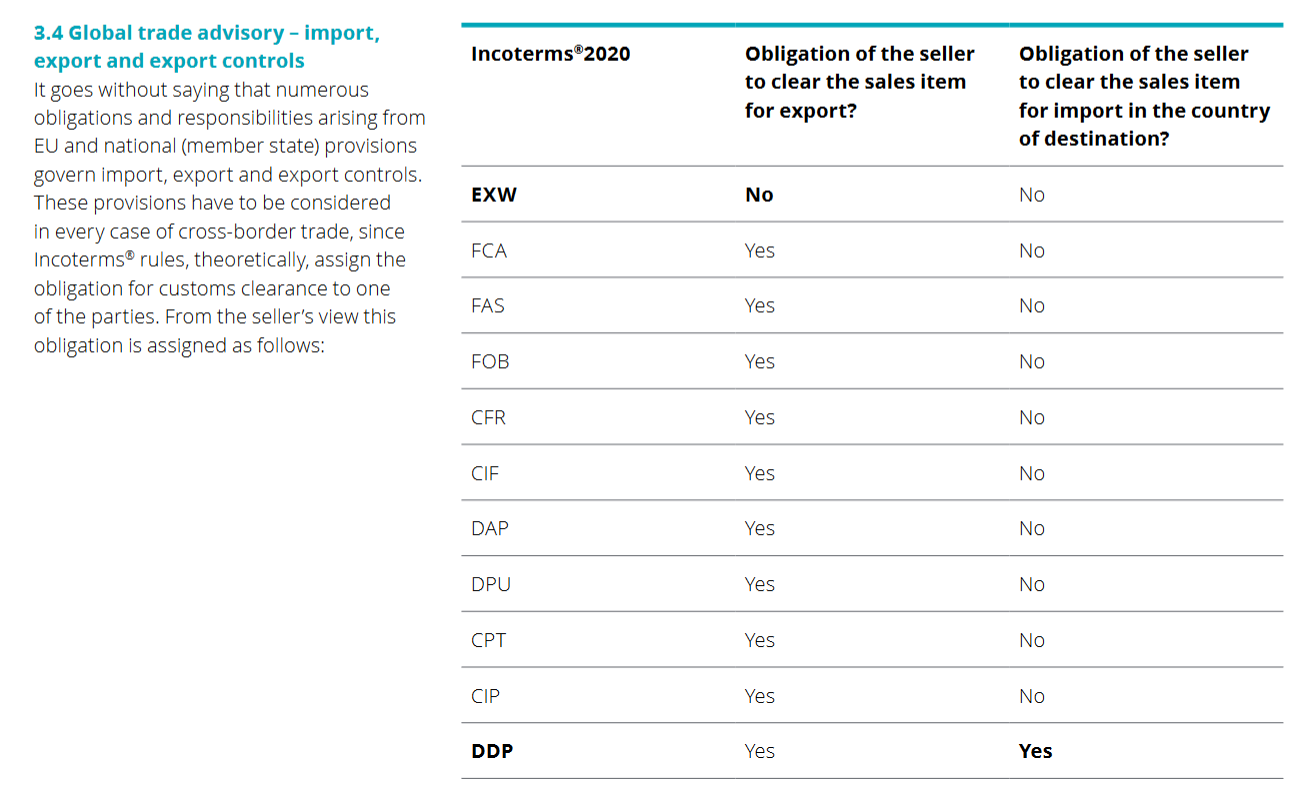
- So FOB origin and destination seem to be used exclusively in North America, from what I understood 'FOB origin' is the same as FOB in global trading, while 'FOB destination' is pretty much like CIF but risk and title transfer at destination
- You're right about DAP, the buyer is responsible for clearing the goods for import, as opposed to DDP
If you want to know everything there is to know about Incoterms, I suggest you buy their book
Adipisci eaque nesciunt voluptatem enim animi. Qui laborum qui molestias et aliquam placeat nihil natus. Perferendis quia maxime hic omnis quae voluptas animi. In corporis eveniet doloremque natus alias aut praesentium. Alias nulla similique magni rem atque aut eius et. Id eaque qui facere.
Eaque autem nobis inventore suscipit vero. Hic numquam incidunt quo qui debitis. Quo natus occaecati exercitationem aliquid distinctio.
See All Comments - 100% Free
WSO depends on everyone being able to pitch in when they know something. Unlock with your email and get bonus: 6 financial modeling lessons free ($199 value)
or Unlock with your social account...