


As Varoufakis and Tsipras move from one failing debt negotiation to the other, UK plans upon the much anticipated referendum on continuing its affiliation to the Euro. The idea of a ‘Brexit’ was the key agenda of competing parties in the recent election. With the motivation behind the same being liberating UK from political interference and immigration policies leading to disproportionate allocation of resources to immigrants from member countries.
Estimating the economic impact of an exit from the Euro has been a controversial topic since the counterfactual would imply considering the world minus the Euro. The following graphic from The Economist demonstrates the economic benefits accrued due the formation of the union. Although the estimates seem significant it can always be argued the European countries would have been on a higher growth trajectory after the depression and the world war.
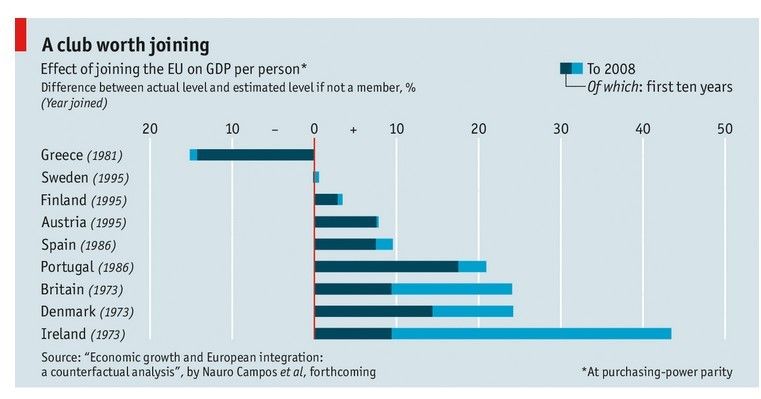
The image has been sourced from the Economist
While political parties argue in favour of a Brexit by stating gains from lower immigration and direction of resources towards Britons, the UK has benefitted largely from low cost access to the European markets. Breaking away from the Euro could also dampen trade partnerships and related economic gains.
As discussion around the referendum advances, the economy witnesses heighted policy uncertainty. This was particularly relevant as rating agency S&P on Friday (06/12/2015) cut its outlook on UK government debt down by a notch to “negative” from “stable”. One of the fundamental concerns of breaking away from the Euro is the stability of the pound and the potential to attract foreign investment.
While Cameron and other politicians argue that the “Brexit” would enhance interactions with rest of the world the answer is far from ambiguous. The open economy structure of UK has been nurtured well so far under the Euro set up with higher inflows of low cost capital and skilled labour.
Other rating agencies echoed similar sentiments last week when Moody’s warned that mistimed referendum would magnify economic uncertainty. Both Fitch and Moody’s has downgraded UK government debt in 2013 and S&P’s recent downgrade raises concerns around stability.
The question at hand is a difficult one to answer and it seems as if the country stands to lose from detaching itself from the monetary union.
So what are your thoughts?
The content for the blog has been sourced using:
S&P cuts UK outlook amid EU referendum warning , Why, and how, Britain might leave the European Union , The benefits of Brentry






Britain wouldn't be exiting from the Euro, its never been in the Eurozone. The "brexit" would just be a move out of the European Union and probably towards a Norway-style "free association" trade style deal. It would be entirely politically driven.
Err we're not in the Euro
lol, is it not common knowledge they don't have the euro over there? I've seen this mistake so many times/
This is with regard to the membership to the Euro zone...and they have a dual currency with both pound and euro as acceptable currencies...
No, they don't. You may only pay in pounds within the UK.
I hate Americans
It's okay, my mother still loves me.
This post is fucking painful.
Still unsure if the post is an example of awe inspiring international ignorance or some truly sublime trolling...
You should write a post on implications of Greece leaving the EU as well. Would love to get your views.
+1 i really hate it when americans talk so confidently about some stuff they clearly have no clue about It's just beyond ridiculous.
The EU is immensely complicated, and it was my experience living in Europe that most people had no clue how it really worked. It's clear that OP is in that boat.
I'm going to participate more actively just so I can throw some MS at this post.
oreos , thewaterpiper: On behalf of America, I apologize for OP....
A molestiae est voluptates ut nobis est aut. Ut quibusdam sed a.
See All Comments - 100% Free
WSO depends on everyone being able to pitch in when they know something. Unlock with your email and get bonus: 6 financial modeling lessons free ($199 value)
or Unlock with your social account...