


BIG DEAL
Why MLK and Andrew Yang Would've Been Pals
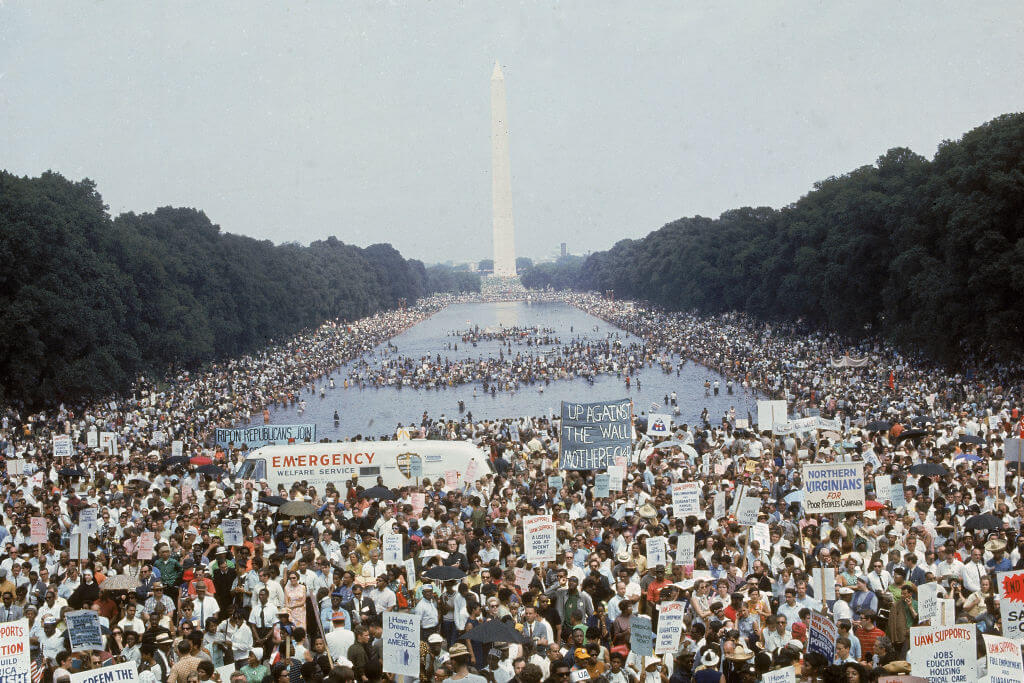
Four years after delivering his “I Have a Dream Speech” in Washington D.C., Martin Luther King Jr. was at it again.
In 1967, King started planning another march on the National Mall—but instead of focusing on racial inequality, this protest, known as the Poor People’s Campaign, would highlight economic inequality.
- The demonstration he envisaged would involve constructing a tent city on the mall, where protesters would pressure Congress using nonviolent methods.
King was assassinated weeks before he could see it through. But as he laid out his vision for the economy leading up to the event, King proposed an idea—shunned at the time but rising in popularity now—of a universal basic income (UBI).
The vision
King was a frequent critic of the economic status quo. But because he was MLK, instead of writing things like “Capitalism is bad” he wrote things like “Capitalism finds herself like a losing football team in the last quarter trying all types of tactics to survive.”
On that note I'll take a step back and let King continue...
- “The contemporary tendency in our society is to base our distribution on scarcity, which has vanished, and to compress our abundance into the overfed mouths of the middle and upper classes until they gag with superfluity.”
- “The curse of poverty has no justification in our age. It is socially as cruel and blind as the practice of cannibalism at the dawn of civilization…”
So what was his solution? King focused on the demand side, writing “We must create full employment or we must create incomes...people must be made consumers by one method or the other.”
King believed that no amount of economic growth in a capitalist system would ensure everyone got a job. So he wanted the government to provide every American with a guaranteed middle-class income, one that would rise with the cost of living.
Bringing it to today
Writing about King’s plan in The Atlantic in 2013, Jordan Weissmann called the idea of a basic income “light-years beyond the realm of mainstream political conversation today.”
Seven light-years later, basic income has entered the mainstream political conversation, if you consider the sixth place candidate for the Democratic presidential nomination mainstream.
Entrepreneur Andrew Yang’s campaign boils down to one tweet:
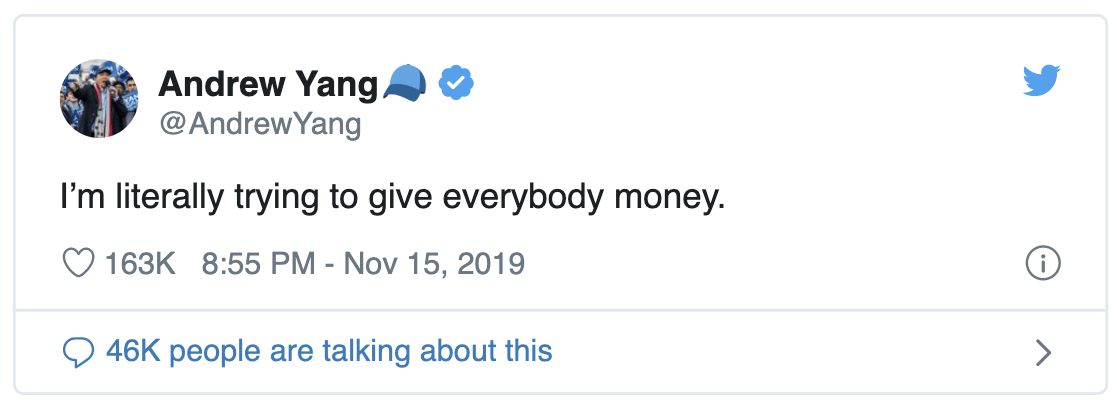
The candidate’s main policy proposal is the Freedom Dividend, a basic income of $1,000/month for every American over 18. Yang’s reasoning for UBI is very different than King’s, though. He’s primarily concerned about the mass disruption to jobs caused by AI and automation as part of the “fourth industrial revolution.”
To be sure, UBI has more opponents in the U.S. than supporters. I’ll list just a few of the major criticisms here…
- It’s too expensive
- UBI would replace existing unemployment benefits and increase inequality
- By separating work and income, it would warp social relationships
- People would have less incentive to work
- It gives politicians a pass to sidestep tough future-of-work discussions
In a Gallup poll released last September, 43% of Americans said they supported a universal basic income program.
Bottom line: UBI mini-experiments are happening all over the world, from Finland to Kenya. There’s no conclusive evidence yet, and some economists say any pilot study in an advanced country is doomed to fail. But the fact that we’re even talking about it shows MLK’s little-known economic message is very much alive today.
Want Morning Brew Daily Served Fresh to Your Inbox?
Drop Your Email Below...
TOP 10

-
1. I am contractually obligated by my family to include this story about the bagel union-mafia wars on the Lower East Side (Grub Street).
2. The dynamics of water privatization in the developing world, with incredible pictures (NYT).
3. The first question of this podcast episode with investor and entrepreneur Reid Hoffman: “On your Wikipedia page, it says that you ‘drove oxen in high school.’ What does this mean?” (Conversations With Tyler).
4. If you want to get meta about the top 10, read this story on the changing incentives of longform journalism (The Baffler).
5. How to invest in startups (Sam Altman).
6. I’m resurfacing this 2018 interview with Alex Trebek because, well, he’s my hero (Vulture).
7. Matt Levine’s dissection of BlackRock’s “pivot to sustainability" (Money Stuff).
8. Our prayers have been answered: What Instagram would look like on Windows 95 (Bēhance).
9. Has Silicon Valley stopped innovating? (The Atlantic).
10. How the Bachelor became a launchpad for influencers (The Ringer).
Reader question: When do you write Monday’s Morning Brew? Do you take turns with weekend assignments?
Neal’s answer: Well, I’m actually writing this on Thursday because it’s a special edition. Future Neal, I hope tonight’s date goes/went well.
But on normal weeks we write Monday’s Brew on Sunday, and yes, we do take turns. I usually like to wake up early on Sunday and write the newsletter in the morning, so I can spend the rest of the day losing money on football games. At night, we review the news again, write a little bit more if necessary, then go about the standard procedure of sending the Brew. Weekends are definitely slower for news, but typically there’s some big event on Monday to preview. For example, last Monday was the new Boeing CEO’s first day.
Got another question to ask us? Fire away right here.
STOCK MARKET TRIVIA

We ask this every year...Martin Luther King Jr. Day is one of nine days in 2020 during which the NYSE, the Nasdaq, and the bond markets are fully closed. What are the other eight?
Want Morning Brew Daily Served Fresh to Your Inbox?
Drop Your Email Below...
STOCK MARKET TRIVIA ANSWERS
New Year's Day, Presidents' Day, Good Friday, Memorial Day, July 3 (July 4 is a Saturday), Labor Day, Thanksgiving Day, and Christmas Day.






Iste omnis eaque sit quia. Omnis error quaerat libero sint in. Laboriosam quia necessitatibus alias possimus voluptates omnis sunt. Sit inventore cum non officiis sequi repellat.
Ut officia modi dolor. Sit in qui minima ad. Nisi illo aut atque consectetur est vel. Ex omnis commodi nulla porro tenetur laboriosam autem.
Voluptatibus ex quisquam repellendus velit laborum libero. Laudantium aliquid quia quis quas excepturi voluptatem. Distinctio voluptatem consequuntur aliquid ipsa eaque delectus. Natus voluptas inventore cum ut. Molestias sit repellendus quia illum.
See All Comments - 100% Free
WSO depends on everyone being able to pitch in when they know something. Unlock with your email and get bonus: 6 financial modeling lessons free ($199 value)
or Unlock with your social account...