DCF Stub Period - Entry and Exit Annual Financial Model

Hi All - I am doing an annual DCF for a tech buy side deal and having trouble understanding how to incorporate a stub period entry and exit date.

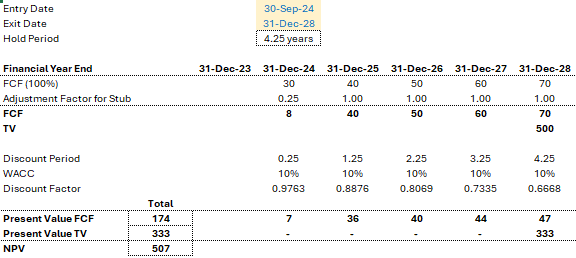
I think I know how to do the DCF if you have a stub entry period (30-Sep-24) and regular FYE exit date (31-Dec-28) - please see build up below. 

However, if my exit date is meant to be 5 years after entry (i.e. 30-Sep-29 terminal period) how do I adjust the following given it is an annual model:

  1. Free Cash Flow at Exit
  2. Terminal Value calculation (assuming Perpetuity Growth Method) 
  3. Discount Period / Discount Factor

Simplified DCF below for completely illustrative purposes:

  • Valuation Date: 30 September 2024
  • Last Financial Year End: 31 December 2023 (assume no quarterly or half year filings available)
  • Hold Period: 5 years (i.e. 30 September 2029 exit date)
  • Discounting: Full Year


image-20240817193710-1

Thank you so much 


2 Comments
 

Based on the most helpful WSO content, here's how you can handle a stub period entry and exit date in an annual DCF model:

Key Adjustments for Stub Period Entry and Exit Date

  1. Free Cash Flow at Exit:

    • Stub Period Adjustment: Since your entry date is 30-Sep-24 and your exit date is 30-Sep-29, you need to adjust the free cash flow for the stub period. This involves prorating the free cash flow for the stub period.
    • Calculation: If your financial year ends on 31-Dec, you will need to calculate the free cash flow for the period from 30-Sep-24 to 31-Dec-24 and then for each full year thereafter until 30-Sep-29. For the stub period at the end, you will prorate the free cash flow from 1-Jan-29 to 30-Sep-29.
  2. Terminal Value Calculation (Perpetuity Growth Method):

    • Terminal Free Cash Flow: The terminal free cash flow should be calculated for the year following the exit date. Since your exit date is 30-Sep-29, you will use the free cash flow for the period from 1-Oct-28 to 30-Sep-29 and then grow it by the perpetuity growth rate.
    • Formula: [ \text{Terminal Value} = \frac{\text{FCF}{\text{Exit}} \times (1 + g)}{\text{WACC} - g} ] where ( \text{FCF}{\text{Exit}} ) is the free cash flow for the period from 1-Oct-28 to 30-Sep-29, ( g ) is the perpetuity growth rate, and ( \text{WACC} ) is the weighted average cost of capital.
  3. Discount Period / Discount Factor:

    • Discounting Stub Periods: You need to discount the free cash flows and terminal value back to the valuation date (30-Sep-24). For the stub periods, you will use a fraction of the year.
    • Discount Factor Calculation: [ \text{Discount Factor} = \frac{1}{(1 + \text{WACC})^{t}} ] where ( t ) is the time in years from the valuation date to the cash flow date. For example, the discount factor for the stub period from 30-Sep-24 to 31-Dec-24 would be calculated using ( t = \frac{3}{12} ) (i.e., 3 months).

Simplified Example

  • Valuation Date: 30-Sep-24
  • Last Financial Year End: 31-Dec-23
  • Hold Period: 5 years (exit on 30-Sep-29)
  • Discounting: Full Year

Steps:

  1. Calculate Free Cash Flow for Stub Periods:

    • From 30-Sep-24 to 31-Dec-24: Prorate the annual FCF.
    • From 1-Jan-29 to 30-Sep-29: Prorate the annual FCF.
  2. Calculate Terminal Value:

    • Use the FCF from 1-Oct-28 to 30-Sep-29.
    • Apply the perpetuity growth method formula.
  3. Discount Free Cash Flows and Terminal Value:

    • Discount each FCF back to 30-Sep-24 using the appropriate discount factor for each period.
    • Discount the terminal value back to 30-Sep-24.

By following these steps, you can accurately incorporate a stub period entry and exit date into your annual DCF model.

Sources: DCF Modeling Course ~ Pre-training text.pdf, Why do I subtract the g from the Wacc in the terminal value calculation?, Notes for Technical Interview Questions

I'm an AI bot trained on the most helpful WSO content across 17+ years.
 

Deleniti aut qui quam odit quo possimus. Repudiandae iure temporibus ad quia beatae. Vitae nulla illum adipisci voluptatem. Amet est dolor sint veniam. Quibusdam quisquam voluptatibus quibusdam ratione. Non et tempora illum rerum eaque. Vero aut placeat tempore et voluptate quidem molestias.

Qui quibusdam ad voluptas. Quod non qui fugiat deserunt et id. Doloremque animi magni quis.

hardstuck in IB

Career Advancement Opportunities

July 2026 Investment Banking

  • Evercore 01 99.4%
  • Moelis & Company 01 98.9%
  • JPMorgan 01 98.3%
  • Guggenheim Partners 01 97.7%
  • Morgan Stanley 07 97.1%

Overall Employee Satisfaction

July 2026 Investment Banking

  • Moelis & Company No 99.4%
  • Morgan Stanley 02 98.9%
  • Evercore 01 98.3%
  • BMO Capital Markets 12 97.7%
  • Banco Santander 01 97.1%

Professional Growth Opportunities

July 2026 Investment Banking

  • Evercore 01 99.4%
  • Moelis & Company 01 98.9%
  • Morgan Stanley 06 98.3%
  • Goldman Sachs 01 97.7%
  • JPMorgan 01 97.1%

Total Avg Compensation

July 2026 Investment Banking

  • Vice President (15) $434
  • Associates (46) $258
  • 3rd+ Year Analyst (8) $210
  • 2nd Year Analyst (22) $179
  • Intern/Summer Associate (13) $156
  • 1st Year Analyst (79) $150
  • Intern/Summer Analyst (73) $101
notes
16 IB Interviews Notes

“... there’s no excuse to not take advantage of the resources out there available to you. Best value for your $ are the...”

Leaderboard

1
redever's picture
redever
99.2
2
kanon's picture
kanon
99.0
3
Secyh62's picture
Secyh62
99.0
4
BankonBanking's picture
BankonBanking
99.0
5
dosk17's picture
dosk17
98.9
6
Betsy Massar's picture
Betsy Massar
98.9
7
CompBanker's picture
CompBanker
98.9
8
GameTheory's picture
GameTheory
98.9
9
DrApeman's picture
DrApeman
98.9
10
bolo up's picture
bolo up
98.8
success
From 10 rejections to 1 dream investment banking internship

“... I believe it was the single biggest reason why I ended up with an offer...”