


I went to a target but have a non-traditional mostly research background. How do I enter finance? Some have said Trading might be the best fit. I have the skills but have non-traditional experiences. Any advice would be appreciated. Experiences are slightly obscured for privacy.
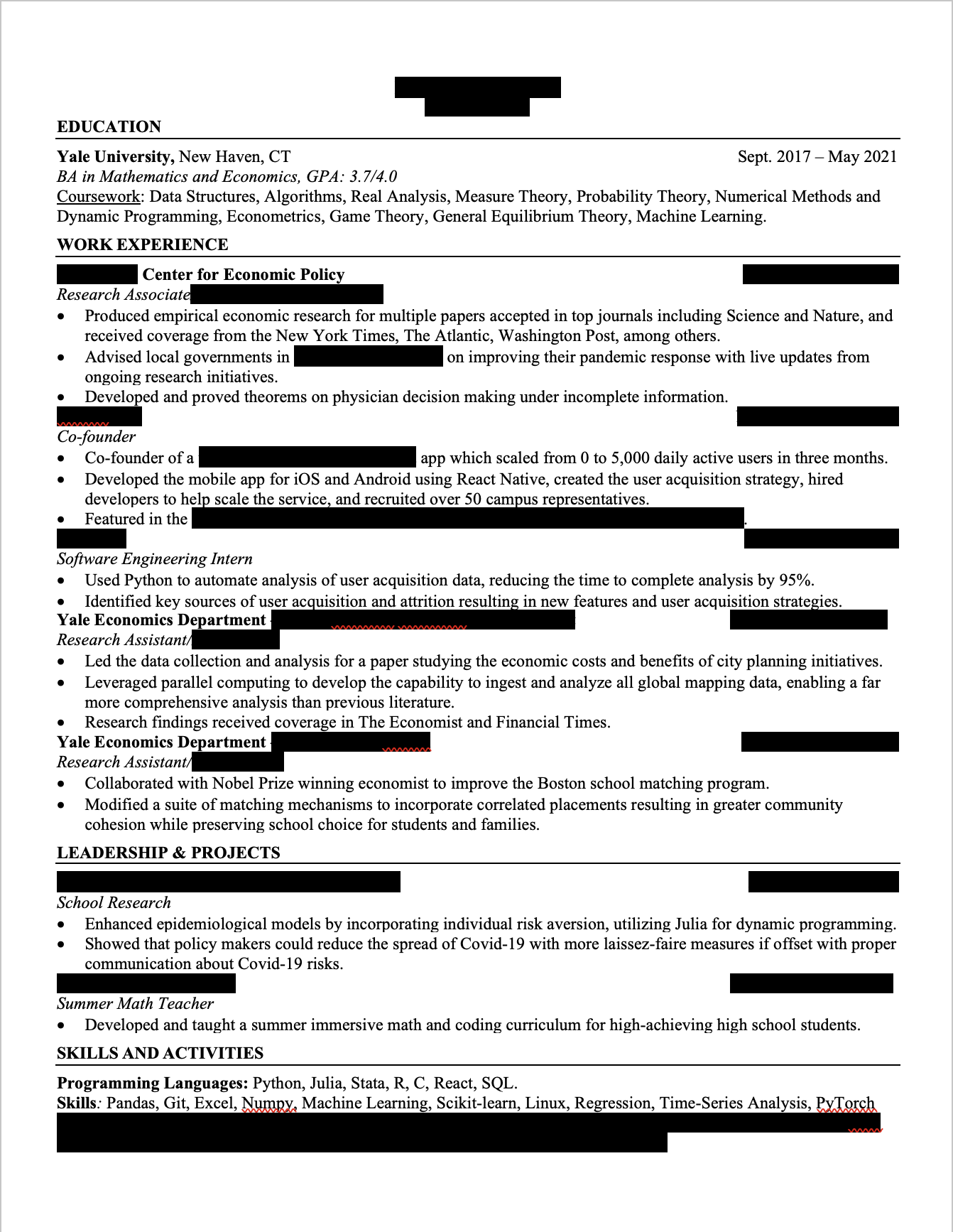






Based on the WSO threads, transitioning into finance with a non-traditional background, especially from a research-oriented role, can indeed be challenging but is certainly feasible. Here are some tailored suggestions to enhance your resume and improve your chances of breaking into finance, particularly in trading:
Highlight Quantitative Skills: Emphasize any quantitative and analytical skills that you've developed through your research. This could include statistical analysis, data interpretation, or any use of financial models. These are highly valuable in trading roles.
Focus on Transferable Skills: Identify skills from your research background that are transferable to finance. This includes problem-solving, attention to detail, and the ability to synthesize complex information quickly. Make these skills prominent on your resume.
Education Section: Since you attended a target school, make sure this is prominently displayed. Include any relevant courses or projects related to finance or economics.
Professional Experience: Clearly outline your research experiences but frame them in a way that highlights their relevance to finance. For example, discuss any exposure to financial markets or economic data analysis you might have had.
Networking: Leverage your alumni network from your target school. Often, connections can provide direct introductions or advice on transitioning into finance. They can also offer specific insights into trading roles.
Tailor Your Resume for Trading: If trading is your target area, tailor your resume to showcase skills relevant to this field. This includes any experience with programming languages (like Python or R), which are often used in algorithmic trading.
Certifications and Additional Learning: Consider obtaining certifications like the CFA or taking courses in financial engineering or computational finance. These can significantly bolster your profile and demonstrate your commitment to entering the finance sector.
Clarity and Precision: Ensure your resume is clear, concise, and free of jargon unrelated to finance. Finance professionals value precision and clarity in communication.
By strategically aligning your non-traditional background with the skills and qualifications sought in finance and trading roles, you can create a compelling case for your transition into this field.
Sources: Q&A: Non-Target School to Portfolio Manager at a Top Hedge Fund – 6 Years Out of Undergrad, Is It Possible? Non traditional background, I'm Trying to get into Prop-Trading From a Non-Target School, M7 Chances for Non-Traditional Background, Ask me anything - Non Traditional Background to MM PE to H/S/W
Your best option is to talk to a bunch of alumni who do a bunch of different things and genuinely ask them about the day to day and the work that they do and see what seems interesting to you. If you really like research there are tons of opportunities for research at the big banks and quant research at the trading firms. If you want to move away from research with math/econ background you can find a job in IB, S&T, PE, HF, etc but you're going to have to put in the work to understand what each team does and how they fit into the whole business. There are tons of great resources for this. People love telling the story that "with a STEM degree, you can get a job anywhere" which is true, but you still need to put in a lot of work to be competitive in the recruiting process, especially for the front-office roles I mentioned after research.
Hello New Haven...
As soon as I opened the thread and saw Yale + Economics, you had my attention.
I think it's a matter of selling the economics part of your resume/CV, but your coding and math background will also add to being an attractive hire. What has been your difficulty/challenge so far? I'm curious of what feedback you may have received.
Are you working now?
What job role are you seeking?
Thanks for your help.
I think I didn't know which roles were the best fit. I was struggling to get bites -- admittedly I hadn't probably done as much applying as I should have. Most of my friends who are making research to finance switches are math PhDs so I had followed them applying for quant research positions. But I think my background wasn't as compelling for quant research even though I could do the math and brain teasers as well as most of my math friends and often my background gave me more experience with the stats based questions.
For someone with industry experience, is there a role I should be targeting? My main problem is I was kind of siloed in research for a little so it's not obvious to me what roles I'd be the most compelling for -- especially from a slightly non-traditional background.
MFin/MFeng —> macro is your best route
Thanks for the encouragement. I wasn't getting interviews but stuck with it a little longer and spoke to some alumni. Had two offers from Goldman within a month.
Will likely be taking a position in the Macro Research team.
I suppose everyone has always said this, but I just needed to do more networking to get my foot in the door and get an interview. Once I got a couple interviews the rest was easy.
Congrats on the offers!
It's honestly surprising how responsive the Yale alum base seems to be. Could you go a bit deeper on your approach to networking and how you might have leveraged your network to get a job? Would love to hear any advice you may have.
Quo aliquam est minus accusantium. Et optio et necessitatibus inventore dolorem et. Sapiente quasi maiores earum ut. Magni eius nihil sit est odio. Qui minima rerum architecto odit. Adipisci ipsum non porro quo nam facilis est ut.
Accusamus iste dolore autem harum cum dolorem est. Autem dolorem perferendis quo doloribus ut quia enim minus. Consequatur doloremque ut quia ipsum. A nisi ut aut voluptatem id.
Voluptate qui ut a corporis eos consequatur in. Ut qui sed labore qui perspiciatis vel quibusdam. Delectus nulla alias enim ut assumenda et molestias.
See All Comments - 100% Free
WSO depends on everyone being able to pitch in when they know something. Unlock with your email and get bonus: 6 financial modeling lessons free ($199 value)
or Unlock with your social account...