Roughly about three hundred years ago, back in 1690, two ambitious goldsmiths went into the banking business. Today, that bank has expanded and is now a highly reputable multinational firm. That bank is known as Barclays.
Barclays is currently headquartered in London, England, which was where it was founded. The firm operates as two entities - Barclays UK and Barclays International. Additionally, each of these entities has three major financial divisions:
- Consumer Banking
- Global Corporate
- Investment Banking
Given the reputation of Barclays, it is a popular choice for those looking to pursue a career in finance. However, landing a high-finance role here can be challenging.
There are typically between three to four interview rounds, which excludes the Super Day. The exact number depends entirely on the type of role you are applying for and what division it is in. For instance, a finance role would have three rounds, whereas a tech role has four stages.
The stages for the finance interview are as follows:
- Online Assessments - which are designed to test your skills and abilities
- Human Resources Interview
- Technical Interview
Having some information about what to expect from the process is always helpful. Like most interviews, the ones at Barclays can be considered difficult. However, with the right amount of preparation, it is possible to successfully make it through the interview process and get hired.
As it relates to the questions, Barclays tends to ask more behavioral than technical ones.
Moreover, their behavioral segment incorporates a lot of brain teasers.
While the firm chooses to focus more on behavioral questions, there still are technical questions, and most often, these require much more practice.
So, give each section an appropriate amount of attention when creating your study plan.
Preparing For The Interview
It’s the night before the interview, and you’re scrolling through a number of forums titled “common questions asked at Barclays” or “technical questions asked at Barclays”.
Ideally, this is a good way to gain insight into the company’s hiring process. But it is never a good idea to study the night before.
Take your time in preparing. There is no doubt that the interview process can feel overwhelming but there are several things you can do to effectively prepare for it. And this does not include studying.
But, just to say, you should dedicate some time to studying for the interview. Learning and understanding the definitions or the formulas are extremely important, especially if you want to ace the technical questions and get the job.
Cramming the material will ultimately lead you to forget most of the information.
Now that we’ve stressed the importance of studying, below are some helpful tips that will assist you in acing the interview process:
1. Research The Company
Having prior knowledge about the company always comes in handy during the interviews. Additionally, researching the company beforehand can help you to decide whether or not you’d like to work for the firm.
Aside from helping you with your decisions, your knowledge will show the interviewer that you are prepared for any questions that may be asked during the interview. Typically, you’d be asked questions like:
- Why would you like to work at this firm?
- How do your values align with the company?
- What is one of our company’s recent achievements, and what are your thoughts on it?
- What do you know about the company?
These are some examples of questions that you are guaranteed to be asked. So, it is suggested that you go the extra mile to learn more about the firm.
Researching the firm will not only impress your interviewer, but you’ll be better prepared for any question on Barclays.
2. Make A Positive Impression
“You never get a second chance at the first impression.”
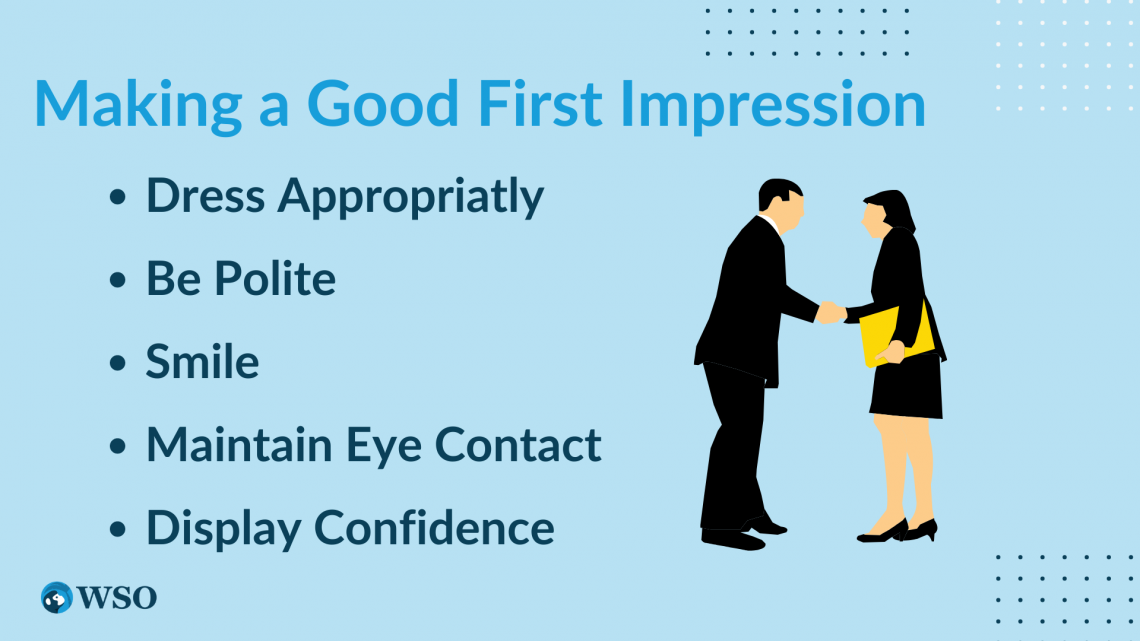
“If you make a good first impression, people are much more likely to remember you over someone who made little to no impression.”
“You only have one first chance to make one first impression that lasts a lifetime.”
We’ve heard all these sayings before, and the reason why we keep hearing them is that they are true. Making a good impression sets you apart from others and, in this case, makes you memorable as a candidate.
There are a few things you can do to ensure that you make a good first impression. Below are some steps you can take:
- Dress appropriately
- Respect your interviewer’s time and be punctual for your meeting
- Be polite
- Smile
- Practice your handshake (if meeting in person)
- Maintain eye contact
- Display confidence
By implementing some of these steps, you are guaranteed to stand out during the interview process.
3. Be Prepared To Share Some Stories
During the behavioral interview stage, you will be asked many questions. Most of these questions may start with “tell me about a time”. Once you hear these words, you should know that you’ll have to share a story with your interviewer.
This doesn’t mean that you have to discuss your spring break escapades or anything of the sort. Instead, share meaningful stories that highlight your strengths.
Of course, there is no way to know in advance what questions you will be asked. If there were a way, it would be easy to decide what stories are worth sharing. Unfortunately, there isn’t such a thing.
Instead, you’ll have to think on the spot about a relevant experience that can answer the question.
If you need time to gather your thoughts and think about an experience, ask your interviewer for a few seconds. Most likely, they will offer you that time.
4. Ask Questions
In the first round of the interview, you'll likely be asked if you have any questions and it is always a good idea to say, “yes, I do have a few questions”.

This will not only show the interviewer that you’re interested in working at Barclays but that you have taken the time to prepare for this interview.
Having a list of questions indicates your enthusiasm for the role. However, if you don’t know what to ask, try thinking of questions that focus on the responsibilities of the role or about the company itself.
Here are some examples of follow-up questions that you can ask:
- Can you tell me about the team I’d be working with?
- What is the working culture like at Barclays?
- What are some challenges that I can expect in this role?
- I know that this is a technical role, but what are some soft skills that will help me?
- What skill does the ideal candidate for this role have?
5. Keep Up To Date With Current Events
During the interview, there is a strong chance that you will be asked questions regarding the economy.
Your interviewer may even ask you hypothetical questions relating to major events. For example, a candidate was asked, “what would be the outcome if Brexit never happened?”
Though this question may not be asked during an interview in the United States, it is common for it to be asked in the United Kingdom because it was a major event that affected the country’s economy.
And so, it is suggested that you follow the news regarding the economy. Chances are you’ll be presented with questions about the topic.






or Want to Sign up with your social account?