
Focus Verticals, Middle Markets, Consalidation


The middle market in strategy is a dead end. Why? Because it tends to be a graveyard of companies with the ability to generate profits but not have great margins, and they tend to die out over time, either through low-end disruption or high-end disruption. Some kind of mix of both, and they get squeezed out. It is important to note they can be decent businesses but often not the most profitable and long-term successful ones. Nike & BMW are good examples; more interesting are the companies they enable.
Nike -
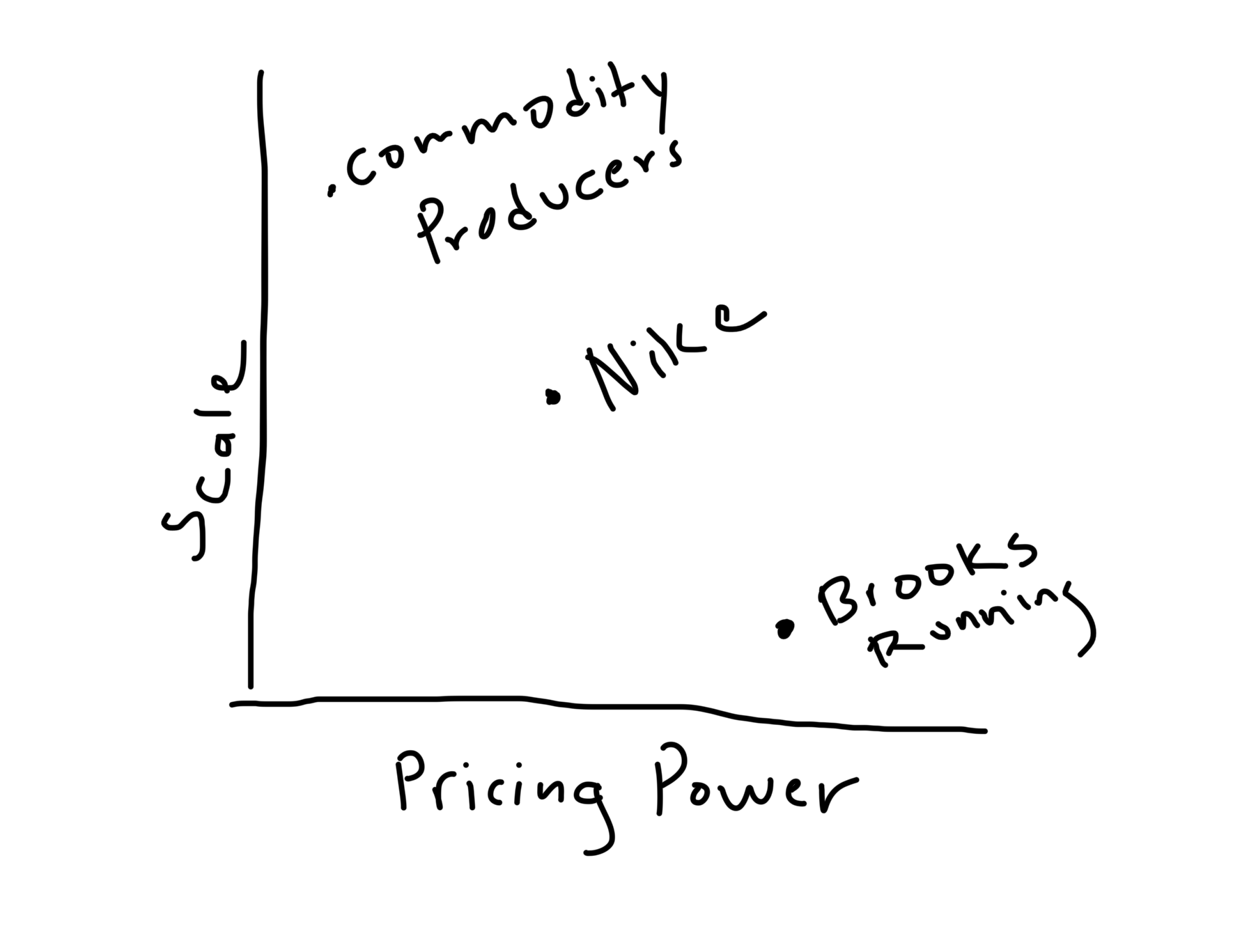
Nike’s core problem is that they have extracted the value and reached a position where they have scale, but still do not price as a commodity; hence, they are not market-specific, such as Brooks. Making them the largest player in a middle market is not the best achievement. They have a cost structure and extensive marketing, which means they cannot lower their price while at the same time having scale; that cannot allow them to focus specifically on one brand, such as running, as Brooks can. So both markets eat at Nike’s competitive position, and over time Nike will just be a shell of itself. From a strategy perspective, they would have to create some kind of switching costs around their shoes, or build an official reselling marketplace for their shoes and capture the take rate. Although it may be too late, they can use the fact that the shoes are their brand to create authenticity approval and force sellers and buyers to use Nike.
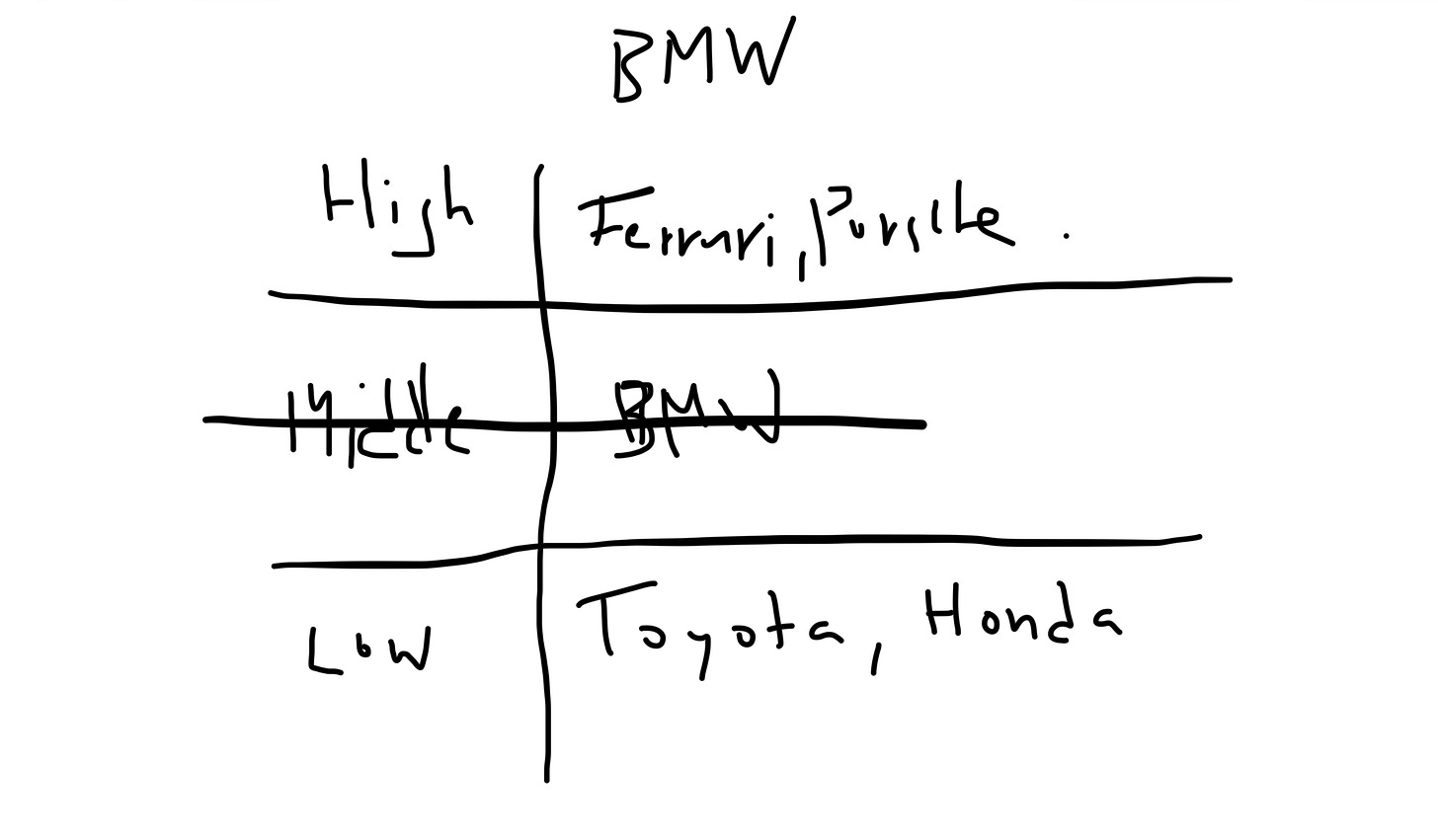
BMW is interesting because I think management knows this; hence the interesting monetization through ads in their car, which people understandably disliked but is a risk they should try at least once. I am not totally sure what they should do, but they should not try to release a high-end or low-end competitor; they do not win that way. Some kind of ancillary service, like car wrapping, could be interesting, trying to monetize through expensive ancillary services.
Firm’s strategies are determined based on cycles; of course, neither BMW nor Nike started out as the dominant firm in a middle market. But as you tend to grow and define an industry, new entrants come in and view you as the incumbent, and their strategy is wholly around being counter-positioned to your firm. Brooks Running is a better business because the cash flows are more durable; they are not reliant on foreign markets and consumer cyclicality; rather, they are “Focused” on X market, which allows them to deliver outsized profits. However, as time goes on, if they are in pursuit of growth, they will have to move downmarket once they saturate their focus vertical.
Focusing on verticals on paper seems like a bad idea, and in the long run, the incumbent tends to eat the share slowly but surely. But there is a short- to mid-term period where focusing on an X market allows for sustainable profits and strong brand affinity. Eventually, the incumbent includes the vertical in their business, and they leverage their scale and greater distribution to take more share in the X vertical. Eventually leading to consolidation of sorts. The reason a focus market succeeds in the short to mid term is that the incumbent cannot focus on every market, and cannot successfully market a product for the X vertical. Hence, it allows for a startup to build a business around that X market and use it as leverage to expand in a land grab. It is this tug-of-war for market share that eventually leads to consolidation, where the incumbent acquires the focus market. Usually, if the company they acquired has a consumer brand, it would be best to leave it operating as itself. Such as, Uber’s acquisition of Postmates.
You see this today in enterprise software, with so many startups using the hype behind AI to create enterprise companies that solve x problem using AI. But fundamentally, you can see why they would not work in the long term because most enterprise software has enough customer captivity that there is not a good reason to leave. B. The AI features can easily be bundled in. If Anthropic’s S-1 comes out and they have great numbers, it does not necessarily mean they have long-term success if, in a couple of years, it becomes clear that, for the cost, the productivity gains are just not enough. It is something difficult to assess; on one hand, growth is unbelievable, but it may be a short-term arbitrage. I generally think models are commodities, and the frontier labs’ pricing power in the long term will be nowhere near enough to be justified as a software business; rather, some kind of public utility. I see a lot of the value from AI strengthening existing moats for current companies rather than creating new ones. Anthropic should leverage the temporary arbitrage of cash flows in acquiring companies that have real, durable businesses under the hood; the current valuation drops in SaaS companies that Anthropic has caused are probably the right place to look, considering most are still growing and have incredible switching costs which last much longer than many think. Fun Fact: IBM had greater revenues than Microsoft all the way up till the early 2010s, far after the market had decided Microsoft was the far better business. Narratives tend to allow for great opportunities in the short term; Stripe pursuing PayPal is such a steal, as they are buying a distressed brand with FCF that is likely on par with Stripe’s revenue as of writing.






Sunt eum delectus iusto dolorum autem repellat. Tempore impedit ratione quo necessitatibus dolores. Corporis labore unde odit hic cum nesciunt aut error. Recusandae est harum saepe dolore provident.
See All Comments - 100% Free
WSO depends on everyone being able to pitch in when they know something. Unlock with your email and get bonus: 6 financial modeling lessons free ($199 value)
or Unlock with your social account...