
Feedback on my unorthodox method to try and get into quant (19 years old)


Hi all,
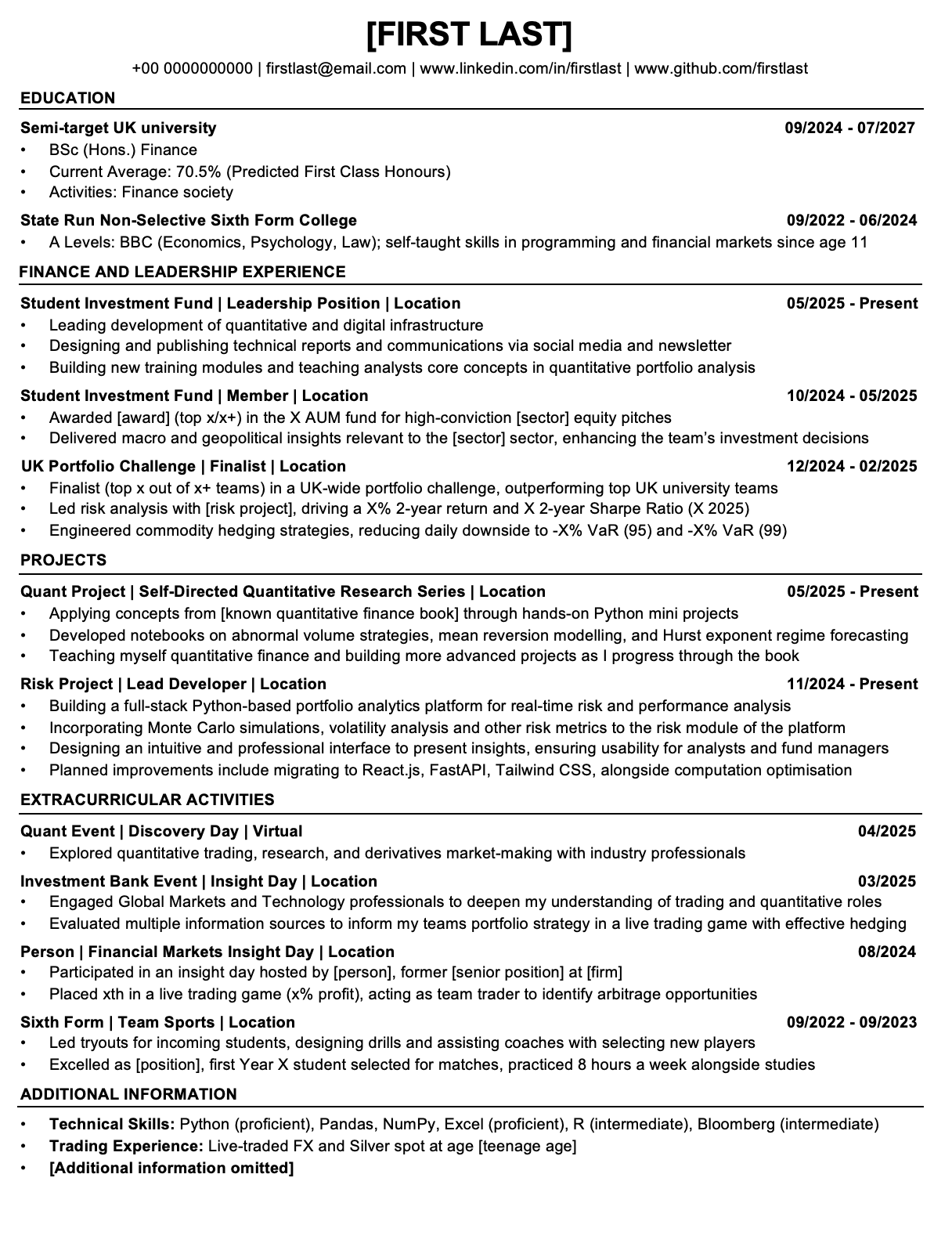
I’m a 19-year-old first-year student at a semi-target UK university, studying finance and aiming for a career in quantitative finance. I’ve taken an unorthodox, self-taught path (e.g., Python projects, quant research, self taught mathematics) and my peers are mostly pursuing traditional finance roles (IB/PE/consulting), so I'm not sure how to judge if I am doing good enough at my age. I am very well aware of my not-so-stellar A-level performance, but I am willing and planning on doing a Master's degree in Europe in the domain of quant finance to clean my academic record.
I’d love feedback from quant professionals or peers on my CV to gauge if I’m on the right track for a quant role. Specifically:
- Are my technical skills (Python, R, etc.) and projects relevant for quant finance?
- Is my experience (student fund, competitions) competitive for my age/stage?
- Any gaps or areas to focus on to break into quant?
I’ve anonymised my CV to protect my privacy, so some details are generalised. Please let me know if anything needs clarification. Thanks in advance for your insights!






"are my technical skills like python relevant for quant" I respect the energy but don't get too hyper about this stuff. Finance and trading experience aren't relevant and talking to intern / new grab applicants who have a ton of "backtested trading strategies" can be very frustrating as they often try to prove that they know more than they do about an area that they don't (which is fine to not know, they're students with no experience that's the expectation and we want to bring on fresh grads with potential and teach them the specifics).
Recruiting boils down to just a few things, depending on the specific job:
Debitis omnis sed sunt officia eos et rerum. Illum harum omnis quo omnis. Adipisci rerum quasi eaque inventore quod officiis earum. Sit ullam aut maxime labore ea. Pariatur placeat voluptatem nihil praesentium aliquam voluptatem iure.
See All Comments - 100% Free
WSO depends on everyone being able to pitch in when they know something. Unlock with your email and get bonus: 6 financial modeling lessons free ($199 value)
or Unlock with your social account...