


This is not even close! The gap between GS (1st) and MS (2nd) is over $200bn! The gap to JP (3rd) is the same as Evercore's entire output and is larger than the gap between JP and BofA (5th), and we all consider JP to be more of a competitor to GS than BofA is to JP. Any thoughts as to why such dominance has been so sustainable for so long? And how can the other top banks possibly catch up?
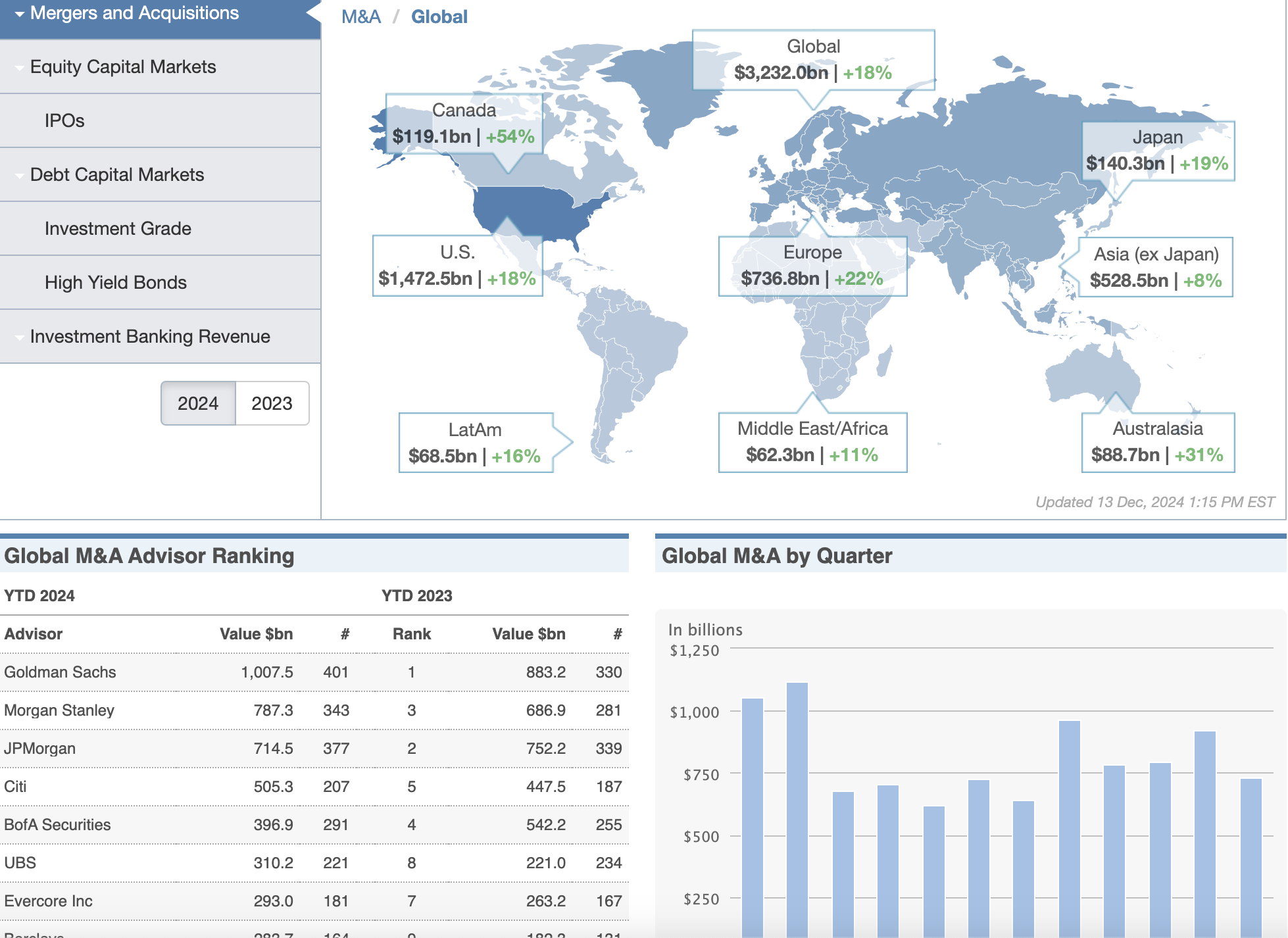






Goldman Sachs' dominance in M&A has been sustained due to several key factors:
Reputation and Legacy: Goldman Sachs has a long-standing history of being a leader in the financial industry. As highlighted in previous WSO threads, its reputation as a "prestige" firm attracts top-tier talent and clients. This legacy, dating back to its founding in the late 1860s, has cemented its position as a go-to advisor for major deals.
Talent and Culture: The firm has consistently been able to recruit and retain some of the best talent in the industry. As noted in WSO discussions, the "mystique" of Goldman Sachs and its alumni network play a significant role in maintaining its edge.
Global Reach and Resources: Goldman Sachs has a massive global footprint and resources to handle the largest and most complex transactions. This scale allows it to dominate league tables and maintain its leadership position.
Adaptability: As mentioned in WSO's top-rated threads, Goldman has a proven track record of adapting to market challenges and evolving its business model. For example, its expansion into retail banking with Marcus and its focus on diversifying revenue streams have helped it stay competitive.
Client Relationships: Goldman Sachs has built deep and enduring relationships with its clients, which often leads to repeat business and referrals for high-profile deals.
As for how other banks can catch up:
Specialization: Firms like Evercore and PJT Partners have carved out niches in advisory services, focusing on specific sectors or types of transactions. This approach can help them compete on quality rather than scale.
Innovation: Banks need to innovate in terms of deal structuring, technology, and client service to differentiate themselves.
Talent Acquisition: Competing banks must focus on attracting and retaining top talent, which is critical for building strong client relationships and executing complex deals.
Strategic Acquisitions: As seen with Morgan Stanley's acquisition of Smith Barney and ETrade, strategic acquisitions can help banks expand their capabilities and client base.
While the gap between Goldman Sachs and its competitors remains significant, the industry is dynamic, and shifts in market conditions, client preferences, or regulatory changes could create opportunities for other banks to close the gap.
Sources: Goldman Top Dog?, https://www.wallstreetoasis.com/forum/investment-banking/2017-investment-banking-report-8-key-trends-to-know?customgpt=1, GS vs MS Hunger Games - Who Takes It?, https://www.wallstreetoasis.com/forum/investment-banking/qa-australian-ib-life-etc?customgpt=1, 2018 Investment Banking Report: 8 Trends in the Industry
The thesis is that JPM has a far larger balance sheet, and when near 0 rates return with PE being larger than ever, that will lead to JPM pulling ahead. GS also has suffered extreme rainmaker loss to EBs, mainly Q and Evercore, in the tech sector. Without Tech, GS would be tied/slightly behind JPM. Basically, GS biggest edge is weakening at the same time industry trends support JPM. Also, JPM has invested far more in up and coming Tech hubs, so they should greatly improve their weakest coverage group.
But that thesis has been around for awhile and is flawed imo. Balance sheet strength only helps in areas where capital infusion is critical such as healthcare (due to size of businesses), and in that space JP has been leading for a while, though GS is not that far behind (JP leads GS by only $4.5bn in YTD volume). As it relates to tech, GS is still ahead despite some inroads by Q and EVR; however, these competitors only manage momentary spurts and have been unable to sustain any punch that can dethrone GS (GS is leading both of these firms by over $120bn in YTD deal volume in tech alone and leads JP by almost $50bn). In FIG alone, where JP was projected years ago to eventually be stronger due to its balance sheet, GS leads by an astonishing ~$220bn. So I will take all those projections with a huge grain of salt as it's been quite a few years now and maybe just better to assume key competencies, expertise and culture is hard to buy. In an industry that is probably the most competitive of all, how one firm has managed to stay on top for so long, I do not know.
The largest batch of GS senior departures was recently, and it takes time for those losses to begin showing. Deals are won far earlier than they are shown on the league tables. This industry is slow moving in changes. GS used to have easily the best PE placement that gap has all but disappeared between the top 3. Better junior talent leads to better seniors later on. The fall is slow. it's sub vertical by subvertical. But it's happening.
I'm not a fan of JPM, but balance sheet strength helps significantly in all coverage areas, not just HC -- the idea it only helps in HC is naive
What are the odds this guy is jealous and wanted to make this post to incite negative coverage on GS? Smells exactly like it lmao
lmao. If anything I'd want to be part of dominant platform, which imo must be celebrated.
I have just realized this is a rage bait and or ad from GS well played.
Try and make your point and not denigrate lmao
There is simply no way this is your first wso post and this is how you act.
Deal fees > deal volume
Vero rem reprehenderit quos neque ut molestiae dolores. Voluptate aspernatur quod accusantium et repudiandae dolorum eum ab.
Voluptate dolor sit tempore cumque voluptatum et. Qui voluptatem esse quia velit maxime. Quam non dolorum laborum. Sit eveniet consequatur similique ipsa eligendi dolores. Quia ducimus qui voluptatem et aspernatur vel reiciendis. Odio quos quia ducimus dicta dolore maxime.
Eius optio sed minus a culpa iure enim. Distinctio quis cupiditate modi. Ut corporis enim et vel omnis. Nobis et esse dolorem nobis corporis ab.
See All Comments - 100% Free
WSO depends on everyone being able to pitch in when they know something. Unlock with your email and get bonus: 6 financial modeling lessons free ($199 value)
or Unlock with your social account...