
Why is there no inflation??


Can some please enlighten me on why there is no inflation while the US prints money like no tomorrow?
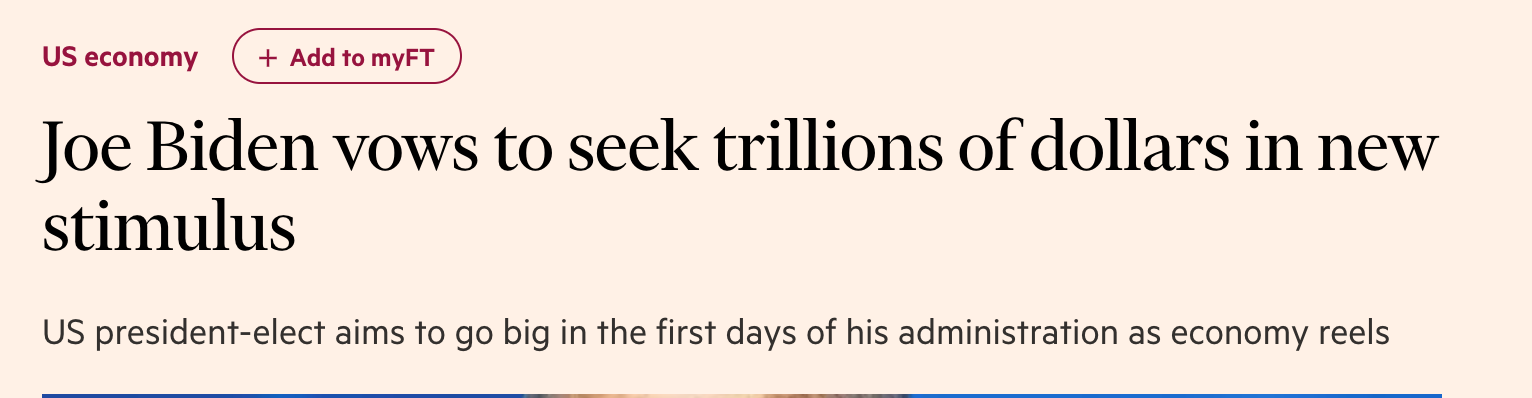
Just now I read on FT again that biden is aiming for a new "trillion dollar" stimulus.. how can there be no inflation I really dont get it lol






Printing money is monetary policy which is different from the fiscal policy mentioned in the article. In the case of monetary policy, banks just keep most of the QE money on their own balance sheets for liquidity purposes. Thus, the money doesn't reach the real economy to cause any inflation. It is the equivalent (not totally but kind of) of printing money and then throwing it into a pit. Mathematically, the velocity of money V in the equation MV = PY behaves inversely to M so P is unaffected.
Fiscal policy is another matter. But the short answer is that as long as the money comes from willing lenders, money is taken out of the economy at the same rate that it is put into it, so all that has changed is the allocation (which can cause localized inflation in certain markets but wont impact the aggregate variable). Of course, this is a very simplistic rundown and a lot has been omitted. But the IMF, ECB and NBER should have many papers on such issues
There's plenty of inflation: look at the stock market, home prices, new car prices
How good of an indicator are home prices for inflation? Are you referring more to the construction/build costs? I'm only thinking this because the value of homes are only changing in response to consumers not wanting to pay expensive rents in major metros. Price growth seems uneven across different markets, and prices before this were continually outpacing inflation.
Remember how cereal used to cost the same as what it costs now but boxes contained more product by weight?
+1. We’ve seen much more inflation in asset prices over the past decade rather than the traditional precendent of income inflation.
100%. CPI is no longer an accurate gauge of inflation
Probably because of where the money is actually going.
Since Covid, there's been a lot of money going into the stock market from retail investors at an unprecedented rate.
By contrast, there aren't enough money going around in markets for everyday products and services.
My guess is that this is due to the inherent failure of the Congress to design fiscal stimulus packages in a way that actually increases overall spending in industries that were hurt the most. Instead, all that money is going into savings accounts, Robinhood accounts, housing, etc...
According to CPI, there is very little inflation - however, this endless cycle of borrowing has to have some consequences. In my opinion, it doesn't come through in CPI because of deflationary advances in tech that have increased business efficiency. However, you hear from the left all the time how millennials can't afford to buy homes, how students come out of college saddled with debt because of the sky high costs, and yet they still want to continue the cycle of borrowing to spend. Forgiving student loan debt, cancelling rent, etc etc, will only lead to higher home prices (thus higher rents) and higher costs of education in the future.
I heard an interesting reasoning for our lack of inflation despite the influx of dollars recently, which seems to make sense. I don't fully understand it so if someone is more familiar with this, please chime in and elaborate/correct. The basis is that the US dollar is the dominant currency in the world, something established when we went off the gold standard. Oil is traded in US dollars and most currencies are tied to the dollar as well. This creates a global demand for US dollars that other countries don't have in addition to our debt being in our own currency. When we print money the effect is magnitudes smaller than a country without these advantages. This idea is one of the arguments for having a large military and having good worldwide relationships (foreign aid spending). Our military gives us a dominance to remain the anchor currency for oil and the worldwide presence keeps us relevant in all trading. So if trade wars are handled improperly, countries will make bilateral trade agreements which ultimately hurts US currency dominance and if continued and we lose our currency dominance, inflation (and our national debt) will become much more of a problem.
This is correct
The book Ray Dalio is currently writing and releasing a chapter of every so often is roughly based on this argument.
Because the CPI is a broken system, and there is plenty of inflation in areas where the consumers actually spend money: housing, groceries, workout equipment, etc. Of course airline tickets and hotels aren't going to cost more
I am not an economist but my guess would be that the lack of inflation may be related to a lack of upward wage pressure.
Core PCE as well as CPI don’t include housing, education, and healthcare which are in fact quite inflationary in the US...The Fed is slow to change, hence the reason why we keep hearing 2.5% inflation benches. Another generality is that we’re a developed nation. Personal incomes have plateaued at this point and automation has created an environment where personal spending will never equate to inflation. At some point fiscal spending WILL equate to inflation via treasuries, when that is nobody knows
Well over 50% of US dollars are outside of the US, just as a starting point.
Money printing is inflation
There's obviously financial asset inflation, so I'm assuming you're mostly asking about CPI (real goods and services) inflation. Here's a good article if you have a couple hours: https://www.lynalden.com/quantitative-easing-mmt-inflation/
A bastardized TLDR is that QE creates the potential for inflation, but not inflation itself. Fed purchases assets and pays for them using reserve deposits, which don't enter the "real" economy until they are loaned out (Fed lends but can't spend, etc.). In past QE cycles (pre 2020), the banks didn't really increase lending and just strengthened their BS, so most of the money printed didn't get loaned out. This ignores the impact of fiscal spending, but you can read more about it in the link above.
It’s because global demand is weak. The concept of rational agents in an economy is not true because policy impacts agents heterogeneously. Drivers of this are: low labor force growth rates in the developed world (limited immigration, falling birth rates), the lack of major public spending programs in the developed world due to squabbling (I’m talking multiples of annual gdp), a less falling United States (lack of investment in education, basic science research, etc. — look at how small these are as a proportion of gdp since the 1950s), and a wobbly playing field (little multilateralism).
Most human problems are political. The current mood of the right is anti-government, which means they are less interested in good governance and more interested in dismantling government. This is dangerous at this point, given how under invested the US is. Unfortunately, for the rest of the world, it means that the only large country with conviction to act is China, which has been driving the cycle in commodity prices and demand. Chinese demand (mix of public and private) was exporting inflation to Australia (boom in minerals) and disinflation to the US (fall in the price of components).
One of my favorite authors, William Gibson, once said that "The future is already here - it's just not very evenly distributed."
This quote also applies to inflation, it's actually already here but just "not very evenly distributed." One need look no further than the price of education, healthcare, and housing over the past two decades.
Repellendus pariatur quia ipsum libero repellat rerum. Sit aut qui optio qui magnam. Laudantium asperiores at possimus sint qui et vel. Debitis illo aliquam sed consectetur id.
Deserunt molestiae aut voluptate cumque dolore distinctio. Consequatur consequatur vero sed error. Fugiat eligendi aut quae magnam.
Harum sint illo quo dolore. Labore necessitatibus nesciunt accusantium dicta. Voluptas illo ratione est.
See All Comments - 100% Free
WSO depends on everyone being able to pitch in when they know something. Unlock with your email and get bonus: 6 financial modeling lessons free ($199 value)
or Unlock with your social account...