


Hoping someone here has run into a similar issue and found a workaround—support hasn’t been too helpful so far.
I’m modeling a construction project that's broken into three phases. Each phase will have its own construction loan, but the lender requires that we contribute 35% equity across the entire project before they release any loan funds. They treat the project as a single collateral pool, even though financing will occur phase by phase.
I’ve been able to model the 35/65 equity-to-debt split at the phase level, but the equity ends up being staggered year over year as each phase kicks off. What I really need is a way to model 35% equity going in up front across the full project, followed by construction loans being drawn per phase.
Argus Developer seems to be a bit rigid here—it only allows an expense to belong to one cost group, which makes this tricky. Has anyone figured out a clean way to handle this kind of structure?
Attached a mock example of the project to give a rough idea. The red box being the upfront 35% equity and the green highlights representing the 35% equity on a phase level.
Appreciate any thoughts or ideas! 
UPDATE 5/15/25
Was able to figure out how to implement the 35% equity threshold as intended. Hopefully this helps someone someday.
Used a single expense pool for construction costs with three separate construction loans and three mortgage rollovers. The key was using the 'Contribution Cap' for each loan. I took the total construction costs per phase and prorated them 35%/65% (Equity/Loan). I used that 65% number as the contribution cap for each loan.
Something I quickly noticed is the financing will only cascade to one subsequent level. When only one 'Contribution Cap' is entered then both Phase 1 & Phase 2 loans are fulfilled, however, Phase 3 is skipped with the remaining costs flowing into equity 'Contribution Shortfall%' (order#5).
Since Argus applies the shortfall at the total costs level (rather than by cost group), only one funding source can absorb the full 100%. For a similar reason I couldn't assign the same 'Order #' to multiple loans — otherwise, I wouldn't be able to set 100% 'Contribution % of Cost' to each loan.
One Contribution Cap - Phase 1 & Phase 2 loans are fulfilled - Phase 3 is skipped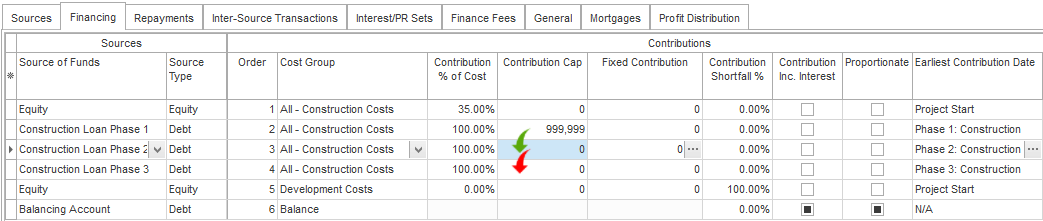
If no contribution cap is entered, then only the first loan is triggered. Since there is a mortgage that subsequently triggers, the construction loan ceases contribution, and the remaining expenses are absorbed in equity shortfall.
At a minimum I needed to include two caps to fulfill all three loans. I left the final loan without a cap to ensure it absorbed the remaining construction expenses.
Two Contribution Caps - All Loans are fulfilled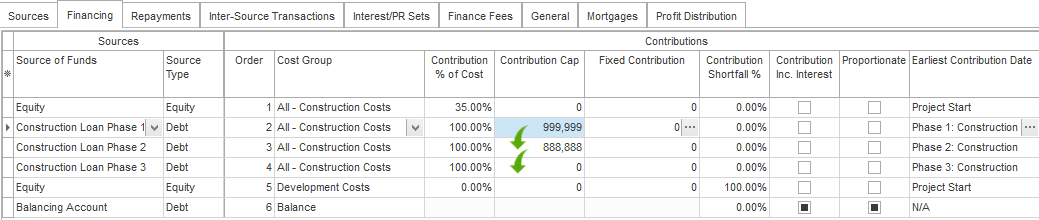
Let me know if you guys think of any other solutions.






Based on the most helpful WSO content, your challenge with Argus Developer's rigidity in modeling the upfront 35% equity contribution across the entire project, while also managing phase-by-phase construction loans, is a common issue. Here are some potential workarounds:
Manual Adjustments in Excel: Since Argus Developer struggles with this level of flexibility, many professionals export the data to Excel for more granular modeling. You can calculate the upfront 35% equity contribution for the entire project in Excel and then allocate it across the phases manually. This allows you to maintain the lender's requirement while still reflecting the phase-by-phase loan draws.
Use a Single Cost Group for Equity: If Argus Developer only allows an expense to belong to one cost group, you could create a single cost group for the upfront equity contribution. This would represent the 35% equity across the entire project. Then, for the phase-level equity contributions, you could adjust the remaining equity and debt split within each phase to ensure the total equity aligns with the lender's requirements.
Custom Phasing Logic: Some users have found success by creating custom phasing logic within Argus Developer. This involves treating the entire project as a single phase for the purpose of equity contributions and then breaking it down into sub-phases for the construction loans. While this approach may require some creative structuring, it can help align the model with the lender's expectations.
Interest Reserve Adjustments: If the lender's requirement is primarily about ensuring sufficient equity upfront, you might consider modeling an interest reserve or contingency fund that reflects the upfront equity contribution. This can be allocated across the phases as needed, ensuring compliance with the 35% equity threshold.
Consult Argus Support or Community Forums: While you mentioned that support hasn't been too helpful, it may be worth revisiting their resources or reaching out to the Argus Developer user community. Other users may have encountered similar challenges and could offer additional insights or templates.
If none of these solutions fully address your needs, exporting to Excel and building a custom model might be the most effective way to achieve the desired level of flexibility and accuracy.
Sources: Development Model - Construction Loan + Mezz, Real Estate Development Modeling, Great Deals You've Recently Done, Open Source Argus, Open Source Argus
Good Monke
Was able to figure out how to implement the 35% equity threshold as intended. Hopefully this helps someone someday.
Used a single expense pool for construction costs with three separate construction loans and three mortgage rollovers. The key was using the 'Contribution Cap' for each loan. I took the total construction costs per phase and prorated them 35%/65% (Equity/Loan). I used that 65% number as the contribution cap for each loan.
Something I quickly noticed is the financing will only cascade to one subsequent level. When only one 'Contribution Cap' is entered then both Phase 1 & Phase 2 loans are fulfilled, however, Phase 3 is skipped with the remaining costs flowing into equity 'Contribution Shortfall%' (order#5).
Since Argus applies the shortfall at the total costs level (rather than by cost group), only one funding source can absorb the full 100%. For a similar reason I couldn't assign the same 'Order #' to multiple loans — otherwise, I wouldn't be able to set 100% 'Contribution % of Cost' to each loan.
One Contribution Cap - Phase 1 & Phase 2 loans are fulfilled - Phase 3 is skipped
If no contribution cap is entered, then only the first loan is triggered. Since there is a mortgage that subsequently triggers, the construction loan ceases contribution, and the remaining expenses are absorbed in equity shortfall.
At a minimum I needed to include two caps to fulfill all three loans. I left the final loan without a cap to ensure it absorbed the remaining construction expenses.
Two Contribution Caps - All Loans are fulfilled

Hope this helps at-least someone out there one day.
Dicta et voluptas dolor voluptas. Id voluptas dolores qui reiciendis alias libero consequatur. Quod est soluta similique exercitationem et nostrum. Provident eum dolores ab vitae facere est dolorem molestias. Sed at non est aut officiis quas non qui. Itaque vitae harum et molestiae et. Cumque vero velit quaerat nostrum adipisci.
Adipisci possimus explicabo maiores cum voluptatem aperiam. Vero dolore eum est deleniti molestiae veritatis consectetur. Sapiente ea aspernatur quisquam est quisquam et accusantium. Beatae rem culpa autem fugiat. Est quaerat eius ratione provident error.
Totam rem ipsam beatae architecto omnis voluptatem. Est dolor voluptatem sit quos ducimus quisquam. Placeat qui est consectetur dicta quis.
Saepe reprehenderit nemo dicta tempora. Quisquam occaecati eos commodi eum minus. Magni corrupti quos distinctio perspiciatis commodi. Culpa asperiores laborum hic aut sunt sit earum.
See All Comments - 100% Free
WSO depends on everyone being able to pitch in when they know something. Unlock with your email and get bonus: 6 financial modeling lessons free ($199 value)
or Unlock with your social account...