
Cascade Investment: The Pivot from Growth Beta to Real Asset Alpha


The capital allocation strategy at Cascade Investment (Bill Gates' Family Office) has increasingly diverged from the broader tech-heavy benchmarks. While the street is chasing AI multiples expansion, Cascade’s recent filing activity suggests a distinct shift toward capital preservation and inflation-hedged yield.
For those tracking Family Office flows, the narrative here is not about "stock picking." It is about structural portfolio immunization. Gates is effectively using the dividends from a legacy tech monopoly (Microsoft) to fund the acquisition of industrial oligopolies. It’s a classic textbook play on wealth transfer from the digital economy to the physical economy.
1. The "Industrial Oligopoly" Thesis
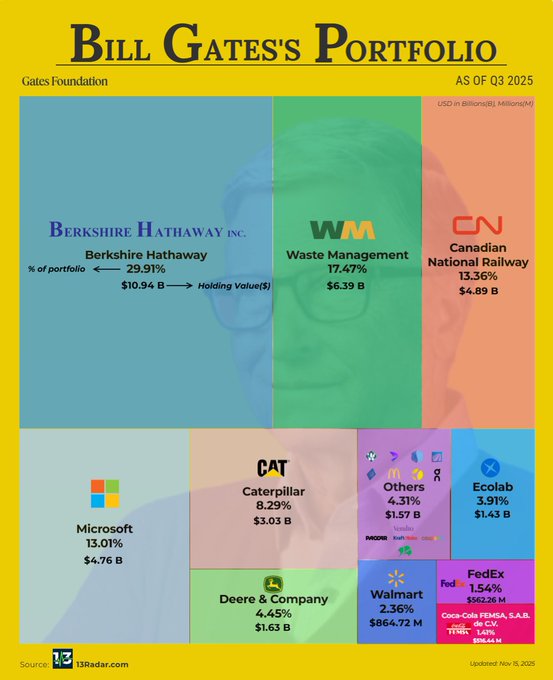
The portfolio is heavily weighted towards sectors characterized by high regulatory barriers and massive CAPEX requirements—moats that are virtually unbreachable by startups. The substantial positions in Republic Services (RSG) and Waste Management (WM) are not merely defensive; they represent a play on pricing power in a consolidated market.
In a high-rate environment, the Discounted Cash Flow (DCF) models for these firms remain robust due to their ability to pass through costs. Unlike SaaS companies facing churn, waste management contracts are sticky. This is infrastructure arbitrage: trading high-growth volatility for steady, compounding ROIC (Return on Invested Capital).
2. Investment Memo: The Logic Behind the Allocation
Analyzing the portfolio construction reveals a clear preference for assets with specific characteristics that serve as a hedge against macro headwinds. The allocation strategy can be broken down into three core "Factors" rather than just stock picks:
- Factor A: Zero Correlation to Tech Beta.
The stake in Canadian National Railway (CNI) provides cash flows that are uncorrelated to NASDAQ volatility. It acts as a ballast. - Factor B: Hard Asset Backing.
Deere & Co (DE) represents exposure to global arable land constraints. It is a derivative bet on soft commodity inflation without the operational risk of owning the farms directly. - Factor C: High Switching Costs.
Ecolab (ECL) dominates industrial hygiene. Once integrated into a client's supply chain, the churn rate is negligible.
3. 13F Analysis and Institutional Flows
The recent adjustments in the portfolio should be viewed through the lens of risk management rather than directional betting. The reduction in certain equity positions aligns with a broader trend among mega-cap Family Offices to de-risk ahead of potential credit cycle shifts.
For analysts modeling out the defensive rotation or looking for comparable valuation metrics in the "Hard Tech" space, the historical filing data provides a useful baseline. You can review the granular sector weightings in the bill gates cascade investment portfolio holdings 2025. The data highlights a disciplined adherence to value investing principles, prioritizing free cash flow yield over speculative growth metrics.
Ultimately, Cascade is operating with an infinite time horizon. The current positioning indicates a view that for the next decade, tangible value accretion will outperform multiple expansion.






Deleniti et numquam omnis quis provident aperiam voluptatem. Corrupti in voluptate amet. Mollitia officia dolor laudantium laudantium.
Soluta vero ut recusandae quibusdam repudiandae consequuntur ratione. Harum eum voluptas possimus et harum facilis. Dolor vero ex ut qui soluta. Ex eligendi nesciunt consequuntur et cumque consequatur. Sequi eos et molestias veritatis amet.
Accusamus voluptatum voluptas mollitia aperiam. Consequatur iusto molestiae recusandae libero quia. Eius omnis quos ullam minus. Qui beatae ut nihil et.
See All Comments - 100% Free
WSO depends on everyone being able to pitch in when they know something. Unlock with your email and get bonus: 6 financial modeling lessons free ($199 value)
or Unlock with your social account...