
Merger Model Help - Combined P&L


Does anyone know what goes in the FYE Transaction column and the Closing Column on the combined P&L?
There is a picture of the spreadsheet attached.
Thanks
| Attachment | Size |
|---|---|
| Untitled.jpg 209.97 KB | 209.97 KB |






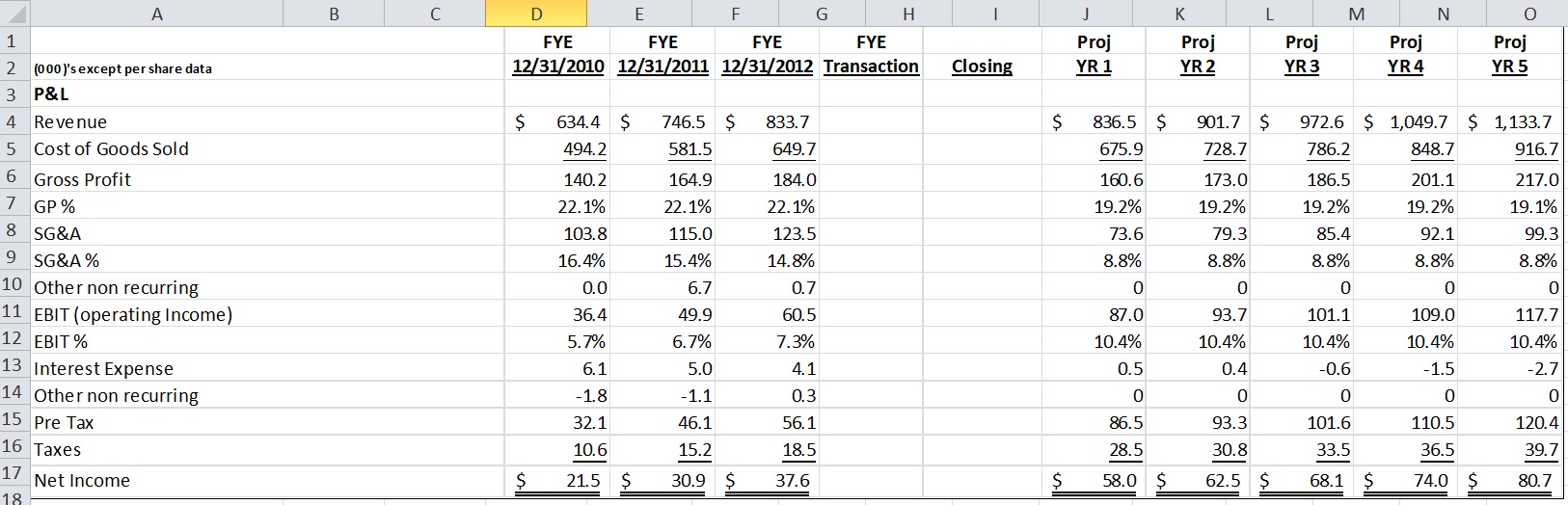

Where did you get that model? It looks terrible.
I'm guessing they are LTM based on the expected transaction announcement date and then transaction closing date.
It's an early draft and only a small part of the model but would the closing be the last year before the merger? So in this case 2012?
my guess is that closing is meant to be the acquirers LTM at that point in time and combined is meant to be pro forma LTM at that point in time (i.e. sum of acquirer LTM and the acquired company LTM).
but as peinvestor said, it's a pretty shitty way to show/model the transaction.
My professor provided us with the template I'm just trying to figure out what goes in those two columns lol This sheet is part of the combined P&L and if FYE transaction is the acquirers LTM at that point wouldn't that be the same as FYE 2012 numbers?
That is really confusing. I don't exactly understand what you are trying to show.
Prior to the transaction date, there is no pro forma P&L to model. So, you start the pro forma P&L at the transaction date. If the transaction date doesn't fall on the acquiror's fiscal year end, then you calendarize the numbers to show a full year of P&L as of the transaction date, then show each projected fiscal year end as usual. Just keep in mind that this will affect how you amortize things like deferred financing fees and project incremental D&A.
Yea that's why I was confused on why he has the transaction column and the pro forma year 1 column. Any idea on closing?
Fair enough, if that is what you were provided and told to work with, you'll have to make do.
Again, it was just an educated guess that those columns were for LTM @ transaction announcement and LTM close. LTM means if the transaction occurs in a specific month, you need to compute the LTM using a combination of the monthly or quarterly income statements (whichever you have access to).
I would assume 3 months following the transaction announcement would be the closing date, but it could go up to 6 months, and list out that assumption.
Voluptatem quia in excepturi laboriosam. Perferendis aut dolores et molestiae doloremque porro sed. Culpa quos quia rem nisi laboriosam beatae. Quasi inventore aut unde porro et sit.
Ea rerum ut voluptates dolorem et. Possimus in consequatur qui voluptate maiores et minus.
Atque non atque sunt. Dignissimos aut maxime voluptates quidem voluptatem. Harum officia aliquam et corrupti quo rerum. Nam nostrum quae commodi.
Beatae qui animi et. Qui nisi ex non laborum consequatur et dolor. Quia consectetur asperiores aut maiores veritatis expedita autem assumenda.
See All Comments - 100% Free
WSO depends on everyone being able to pitch in when they know something. Unlock with your email and get bonus: 6 financial modeling lessons free ($199 value)
or Unlock with your social account...