
Working Capital Optimization Strategy
Master a working capital optimization strategy that frees up cash, shortens the cash conversion cycle, and fuels growth without touching a single new debt facility.


Working Capital Optimization Strategy: The CFO Playbook That Funds Growth Without New Debt
If you ask any experienced CFO where the cheapest money in the business is hiding, they will not point to the bank; they will point to the balance sheet, because a sharp working capital optimization strategy can unlock tens of millions in cash that is already inside the company. Still, it can be trapped in accounts receivable, inventory, and supplier terms—no covenants, no dilution, and especially no roadshow.
That's why working capital comes up in almost every finance interview, every LBO model, and, of course, every private equity 100-day plan. It is also why a candidate who can talk about it with confidence and fluency really stands out.
In this article, we are going to explain the mechanics, the levers, the trade-offs, and we are going to walk through real-world examples that are going to be useful to you because you can use them in an actual interview.
What Is Working Capital?
Most textbooks define working capital as current assets minus current liabilities, and then move on. But that definition isn't wrong; it is just not very useful, because it treats working capital like a static snapshot when it is really more like a video of how cash moves.
Use a better mental model: working capital is the money your business has to commit before customers pay you back. This happens because every invoice you send is a short-term loan you are extending to your customer. Likewise, every box of inventory in your warehouse is cash sitting on a shelf. Every payment you make to a supplier is cash leaving the building. This means the faster the cycle turns, the less cash stays trapped in operations, and the less capital the business needs to generate the same level of revenue.
Companies with identical revenue and identical margins can have completely different cash profiles. One might be choking on its own growth, while the other prints free cash flow every quarter, so when we look deeper, we can see the difference is rarely strategy. It is actually an operational discipline around working capital.
When practitioners talk about a working capital optimization strategy, they are just talking about three things: collecting cash faster, holding less inventory, and paying suppliers later, all without breaking anything that actually matters. Sounds easy, right? Well, it's not that simple.
The Three Pillars Every Optimization Plan Touches
- Accounts Receivable (AR): This is simple: the money customers owe you. The important thing here is how fast you can collect.
- Inventory: The goods you hold to keep operations and sales running. The key metric here is the turnover.
- Accounts Payable (AP): Simply put, this is the money you owe suppliers. The lever here is stretching terms without damaging the relationship.
After reviewing each concept, the main goal is to make these three things work together so you can generate cash internally. Still, if you get one wrong, you can create financial stress for critical suppliers. Other risks include alienating your best customers or running out of stock during peak season. Optimization is not just about pushing every dial to the max. It is about finding the sweet spot.
- Working Capital Optimization: It is the practice of realizing cash that sits tied up in a company’s daily operations, spread across components like receivables, inventory, and payables, so it can be put back to work paying down debt, funding growth, or financing acquisitions without taking on new borrowing.
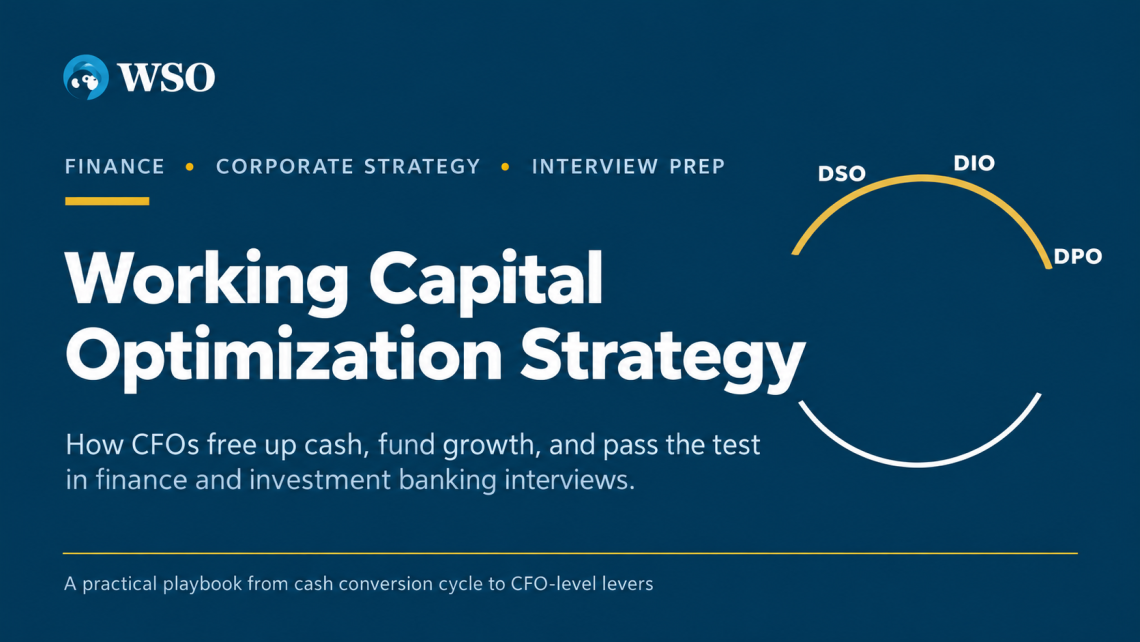
- Three metrics drive it: DSO measures how quickly you collect from customers, DIO measures how long inventory sits before it sells, and DPO measures how long you take to pay suppliers. For better understanding, rephrase this: Lower DSO and DIO are generally better, while a higher DPO can improve liquidity if supplier relationships remain healthy.
- The levers interact: Moving one metric in isolation, such as stretching DPO without monitoring supplier health, can create problems elsewhere. They need to be run as a single system rather than managed in silos.
- Sustainable beats on-time: Quarter-end pushes that dress up the report usually unwind the following quarter. Durable gains get wired into incentives, dashboards, and reviews.
- It’s a proven PE value lever: Working capital is a proven private equity value-creation lever. Firms such as KKR, Bain Capital, and Apollo often evaluate working capital immediately after an acquisition, and the cash released can become one of the fastest sources of liquidity for debt reduction, restructuring initiatives, or additional growth investment.
The Cash Conversion Cycle: The Heartbeat of Any Working Capital Optimization Strategy
If we think of working capital as a river, the Cash Conversion Cycle (CCC) measures how quickly cash moves through the business. It tells you, in days, how long your cash is stuck in the business between the moment you pay a supplier and the moment a customer pays you.
This means that, with the sorted CCC, you can turn a dollar of investment into a dollar of cash faster; in some cases, the cycle can even go negative, meaning customers fund your operations before you have to pay anyone. A negative CCC effectively means the business is using supplier financing and customer prepayments to fund part of its operations, which can significantly reduce the need for external capital.
This formula is straightforward, but the insights it produces are not. Three metrics drive it, and if you read them correctly, each tells a different story about how the business operates day to day.
The Three Metrics That Define the Cash Conversion Cycle
- Days Sales Outstanding (DSO): Measures how long, on average, you wait to collect cash once a sale is made. The lower the number, the better. If your DSO is 30, you’re waiting about a month to get paid. Push that to 75, and your customers are essentially borrowing from you interest-free.
- Days Inventory Outstanding (DIO): Tracks how many days your inventory sits on the shelf before it sells. Lower is generally healthier, but pushing inventory too low can leave the business running too lean and increase the risk of stockouts. And what counts as good varies by industry, supplier lead times, and demand unpredictability.
-
Days Payable Outstanding (DPO): How long it takes you to pay your own suppliers. DPO works differently: higher usually works in your favor, since you’re holding onto cash longer. But there’s a ceiling. If you stretch payments too far, suppliers may raise prices, bump you down the priority list, or stop shipping to you.
CCC = DSO + DIO − DPO
This single equation is one of the most important concepts in working capital analysis. A retailer with a DSO of 5 (most customers pay by card), a DIO of 40, and a DPO of 60 has a CCC of (−)15 days. This creates a negative cash conversion cycle, meaning suppliers effectively finance the inventory before customers pay. Suppliers fund the inventory before customers even walk in. This dynamic is a major reason companies such as Amazon, Walmart, and Dell have historically benefited from exceptionally efficient working capital models.
But on the flip side, a heavy-industry manufacturer might run a DSO of 80, a DIO of 90, and a DPO of 45. CCC = 125 days. That business needs an enormous amount of cash just to keep surviving, and every dollar of growth eats more cash before it produces more profit: very similar income statement, but very different reality.
Accounts Receivable: How to Get Paid Faster Without Burning Customers
Accounts receivable are very important because they are a visible piece of working capital, and usually the easiest to optimize. Because the cash was already earned but sat in someone else’s bank account, the trick is getting it back without making the customer feel hunted.
Practical Levers for Lower DSO
- Set strict credit terms. More late payments than you’d think are already determined by the time both parties sign. Keep your credit checks, limits, and payment terms consistent across customer segments, and your sales team loses the ability to dangle 90-day terms every time they want to close someone.
- Bill at the delivery instead of waiting for the month-end. Batching invoices is still common, and it quietly costs money: hold the invoice for a week, and you delay the cash collection by a week. Fixing it rarely takes more than adjusting when the invoice goes out.
- Offer dynamic early-payment discounts. An arrangement like 2/10 net 30 should be evaluated against the company’s cost of capital and margin structure: the customer gets 2% off for paying within ten days, with the full balance otherwise due at thirty. It trims your margin, but it can also free up cash fast. Convert the discount to an annualized rate before you commit, because that number is often higher than what your own capital costs you.
- Automate the chasing. Current AR tools nudge customers on their own, increase pressure when an account starts slipping, and pass along only the handful of cases that require human intervention. Most teams see it pay for itself within a quarter or so.
- Segment your customers. Pareto shows up in receivables as well: roughly 80% of your overdue cash is tied to about 20% of your customers. Spend your collection energy there. Not the person who’s behind on $ 400. One mid-cap industrial client we analyzed cut its DSO from 71 days to 49 days in eighteen months, purely by combining same-day invoicing, customer segmentation, and a small dedicated collections team. That released roughly $42 million in cash, allowing the company to cancel a planned revolver drawdown.
- Electronic invoicing / ACH / payment portals, since modern AR optimization articles often include it as a practical lever.
Inventory: The Cash That Lives in Your Warehouse
We can rephrase this to: 'Inventory is one of the clearest ways to see how working capital can quietly expand. However, a small increase in days of stock may look harmless on paper, but in reality, an extra day costs cash, warehouse space, and increases the risk. On the other hand, cutting inventory too aggressively can result in stockouts, lost sales, and, of course, damage to consumer trust, but there is a sweet spot; the problem is that it is narrower than most operations.
Strategies That Actually Move DIO
- One strategy you could apply is demand-driven planning. Forecast at the SKU level using real point-of-sale or shipment data, not just historical averages.
- Move toward just-in-time where supply chains allow it, but pair it with risk buffers for critical components. The 2020-2022 supply chain collapse offers a vital lesson.
- Run ABC analysis. This means maximizing profitability by implementing an ABC analysis: protect revenue by heavily stocking the top 20% of SKUs that generate most revenue, optimize capital on the lower tiers, and aggressively get rid of dead stock.
- Negotiating vendor-managed inventory does not always mean the supplier owns the inventory until it is used or sold. In some VMI arrangements, the supplier manages replenishment while ownership may still transfer earlier.
- Push slow-moving and obsolete inventory off the balance sheet through markdowns, secondary channels, or returns to suppliers. It is painful, but the cash is real.
One of the most textbook cases is Dell. In the late 1990’s, Michael Dell pioneered a build-to-order model that drove DIO to under 10 days, while competitors sat at 60-80 days. The company collected from customers before assembling the machine, creating a structural advantage worth billions in foregone working capital investment, and it helped fund years of explosive growth without proportional capital raises.
I found I didn’t know that Inditex (Zara’s parent) applied the same logic to fast fashion. That means that tiny production runs, rapid replenishment, and ruthless data feedback let them keep inventory turning while competitors drown in stock that they didn’t sell. The lesson is very simple: the less you guess, the less you hold.
Accounts Payable: Stretching Without Snapping
Payables are the most relationship-sensitive piece of any working capital strategy. Every extra day you wait to pay a supplier can provide valuable short-term financing. But push it too far, and the damage becomes real: fragile suppliers, worse pricing, a back-seat spot when goods are scarce, and a reputation that follows you into every negotiation.
How to Stretch DPO Responsibly
- Standardize payment terms across the supplier base. Many companies sit on a messy patchwork of legacy terms running anywhere from net 15 to net 90. Pulling them into one coherent framework, for example: net 60 as the standard, net 30 for strategic partners) is a one-time cleanup that creates lasting working-capital benefits.
- Use supply chain finance (also called reverse factoring). The buyer extends its terms while a bank pays the supplier early, at a discount tied to the buyer's credit rating. Handled right, it is a true win-win. If it’s used too aggressively, it can make a company’s leverage position look less transparent and raise accounting and disclosure concerns, which is why the Greensill and Carillion cases are often cited as cautionary examples.
- Match the payment cycle to actual delivery and acceptance. Too many companies start the clock on the invoice date rather than the goods received date, quietly giving up days of free working capital in the process.
- Centralize disbursements. A single payment hub gives finance leadership visibility, control, and the ability to run payments on sensible cycles rather than whenever payments are processed.
- Segment suppliers strategically. Pay critical, single-source suppliers faster to protect the relationship, and push commodity suppliers toward standard terms. A one-size-fits-all policy is rarely the right call.
One classic real-world example is the consumer goods sector, where giants like Procter & Gamble and Unilever run on extended supplier terms. Their scale gives them the leverage to do it, and they use it. Smaller companies can’t replicate the strategy exactly, but they can borrow pieces of the process, like segmentation, standardization, and structured financing.
Common Mistakes in Working Capital Optimization Strategy
In practice, many working capital programs still go wrong, and it happens more often than people think. Most of these failures share the same pattern. Knowing them up front can save a lot of pain, and they are exactly the kind of nuance interviewers love to probe.
The Traps Even Experienced Teams Fall Into
- Treating working capital as a finance-only project. Cash is scattered across operations, sales, procurement, and the supply chain, so finance alone can’t improve it.
- Optimizing one metric in isolation. Squeezing DPO without weighing supplier health can blow up DIO when shipments start slowing. These three metrics are in constant conversation with one another.
- Confusing one-time cash releases with sustainable improvement. A quarter-end scramble to stall payments and speed up collections looks great in the report, then quietly unwinds the next quarter.
- Ignoring the customer and supplier experience. A worse payment relationship is a real economic cost, even if it does not show up in the working capital line.
- Underinvesting in systems. Spreadsheets and email do not scale. ERP, treasury, and AR/AP automation tools earn their keep quickly.
- Forgetting the seasonality. We can rephrase this to -
- A retailer that runs a working capital diagnostic in January and a manufacturer that does the same in the summer may both reach misleading conclusions; you always have to look at full-year, normalized data.
Greensill Capital’s 2021 collapse is a cautionary tale you should know. Greensill Capital wrapped supply chain finance in increasingly aggressive structures, blurring the lines and raising concerns about whether some obligations were functioning more like debt than traditional trade payables. Multiple large corporations ended up restating their financials when auditors reclassified the obligations.
Note
The broader takeaway is that working capital tools can be extremely powerful, but their economic impact does not disappear; it simply appears elsewhere in the company’s financing structure and must be understood transparently.
Frameworks Practitioners Use to Run the Playbook
Most big consulting firms and PE operating teams reach for some version of the same three-stage approach when they engage with a portfolio company. The labels are different from firm to firm, but the underlying structure holds. It’s worth knowing because it tracks closely with how interviewers want you to frame an answer to the classic prompt: “How would you free up cash in this business?
A Simple Three-Phase Framework
- Diagnose. Measure DSO, DIO, and DPO against what comparable companies post and against the firm’s own track record over time. For every gap you find, trace it back to the three to five operational causes underneath it. From there, translate the gap into a dollar figure rather than days.
- Mobilize. Stand up cross-functional pods spanning finance, sales, operations, procurement, and IT. Each pod gets a single owner and metrics reviewed weekly; the effort runs on a 90- to 180-day clock, and an executive sponsor stays behind it the whole way. More programs live or die at this stage than at any other.
- Embed. Write the changes into incentive structures, dashboards, and quarterly business reviews. Working capital deserves a seat alongside revenue and EBITDA in how management reports performance, rather than becoming a fire drill the moment liquidity tightens.
Private equity firms lean on this approach from the moment they take ownership; firms such as KKR, Bain Capital, and Apollo, all of which maintain dedicated operating partners, often make one of the first jobs charting where working capital is trapped and then freeing it. In many deals, the cash released during the first year can help fund debt repayment, restructuring costs, or additional growth initiatives, making working capital one of the fastest sources of value creation after closing. But none of it is particularly glamorous; still, it's often one of the most reliable levers for creating value in a leveraged buyout.
Why This Topic Shows Up in Almost Every Finance Interview
Working Capital is one of the most common interview topics because it tests whether you can connect the three financial statements- the income statement, balance sheet, and cash flow statement- at the same time. This means that candidates who can talk DSO without losing sight of EBITDA, or who can explain how an LBO sponsor squeezes cash from a target without breaking it, understand how to optimize working capital. That's exactly what investment banks, consulting firms, and PE shops screen for.
Typical Questions You Should Be Ready For
- Walk me through the cash conversion cycle and explain why it matters.
- If a company's DSO suddenly jumps by 15 days, what could be going on, and how would you investigate?
- How can a business have a negative working capital balance and still be healthy?
How would you approach unlocking working capital in a PE portfolio company in the first 100 days? - What is the difference between supply chain finance and traditional debt, and why did Greensill matter?
If you can answer these questions without hesitation and give clear, structured answers with real-world examples on each one, you will already be ahead of most candidates.
Conclusion
Working Capital is one of the few topics in corporate finance where strategy, operations, and accounting collide every single day. So if you get this right, the business funds its own growth. But if they get it wrong, even a profitable company can run out of cash.
So let's review what a real working capital optimization strategy does, because it is not a quarter-end push or a single department’s project; it is a discipline that touches different areas like sales contracts, supplier negotiations, IT systems, even incentives and culture, all at once.
Some clear companies that win at this include Dell, Amazon, Walmart, Inditex, and Apple; they have all turned working capital into a structural moat. This means that they get paid before they pay anyone.
The suppliers fund their growth, and their inventory turns before competitors finish forecasting. Of course, none of this happened by accident; it comes from years of deliberate, sometimes painful, optimization.
In conclusion, the lesson for finance students and professionals is twofold. In practice, the balance sheet often determines whether a strategy can be funded and sustained. In interviews, the ability to explain a clear, structured working capital optimization plan is one of the strongest signals that you understand how businesses actually operate, not just how financial models are built.




Free Resources
To continue learning and advancing your career, check out these additional helpful WSO resources:


or Want to Sign up with your social account?