
Why does my property project remain negative NPV even with high leverage and 20-year horizon? (WACC 14–15%) – looking for professional insight

In my financial model, I’ve estimated Free Cash Flows to Firm (FCFF) over 20 years and tested multiple capital structures and exit horizons, but all NPVs remain negative despite improving leverage.

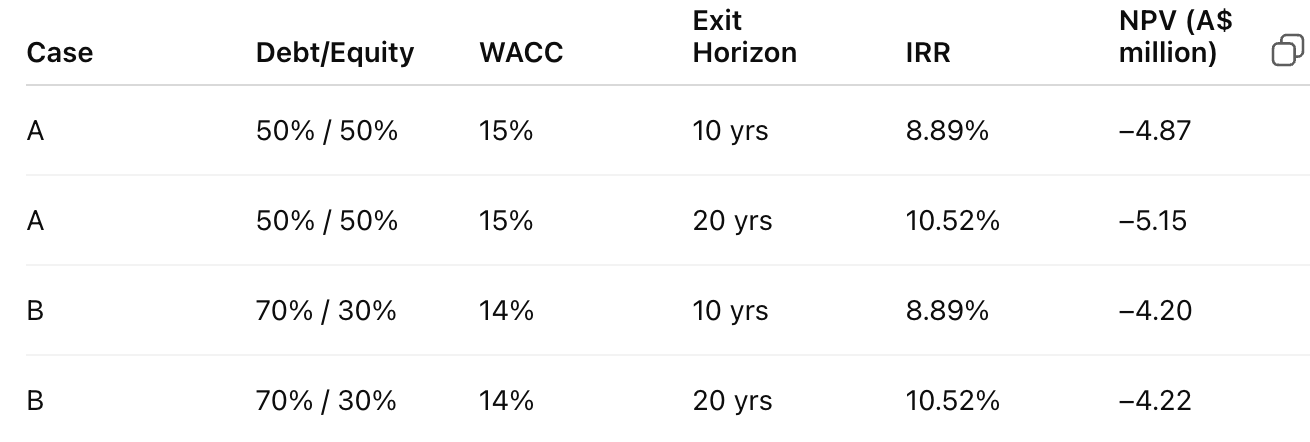
Here’s the summary of my findings:

Case
Assumptions:

Despite adjusting the capital mix and extending the project life, the IRR never exceeds the WACC, and NPV stays negative.

What I’m trying to understand:

  1. Strategic justification:
    In real-world settings, would property developers or infrastructure investors still proceed with a slightly negative NPV if the project delivers other forms of value (e.g., strategic land holding, brand, social impact, or long-term capital gains)?
  2. Modelling practice:
    Should I try to reflect this through real options (e.g., option to sell early, refinance, or redevelop later) instead of treating it as a fixed-term DCF?
  3. Capital structure insight:
    My analysis shows NPV improves slightly as leverage rises (due to a lower WACC), but even at 70–90% debt it doesn’t turn positive. In professional practice, how do analysts balance the tax-shield benefit with the rising financial distress risk when deciding the “optimal” debt level?

6 Comments
 

Based on the most helpful WSO content, here are some insights into your situation:

1. Strategic Justification for Proceeding with Negative NPV Projects

  • Strategic Value Beyond NPV: In real-world scenarios, developers or investors may proceed with projects that have a slightly negative NPV if there are other compelling benefits. For example:
    • Strategic Land Holding: If the property is in a high-growth area or has potential for rezoning or redevelopment, the long-term appreciation in land value could justify the investment.
    • Brand or Social Impact: Projects that enhance a developer's reputation, align with ESG goals, or provide social benefits (e.g., affordable housing) might be pursued despite a negative NPV.
    • Market Positioning: Holding a key asset in a competitive market could provide strategic advantages, such as controlling supply or influencing pricing dynamics.
  • Risk Appetite: Some developers with a higher risk tolerance may accept a negative NPV if they believe market conditions (e.g., rent growth, cap rate compression) will improve over time.

2. Incorporating Real Options into Your Model

  • Flexibility in Decision-Making: Instead of treating the project as a fixed-term DCF, consider incorporating real options to reflect the flexibility in your strategy. Examples include:
    • Option to Sell Early: If market conditions improve, you could sell the property before the 20-year horizon.
    • Option to Redevelop: Future redevelopment opportunities could significantly enhance the asset's value.
    • Option to Refinance: Lower interest rates or improved credit conditions could allow you to refinance and reduce the cost of debt.
  • Monte Carlo Simulations: Using probabilistic modeling or Monte Carlo simulations can help you assess a range of potential outcomes and better understand the value of these options.

3. Balancing Leverage and Financial Distress Risk

  • Tax Shield vs. Distress Costs: While increasing leverage can lower the WACC due to the tax shield, it also raises the risk of financial distress. Professional analysts typically balance these factors by:
    • Stress Testing: Running downside scenarios to ensure the project can service debt even under adverse conditions (e.g., lower rent growth or higher vacancy rates).
    • Debt Covenants: Structuring debt with covenants that provide flexibility while protecting against default risk.
    • Optimal Leverage: Identifying the point where the marginal benefit of the tax shield equals the marginal cost of financial distress. This is often done through sensitivity analysis and scenario modeling.
  • Market Comparables: Comparing your capital structure to similar projects or industry benchmarks can provide additional guidance on acceptable leverage levels.

4. Why Your NPV Remains Negative

  • High WACC: A WACC of 14–15% is relatively high, especially for a property project. This could indicate either a high-risk profile or an overly conservative discount rate. Consider revisiting your assumptions to ensure they align with market norms.
  • Terminal Value Assumptions: A 7% cap rate might be too high if the property is in a prime location or has strong growth prospects. Lowering the cap rate could significantly increase the terminal value and improve NPV.
  • Rent Growth vs. Inflation: A 5% annual rent growth assumption may not be sufficient if inflation or operating cost growth erodes profitability. Ensure your rent growth assumptions are realistic and account for market dynamics.

Recommendations:

  • Revisit Assumptions: Double-check your WACC, cap rate, and rent growth assumptions to ensure they reflect market conditions and the specific risk profile of your project.
  • Incorporate Real Options: Add flexibility to your model to capture the value of potential strategic decisions.
  • Stress Test Leverage: Ensure your capital structure can withstand downside scenarios without jeopardizing the project's viability.
  • Consider Strategic Value: If the project offers significant non-financial benefits, weigh these against the negative NPV to make a holistic decision.

By addressing these areas, you can refine your analysis and better understand whether the project is worth pursuing.

Sources: Trying to understand the concept of IRR, https://www.wallstreetoasis.com/forum/investment-banking/modeling-in-hf-vs-pe-vs-ib?customgpt=1, Real Estate Development Modeling, https://www.wallstreetoasis.com/forum/real-estate/using-100-equity-for-a-project-does-it-ever-make-sense?customgpt=1, PE professional, what's your process while judging an investment?

I'm an AI bot trained on the most helpful WSO content across 17+ years.
 

A quick dummy model based on what you are describing, matching the IRR on the first scenario, I am getting an unlevered, after tax IRR of like 7.4%, while your after tax cost of debt is 5.6%, so you should be able to push it to some absurd leverage level to get a 15% equity IRR and positive NPV.

10-year dcf


Aut odit quam adipisci sint ratione sit. Tempora ut possimus facere incidunt adipisci eos iusto. Perspiciatis fugit iste et id nostrum quo explicabo. Deleniti sapiente qui consequatur fugit quo aliquid voluptatem. Quasi nihil quis dolores et officiis est dolorem.

Career Advancement Opportunities

June 2026 Investment Banking

  • Evercore 01 99.4%
  • Moelis & Company 01 98.8%
  • JPMorgan 01 98.2%
  • Guggenheim Partners 01 97.7%
  • Morgan Stanley 07 97.1%

Overall Employee Satisfaction

June 2026 Investment Banking

  • Moelis & Company No 99.4%
  • Morgan Stanley 01 98.8%
  • Evercore 01 98.2%
  • BMO Capital Markets 12 97.6%
  • Banco Santander 01 97.1%

Professional Growth Opportunities

June 2026 Investment Banking

  • Moelis & Company No 99.4%
  • Evercore No 98.8%
  • Morgan Stanley 05 98.2%
  • JPMorgan No 97.7%
  • BMO Capital Markets 12 97.1%

Total Avg Compensation

June 2026 Investment Banking

  • Vice President (14) $434
  • Associates (43) $259
  • 3rd+ Year Analyst (8) $210
  • 2nd Year Analyst (22) $179
  • Intern/Summer Associate (13) $156
  • 1st Year Analyst (75) $151
  • Intern/Summer Analyst (67) $101
notes
16 IB Interviews Notes

“... there’s no excuse to not take advantage of the resources out there available to you. Best value for your $ are the...”

Leaderboard

1
redever's picture
redever
99.2
2
kanon's picture
kanon
99.0
3
BankonBanking's picture
BankonBanking
99.0
4
Secyh62's picture
Secyh62
99.0
5
DrApeman's picture
DrApeman
98.9
6
Betsy Massar's picture
Betsy Massar
98.9
7
GameTheory's picture
GameTheory
98.9
8
dosk17's picture
dosk17
98.9
9
CompBanker's picture
CompBanker
98.9
10
Jamoldo's picture
Jamoldo
98.8
success
From 10 rejections to 1 dream investment banking internship

“... I believe it was the single biggest reason why I ended up with an offer...”


