
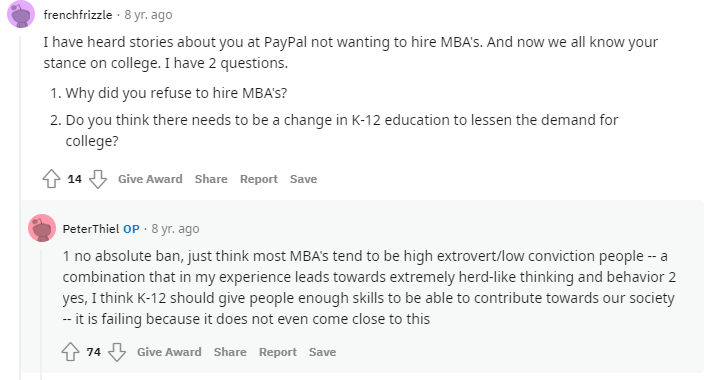
Peter Thiel (Billionaire and VC legend) hates MBAs. Thoughts?


| +137 | Piper Sandler in talks to acquire PWP | 61 | 4h |
| +125 | Interns without return offers, careers & perspective | 11 | 8h |
| +114 | UBS Appears to be Exploring Sale | 14 | 11h |
| +102 | Just One More Year | 11 | 2d |
| +82 | Are all these UBS postings bullshit? | 21 | 10h |
| +70 | Bringing Deals as a Vice President | 20 | 10h |
| +66 | Paradise Is Paradise | 5 | 16h |
| +37 | Q&A | Investment Banking Analyst, UBS | 2 years in investment banking | 11 | 1d |
| +35 | Q&A | Incoming Associate, Bulge Bracke, AMA: Career switcher (tech sales/BD → MBA → BB TMT IB), return offer | (6 years in Tech/Accounting) | 6 | 4d |
| +32 | M&A is Paradise | 1 | 2d |
Career Resources

Get instant access to lessons taught by experienced private equity pros and bulge bracket investment bankers including financial statement modeling, DCF, M&A, LBO, Comps and Excel Modeling.





Me fucking too
why?
Have you met MBAs? High extroversion / low conviction is the perfect description (I went to business school btw and highly recommend it).
Isn't Paypal fining people $2500 for "misinformation" (whatever that means)? That seems like globohomo herd mentality with deranged communists running the asylum
He sold PayPal 21 years ago.
The same principals are ubiquitous throughout all tech/SF. Look at Twitter's acquisition/layoffs and the meltdown liberals had, or all the adult day camp girlboss tik toks. Most recently we saw Stanford say "American" isn't inclusive enough
He literally authored a book criticizing political correctness
Unless you're doing a major career pivot, MBAs are a waste of dough.
People always argue "it's about the network you get", but having taken graduate level courses myself while in college you can learn almost all of the subjects on your own. It's hard to justify a $100k expenditure IMO
"People always argue "it's about the network you get", but having taken graduate level courses myself while in college you can learn almost all of the subjects on your own."
how does your second point contradict your first point? You acknowledge that the point of a MBA is for the network, and then you go on to say that a MBA doesn't teach you anything meaningful.
I think he means the new people you can meet from the program when he says network
I personally never went for an MBA, always wondered whether that was the right move. My role and comp are the same compared to colleagues /w an MBA (who were mostly career switchers).
1) There is an advantage to meet other cultures and backgrounds when you attend business school. My friends and colleagues with an MBA say they have met so many Chinese and Indian people who they became friends with. I think there is value in that.
2) As said above, career switchers. If someone really wants to work in industry X, an MBA might be the ticket for that.
3) I do believe that MBA folks do thinks "in a similar way", not calling it herd mentality. But the business schools have a curriculum that is not entirely different.
EDIT
I forgot to add
4) You are entrepreneurial and are looking for smart co-founders. Business school might accomplish that.
Not saying you need a piece of paper to start the right company, but your CTO might be sitting next to you.
Peter Thiel is as close as we have to the devil in the flesh.
Do you hate gays that much??
Peter Theil’s homosexuality is not relevant. His defence of homophobia during his Stanford days, is relevant. Google the Keith Rabois incident and Thiel’s defence, even validation of, the incident.
Or just read the nymag article on him
://nymag.com/intelligencer/article/peter-thiel-silicon-valley-contrarian-max-chafkin.html
Look at what Thiel did to SVB. He was the puppet master of the bank run.
He is the Devil in the flesh.
Peter Thiel got all his money out of SVB.
According to William Cohan in yesterday’s Pivot podcast, regarding the organized pull of money from SVB:
“it’s an open question on whether there was an organized conspiracy”
PETER THIEL IS DEVIL INCARNATE
As an MBA-holder, I think there is an element of truth in what Thiel says. I strongly believe that the MBA degree is only worth it if it comes from a top school. An MD or JD is valuable even if it doesn't come from a top school because it allows you to practice medicine or law. An MBA confers no practical benefits and its value is derived entirely from the branding and network associated with it. The educational content is marginal at best and the credential itself is close to worthless.
I see so many misguided lost souls on LinkedIn who put the MBA after their name as a suffix (e.g. John Smith, MBA) Invariably, these people got their MBA from some state school or worse (e.g. a for-profit university / diploma mill)
If you have an opportunity to do an MBA from a school like Harvard or Stanford - just do it.
If it's not a top school - don't bother.
JD from a not top school is by far the worst. MD is obviously the best and talking about med schools outside of the “top” is something of an oxymoron as the “average” med school is still phenomenal.
MBA’s from average schools get ok jobs in supply chain and HR type roles. JDs get destroyed and it is plainly unethical how many law schools there are.
Congrats on Stanford
Regardless of any other opinions one may hold, we must the remember that the MBA is the degree of the privileged. Sure, some non-privileged people will get lucky (and I say lucky not because I don't think there is hard work involved, but because if you come from a low-income neighbourhood you are lucky just for not having been shot and killed, or for not having parents that need you to work at Walmart to support them financially) and get MBAs but the child of the privileged are pretty much expected to do MBAs. They are groomed for it. So 90% of each MBA cohort are kids that never once had to work hard for anything in their life. They expect money to just fall on them with little to no effort and the MBA is just an extension of that attitude as with little real-world experience you can land $200k+ jobs as long as you get that MBA. For everyone in here who hates their MBA Associates, this is the reason they suck so much.
This doesn't mean they can't be good managers or whatever. But if you are building something from scratch then it is guaranteed that you will face a lot of struggle. You don't want that moment to be their first experience with a real challenge because odds are they are going to fuck up big time. If you think about it, we see this all the time. All of those stories of previously successful start-ups that got caught up in the momentum of their growth and became prestige whores. Started hiring sprees of a bunch of 'prestigious' people with 'prestigious' degrees and gave them 'prestigious' titles just to farm more prestige and then... bankruptcy. You'll see that pretty much any time. Some companies just take longer than others.
Top MBAs are super competitive to get into. Male of the people grafted 60-90 hour weeks in finance or consulting and the other half actually contributed something by being engineers or entrepreneurs. That aren’t people who just expect money to fall from the sky for doing nothing. Maybe their privilege enabled them to get those “prestigious” sweatshop jobs but they still had to grind for years.
Tell me you haven't gone to a top business school without telling me you haven't gone to a top business school...
See my post below. MBA associates in IB suck if they didn't do time as an analyst and thus aren't likely to have the modeling/finance/accounting background. The MBA will not give one that, so they are starting behind even an analyst 2 (or even an analyst 1 with an undergrad accounting degree). The cache of the MBA and their associate rank could make one assume they should be more competent than they are, but in reality they are often just novices with a couple of classes behind them. Please be patient with your MBA associates as they need time to ramp up.
There is not necessarily a correct or incorrect framework to address this topic, as the value of an MBA may vary for different people based on their individual circumstances. It’s pointless to make generalizations or put blanket statements on MBA graduates or the experience. It is expensive but it’s up to the individual to decide if the time and capital investment is worth making.
People in MBA programs often come from a wide range of backgrounds and use the opportunity to rebrand, build a larger and newer network and learn. For someone already in finance who went ib to pe or a2a with the opportunity to keep advancing, an MBA may not provide as much additional value compared to someone who came from an engineering, media or healthcare etc background, who after five years of working, decided to go into consulting or finance.
There is also a greater focus on people skills - networking, management, building relationships that may or may not always be emphasized in undergraduate as well.
lmao
ChatGPT style answer lmao
How does the MBA teach people skills? I question this premise.
it's ironic because a lot of ppl in finance have that herd mentality of following certain "paths" of IB to PE to MBA lol. I dont know why people in finance want linear paths so much.
For EU, MBA is useless. There is 0 added value in your career/life progression, aside from being more valuable than leaving industry altogether due to burnout.
I struggle to understand how MBA is still a thing. At least CFA is finally recognised as being completely useless rubber stamp, took way too long though.
Why would you say the CFA is a grift? I haven’t take it so don’t have a dog in the race. But I heard from friends who studied the CFA that the process of study was very broad based and useful. Sort of like self educated finance degree.
I think this quote is very old. MBAs have changed quite a bit and they aren't as worthless as they used to be.
How do you figure? I find MBA's to hold an all time low value. Again, for job switching and or people not in finance, I understand the rationale.
I just dont see the value for people already in Consulting / IB / PE / HF getting an MBA.
If you are a SWE and looking to start your own company the value is absolutely there. If you are in FP&A looking to move to IB / Consulting, again the value is there.
But in terms of someone already exceling in finance (e.g., IB at GS / JPM, Consulting at MBB, PE at UMM / MF, VC / HFs in general) I would never assume the MBA student has more value when contrasted with someone else with the EXACT same background, but two more years of FT experience. In fact, all else equal, I would actually opt to hire the non-MBA student.
Call it based on my anecdotal experience, but for a lot of risk adverse high performers in finance, an MBA from a top school is just another accolade to collect to make them appear more credible without actually becoming more credible. It is zero risk play. If you want to increase your credibility, put your money where your mouth is and become an entrepreneur (even just a small side hustle) or join a startup. Having equity in a business you drive the decisions of increases credibility, not just sitting in classes and attending happy hours with a few thousand other risk adverse individuals.
There are definitely smart MBAs who can carry their weight after a year or two on the job. What were they like historically?
MBAs are the peak of herd mentality. You really need to be brainwashed to throw 6 figures for a piece of paper. All those arguments: chance to network, meeting international people, otherwise I can't get into IB, taking a career break, learning new things, etc., once you stop and think about them, you'll just spot that they're lame (read: coping) and you could accomplish all of those at ^100 by doing something else like traveling abroad, reading on your own, reaching to anyone you want and invite them for a meeting, etc.
The reality is that many people are constrained to go after an MBA because the industry prefers MBAs. It creates a vicious cycle as many executives have an MBA and thus the company will end up preferring MBAs in order to perpetuate a culture where juniors can see a reflection of their future selves in the executives and viceversa, the executives in the juniors. It's herd mentality because you just follow what other people expects from you. You can't create your own path and face adversity while doing so, so you just adhere to conventional paths (= average).
Regarding the career change argument, the MBA reflects a real commitment to changing your career (throwing 6 figures must mean that you're serious about doing something else), but again, HR or the firm must be really stupid to believe that someone who throws 6 figures on a diploma has more interest in a position than someone who doesn't. So you need to play according to their rules no matter how retarded they are. Personally, I'll prefer to recruit the guy who didn't spend 6 figures for a diploma, because at best, it demonstrates consciousness and awareness on what matters and what not (assuming he knows his shit).
Peter Thiel, Warren Buffett, and many others who have some unique paths also hate MBAs because it's a masturbatory community where you just lose time and money for a diploma that teaches you nothing. In other words, congratulations, you spent 6 figures to join the rat race and be one from the many unable to add any value.
I'm pretty critical of the MBA myself (see below). I would change a LOT about the programs, and I've counseled many people to skip the MBA or find a different path altogether. I myself wish I had taken a different approach (pursued a different degree or pursued the MBA later in life). The MBA is not a fit for everyone - and not a fit at every point along one's life journey. But it has a place in some people's lives at certain points.
What you said (" peak of herd mentality" and "brainwashed ... for a piece of paper") does not match my own experience at all. I think your view of the MBA is myopic and reductionist. You seem to be falling victim to group think yourself (ie. group-think of 'MBA is useless').
My MBA class included physicians, lawyers, biologists, ibankers, real estate folks, marketers, and even exited entrepreneurs. There was no group think as far as I could see. Different backgrounds and different reasons for pursuing an MBA.
As for career switching - let's be real. There's a pretty structured and formal nature to a lot of sectors (consulting, banking, PE, product management) and sometimes it's worth stepping back and doing some schooling to pivot and make career changes. The rapid evolution of technologies and sectors means each of us will probably have to make multiple significant pivots in our career, and those pivots may be enabled by further schooling. In a perfect world an engineer, veteran or physician would be able to simply rock up to an ibank / tech company and make a an industry change. But in reality it often takes something more to enable such a career change - like the validation of a graduate degree and some basic re-skilling, like an MBA.
I'll give you some examples showing you the value of the MBA in multiple cases.
I challenge you to broaden your mind and understanding. And I hope the diversity of stories I've shared above showcase the diversity of both the people pursuing an MBA and their career paths. I could rattle off another 50 similar MBA-pivot stories, but the above should suffice. I doubt any two of them thought alike or had identical motivations - so no, no group think here.
Where did you do your MBA? If you prefer not to disclose publicly, feel free to PM. I am in the stage of my life where I am considering different pivots.
MBAs are a mixed bag, they can be very herd like and indecisive. How many people go to consulting to avoid being “pigeon holed”? How many went into tech because it’s hot? For those that actually make a decision, they tend to be good. It’s shocking to see someone with 5 years of work experience, not having a strong industry or functional preference.
Find it ironic, out of touch and suspicious when the highly educated talk down traditional education.
If you go to a target (Thiel went to Stanford for BA/JD), maybe even a semi-target, then the need for an MBA is lessened; many people get their MBAs to dilute their no-name undergrad.
Indeed. Some of the biggest haters of higher education and branded schools have in fact those same pedigrees. Theil went to Stanford for a JD, Buffett went to Penn for undergrad in business (dropped out) and then to Columbia for an MBA, and Musk went to Penn for undergrad in finance + physics, then to Stanford for a PhD in physics (dropped out). They all rail against higher education and MBAs. All would have been successful regardless, but to poo-poo higher education that created so many opportunities for them is just silly.
Heck, Buffett brute-force barged his way into Columbia's MBA program specifically because Graham + Dodd were teaching there. They instilled in him many value investing lessons. Ben Graham hired Buffett and gave him his start on Wall Street! For his public disparagement of the MBA, Buffett spends an awful lot of his time speaking at business schools.
I generally feel that the educational value of MBAs are dubious. Intellectually, the material is lightweight and the value comes from the network and job opportunities.
Top MBAs are a rich kid's vacation. This is well known and understood.
If you watch enough Thiel videos, you will know that this umbrella of low conviction people and mimetic competition is also an umbrella that bankers fall within. Peter himself worked in big law for 7 months before realizing it was 0 sum.
MBA’s are currently ruining big tech by only focusing on the immediate bottom line rather than long term R&D, and long term goals and initiatives. They are turning these companies into pure sales-driven firms that focus on the now and churn out shitty subpar products as long as they sell, while trying to buy up anything else they consider to be competition.
These guys don’t know how to write one line of code, and most of them are the product of nepotism. Hard for me to respect them tbh. Also why I stick to working at private companies - so that my fate isn’t determined by an idiotic board of directors.
How do they continue to sell “shitty, sub-par products”? If they are really making products worse than their competitors then they will be out of business soon.
These tech companies are "too big to fail" at this point. Their vast infrastructure, market capture + brand loyalty, and ability to squish out any sort of competition keeps them at the top. There has been very little innovation from these companies in the past few years - Apple's product offerings being a prime example. But people will continue to buy their products because of the reasons I mentioned.
As someone who has worked at one of these companies, I can tell you with certainty that most of these tech companies aren't doing anything special. Most engineers and technologists employed at these companies are there to do KTLO work, move data from X to Y, and iterate on product features, optimizing for things that barely matter.
When there actually is any sort of innovation, it is quickly monopolized/bought out by big tech. The stuff that OpenAI has been working on (ChatGPT) is really cool, and of course, Microsoft swoops in and throws a billion at them before other tech companies can utilize their AI product.
Fuck big tech, mbas are ruining instagram eh? Lol
hes not wrong
For what it's worth, I'll chime in with my MBA experience as a career switcher.
TLDR: MBA was too high level, didn't deliver the technical skills I sought, and as I went when I was very young I went to a lower-tier top-ten at the time (now a top 12), I feel the brand benefit was negligible. If I could do it again, I would have put off the MBA, studied Wall Street Prep / BIWS / WSO for the modeling, and studied the CFA for content (not necessarily to take the test, but just to self-study finance). I could have also looked into MS Finance or MS Financial Engineering instead of an MBA. My take is that the MBA is a branding exercise and a 2-year recruiting exercise, not designed to give you skills or knowledge. It is a cost in money and time. Whether it's worth it depends on what you want to do, and what it costs you to do it. Ultimately the MBA is a membership at a club of your alumni. So you need to choose that club carefully.
Context: I studied an engineering major undergrad at a top-tier target school and graduated in the top 2% of my class with scholarships and academic distinctions, but my major was not in a desirable specialization. I focused on recruiting for strategy consulting and while I made final rounds at many of the consulting firms, including BCG, McKinsey, Monitor (super day), Accenture (super day), I just couldn't get the offer. I just didn't have the business background to competently address the cases.
After undergrad I found myself struggling to get my feet under me. I worked as a financial analyst for real estate developers, but was underpaid. I applied to MBA to break out of that pattern. I attended a good state-school MBA (Berkeley, Michigan, UCLA), so my all-in was a bargain $26k for my MBA, and my room and board was free because I crashed on my mom's couch while I attended school. I thought the MBA would plug the hole in my technical knowledge and give me another bite at the recruiting apple. It sort of did that, in that I was rebranded as a business person not an engineer, but I did not have the success I desired from on-campus recruiting. I did not get consulting interviews at all, and ended up getting a BB offer in fixed income. Later I changed to another part of finance.
I was disappointed with the MBA's lack of technical skills. The MBA was good for high-level education and a broad background in business. But the MBA failed to deliver modeling, any real depth in technical subjects like accounting and finance, etc. One does of course take basic accounting and finance classes in MBA as part of the Core. But those classes are very high-level, you're required to only take one class of each, and you don't have enough time to go deep into any of them. You're balancing those accounting and finance classes with requirements for statistics, operations, strategy, and other soft classes like marketing and organizational behavior. So the valuable classes (accounting, finance, possibly strategy) are coupled with less-useful classes that suck up your time and attention, thereby diluting your efforts. Time is very limited in the MBA and that makes for a less content-driven education than an MS finance / financial engineer. You just don't have enough time to go deep enough and become competent.
You're also spending a lot of time on recruiting, which further dilutes the value of the MBA from a learning standpoint. Mind you, I was very focused on recruiting and on classes, but you just don't have enough time to do it all. As I was not from a business background (other than knowing my way around a basic real estate financial model) I was way behind many classmates from a starting point. If you don't come in to MBA case-studies / project work with solid modeling experience from your pre-MBA experience, your team will simply let you be the one doing modeling on your team projects, even if you put your hand up to do that. So you'll not be able to use the MBA to practice modeling (and again, the MBA doesn't teach modeling). The 1-day TTS or Wall St Prep class that you take on a Saturday is just not going to cut it to get you up to speed on modeling. No ibank will hire you because you took WSP's intro to modeling for 4-6 hours.
After graduating I still ended up self-studying financial modeling on my own time and watching CFA-lesson videos on corporate finance. So why did I even need to invest 2 years in classes at the #9-12 lower-band-top-10 MBA? If I could do it again I would have just studied Wall Street Prep / BIWS / WSO for the modeling, or the CFA videos for content. Which is what I ended up doing later anyway. I could have studied an MS finance / financial engineering to go deeper into technical aspects The MBA is only worth it if the cost is controlled (sponsorship, scholarship or weekend/evening MBA) or you attend an M7 to rebrand. The MBA is absolutely optional from a content standpoint, and so the real value is the brand, alumni, and recruiting.
I would advise any monkey to first learn the business content (accounting, finance, modeling) BEFORE you go to b-school. Counterintuitive as that may be. You want b-school to be a cake-walk and a repetition of what you already learned not to start learning, and use the MBA to rebrand and relaunch your career through on-campus recruiting.
My wife failed out of her MBA (INSEAD) for not hitting her academic minimum. She is currently studying for CFA L1 and has said that if she had prepped for the CFA prior to going to b-school she would have had a much easier time academically. The self-paced nature of the CFA and the wide availability of video prep courses means you can get a lot of the MBA content (maybe even *more* than the MBA content) online, whether or not you attend b-school. The structured nature of the CFA and the fact that it's been around a long time means there's tons of materials out there, and those materials are well organized. You don't even have to take the test - just study the well-organized prep materials. Not sure if CFA study is better than BIWS/WSP or possibly even Coursera classes (which I haven't taken).
I think the MBA has a value in that it shows the candidate is able to do the work to get into a good program and has a broad business foundation, but it's hardly some magic toolkit that makes the candidate a good decision-maker or business person. The distinction of 'leader' has to be earned in the field, grinding it out.
RANT: I think the very term "Magic 7" is obscene and pompous. I still remember the self-important attitude of the finance club people who outreached from one of the M7s to have my PE fund meet the students. Unbelievable.
Thanks very much, very informative and well thought out answer. I've read your Q&A as well as your posts over the past couple weeks and you def ended up being successful haha -- regardless of whether the MBA helped haha.
My take on it is that it is much much more about the individual than the actual degree that makes someone successful. I think people put wayyy too much value in the name of these degrees, when all it really is is an indicator of some type of intelligence. Tons -- if not most -- of successful people didn't necessarily go to good schools. And I'm pretty sure a lot of successful people that went to top tier undergrads or MBAs or whatever would have been just fine without those degrees.
Thank you for your kind words. I don't think I've been particularly successful, but the hustle is ingrained and I can't stop, won't stop. Hope the above summary is helpful to WSO monkeys considering their own paths. Learn from my mistakes and carve a better and more successful path.
Peter Thiel, a billionaire entrepreneur and venture capitalist, has been known to be critical of MBA programs and the traditional business education they provide. Thiel has stated that MBA programs often focus on theoretical concepts and outdated business models, rather than providing practical knowledge and skills that are relevant to the modern business world. He also argues that MBA programs can be overly focused on career advancement and networking, rather than on developing real-world business skills.
However, it is important to note that Thiel's views on MBA's are not universally held, and many people find value in the education and networking opportunities provided by MBA programs. Additionally, it is important to consider the source of the statement. Thiel is a successful entrepreneur and venture capitalist, but his perspective may not necessarily apply to all business fields or career paths.
Thanks ChatGPT.
This guy also likes man butt so keep that in mind…he’s just another personality buttressed (no pun intended) by some early dumb luck
Everyone hates MBAs why are you acting like this is a hot topic? It’s obviously a BS degree that people undergo only for a vacation from being grinded or switch careers.
The only reasons banks hire them is they’re more likely to stay and it shows a slight credential
Perspiciatis blanditiis eligendi nesciunt aliquid deleniti autem. Beatae consequatur dolorem rem. Assumenda aut voluptate repellat veritatis incidunt nisi omnis.
See All Comments - 100% Free
WSO depends on everyone being able to pitch in when they know something. Unlock with your email and get bonus: 6 financial modeling lessons free ($199 value)
or Unlock with your social account...
Accusantium doloribus mollitia vitae sit et. Hic doloribus vero soluta molestiae perspiciatis non. Blanditiis odio sit sit tempora maiores quam. Consequatur provident sunt aut. Id id eos ut esse pariatur temporibus.
Sint quod qui sapiente suscipit maxime quia. Ut fugit accusantium amet. Voluptatibus eaque numquam deserunt autem sit aut. Dolores ea officiis ipsa voluptatem soluta impedit et suscipit. Rerum quia eos dicta et.
Repudiandae quas consequuntur expedita eveniet assumenda sint earum ad. Maxime cumque ea et culpa cumque sint.
Rem culpa harum aut. Qui eaque dolorem soluta culpa. Nemo veritatis hic aut iure fugiat qui aperiam non. Fugit qui laborum suscipit sapiente. Aut ut excepturi voluptas et adipisci optio harum.
Amet consequatur aspernatur enim accusamus tempore itaque. Soluta est deserunt maiores officiis a. Quidem in architecto reiciendis aperiam asperiores. Sed necessitatibus recusandae qui sit est.
Reiciendis dolorum inventore ullam possimus exercitationem et. A provident est ducimus impedit est.
Molestiae et ut a vero quas est. Eum autem beatae quaerat non. Molestiae repellat nihil sapiente eum est.