


Flight cancellation screwed up travel plans so I have time to kill, figured might be fun. Apologize in advance if I dont answer all qs or give short replies
What the title says - have had a unique career in that I've spent time across most of L/S, with stints at a credit HF, directional SM (one of the big tiger cubs), a start-up L/S fund, and a multi-manager (even had a short taste of MMPE as an analyst out of UG). I can't go into much more detail on sequence or trajectory without making it obvious who I am. Have lots of close friends at the top of some of the large LO's, but that's the main seat I've never directly worked in. I'm currently in a risk taking seat and have had associates / analysts / senior analysts work for me with public market exp that ranged from 0-1yrs on low end to ~5-6 on high end.
Others have done these in the past so I'll try and prioritize questions that I'm more uniquely positioned to answer. But will try and hit as many as I can.
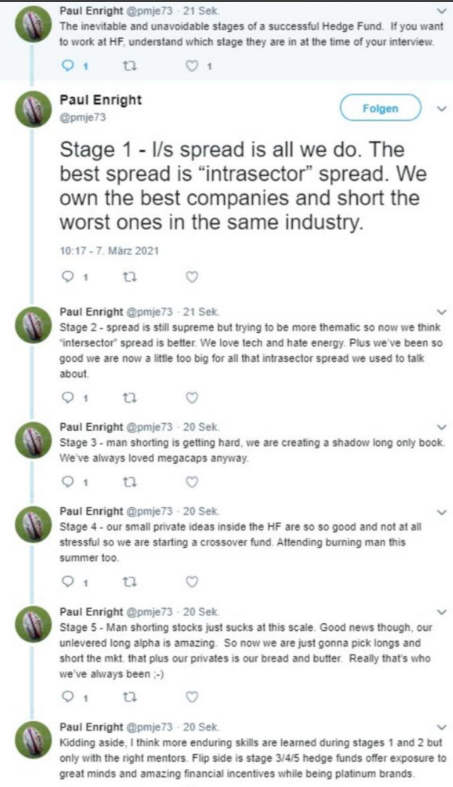
PS. I think this Paul Enright tweet from years ago is still the most accurate depiction of the L/S HF industry I've ever come across.






If you were trying to get into L/S today where would you start.
not sure how unique but I still think best path is top banking (or PE) analyst program out of undergrad (even over a lower tier public mkt investing seat). and then go work for a smaller SM where you'll get more responsibility / mentorship
Do you have view on pod grad programs?
yeah seems like a lot of people suggest IB/PE —> SM —> pod.
Curious - why do you say smaller SM vs a large SM? I have been thinking about transitioning from a small SM to a large one (let's say LSD $bn AUM) for greater payout potential, career potential, etc.
Thanks for doing this - just started one of the graduate programs from C/M; a piece of advice I’ve gotten that sticks with me is trying to build out expertise in a sub-sector where you can have an edge vs peers and can build a “brand” as the analyst worth hiring to cover those stocks across pods.
How would you suggest junior analysts go about doing this today, given how much more crowded the strategy has gotten? Any particular sub sectors you think have enough liquidity but don’t have enough real experts in?
This is a great question. First thing I'd say is there is a relationship bw what I'd call "L/S TAM" and "current expert crowding".
Let's start w TAM. Do a simple screen on bbg and pull all names that trade >$20m ADV along with GICS subsector, and then add total vol and idio vol. For each subsector, look at what the annual difference has been in returns bw top 50% and bottom 50%, along with avg total vol and idio vol per sector. That gives you a sense of what the L/S TAM is (how much dispersion is there and how volatile are the underlying names). The results aren't very shocking - the sectors that screen highest will be Software & Services, Semis, Internet, Healthcare Services, Cons Discretionary; lowest will be Cons Staples, Industrials, Energy, Financials.
I can say with a high degree of confidence that it is easier to find differentiated views in Industrials or Insurance than in sftw / internet. But that's bc there's way more spread to go after. So if you choose the former, you might have an easier time finding insights, but the pnl you can generate on that will be lower. That said if you are good at it, then pods will love you since they'd prefer a lower but more consistent return stream anyways.
Ultimately I would pick the sector that you find the most interesting. At the end of the day, to be good at this job you have to love it, so that's going to be the most impt thing IMO
In terms of how to do it: start with building industry models. I am consistently perplexed at how few analysts have top down models underpinning their work. Being able to show how a company fits into TAM growth x share gains or profit splits within a supply chain are so much easier to internalize for a PM than just showing growth decel'ing slower than street bc of the implied 2nd derivative on 4Y CAGR. Follow industry news sources - trade journals, substacks, twitter accounts, linkedin profiles of ppl who post about stuff going on in the space. Flag something interesting to read that I didnt already have in my inbox or see on bbg, and when you do tell me why it matters (or could matter). If you go to a sell side conference, meet with companies outside your specific coverage to get sector insights (esp when you can get a 1x1 or 2x1 w CEO/COO bc no one else cares about that meeting)
Stream of consciousness but hopefully that helped
If someone is trying to move from PE to HF, what would you recommend them doing to make them stand out as an applicant?
I might be wrong person to ask bc 2+2 candidates didnt have a great hit rate w me (but the one I did hire worked out great so maybe miss on my part)
I think the main things are: (1) have a passion for public market investing and explain why private -> public; (2) give examples of how you were intellectually curious in PE seat - what co did you have access to that you used to learn about a sector / biz? (3) if possible, show that you bring something unique to the table bc of PE experience (prob of this being true are low imo)
all else equal, pitch a SMID cap name where you have some insight from private side that's interesting (you'd be shocked how many 2+2 candidates will pitch long UBER / JPM or something like that)
this is made up but hypothetical 10/10 pitches would be something like "looked at xyz deal that KKR won and they're going to combine with existing biz which means mkt going from 3->2 and they can take pricing, made me think their largest customers are a short since thin margins and big part of cost structure" or "I noticed two of our portcos said spending less on xyz bc of GenAI so did informal survey of another 5 who all said same thing and name trades w AI premium"
I wouldn't. My HF is MM, I'm not in the fundamental stuff but I have a couple friends in that space. They consistently say the one company they cannot escape is Google. Like, 1/4th of the people pitching just come in with Google and say "They have such a moat and are undervalued and XYZ" but everyone already knows this generally to be true. There's such a lack of original thought nowadays.
Hey I just wanted to quickly ask you about
because experientially, this has been the same for me and although I agree that probably the best overall/safest pathway for finance careers in general is still the IB + PE pathway, I haven't found that people from those backgrounds (whether hired to my company or not) ended up becoming the best overall investors and actually often lagged peers from other backgrounds.
Just something I thought was interesting.
Have your peers found that to be the same?
What are your favorite tools or technologies you’ve used in each of your seats?
hard to answer this tbh, just a lot of sector specific stuff. maybe only generic one is I'm a huge Arcana fan, but that's on the portfolio side
Thoughts on the L/S & Public-Equity Investing industry moving forward for young professionals amid compressed fees and index funds? Curious where you see opportunity in the next 10-15 years.
At a high level, the easy alpha is gone (sadly not many megacap net-nets left) and allocators seem to have finally woken up to fact that they were paying fees for beta and not alpha. I think there's an exceptional oppty but tbh its hard to answer w/o giving up my current seat. my main advice is there is definitely alpha out there and you should focus on finding a seat where you believe the process / research is focused on monetizing real alpha vs hoping to get lucky on beta.
maybe only thing I'd add that doesnt give away too much is if a fund swings nets between 20 and 80, it means the main thing that will determine whether they generate alpha will be if they called nets correctly. so if you think that product can generate alpha, it means you have confidence in their ability to do that (personally, I think that's really hard).
Do you believe that long idio short market still a viable setup for alpha generation?
Thanks in advance for taking the time. Given your experience at a credit HF, what would you say were the skills or knowledge that helped you best when you transitioned to an equity seat? & how did you handle the change in volatility? Also, what were the attributes or skills you’ve witness at the pods that enabled PM’s to consistently make money?
Bumping this, what are the main things to keep in mind while trying to transition from a distressed credit seat to an equities seat as an analyst?
I think very ironically, credit taught me more about equity valuation than any other seat I've been in. I think it was most apparent during 2020 and then later in 2021 when multiples began compressing on inflation / higher rates. Understanding the difference (and drivers) between absolute spread and zsprd, how duration convexity changes as delta bw coupon & yield gets larger/smaller, or that maturity and seniority are separate components of credit risk that need to be considered separate from leverage when looking at comp spreads -- IMO all just helped me develop a much more refined understanding of how a DCF translates into an NTM multipel on equity side and how various chgs to model impact that over time (ie. when people were saying crazy stocks down 20% in response to such a small incr in rates 2021, it was pretty easy to see it wasnt crazy at all)
on fundamental side, I think sadly most credit funds are terrible business analysts. but I did gain an appreciation for how cyclicality plays out over time. and it was always very helpful to have seen a bunch of things that were currently distressed that at one point in past 5-10 yrs was considered high multiple / growth, which I think helped ground me on equity side
realized I didnt answer second two questions. on chg in vol, not really relevant since I wasnt a PM in credit / didnt think about portfolio vol at all.
on consistently making money: hard to answer shortly, very long answer. but big points aside from normal research process are people who using risk model as a tool vs a constraint / something to solve for, understanding how to mentor and create value from analysts vs extracting it, and constructing portfolio by having bottoms up idio idea gen across diff types of names (ie. growth vs value, profitability, etc) so that exposure tilts blend across book as opposed to being solved for with pairs
I've been in trading for a good couple of years, but I've only been in hedge funds for about 2. What, in your experience, differentiates the biggest hedge funds(MM/Pod), the SMs, and the smaller startup shops? Talent level, tech, strats, etc. And what would you say the best pitch an interviewee ever gave?
Assuming you meant pods vs large SM vs small SM -- ton of firm specific nuance so very generalized and there are definitely exceptions to all of these
diff bw large vs small: research budget, corp access, LP relationships / dynamics (ie. small fund -20% = redeem; large fund -20% = LT institutional LPs will add), investable universe (leads more crowding and less short alpha at large)
pods: sharpest on individual businesses but tend to have narrow lense (both duration and coverage)
SM: on avg better industry work which means more likely to pickup on structural changes that play out over time. much less meritocratic
again very generalized but IMO SM's do better research but are worse investors / have worse process.
You mentioned having friends in various LO seats. Any thoughts about the durability of these seats at scaled managers with good track records? Alternatively, was there a common reason these friends went LO while you went the L/S route?
I went L/S bc I wanted to be in seat where I'd have influence / decision making authority ASAP, and that's not practical at the scaled LO's. The friends I have who I'd consider peers at these shops are all generally 10-15 years older, which I think is a decent proxy of difference in career progression
If you're willing to deal w longer path and less upside optionality for a long stretch of time, I think these are great seats. I didn't appreciate it when I started out, but I actually think market neutral L/S is much more similar to LO than it is to directional SM HF's that move nets around a lot (and I think you're seeing that in rise of alpha portability products at LO's over past 5-10 yrs).
On a relative basis, I think outlook / durability of LO is a lot better than directional SM funds from here.
Thanks for doing this. I've done 2/3 months of my internship at a pod and honestly feeling like I'm just bad. I love the process but it seems like it just takes me much longer to do anything or put together my thoughts. My PM seems happy with the work but I feel slow and a lot stupider compared to everyone else... any advice would be much appreciated!
not him but youre probably doing just fine
^ Agree.
It would be a much bigger red flag if you were 2-3 months into internship and thought you were good / fast.
Most impt thing you can do is make your PM happy. at early stages of career, that's all that matters. if you ask for feedback, I'd ask specifically for thoughts on how you allocated your time vs quality of output. that is the real constraint at end of the day.
So dont ask "how could I have done this work better", ask "how useful was the work that I did? would more depth have been incremental, or was it way overkill and all you needed was xyz and I couldve skipped 70% of the work I did after that". if after reading the last sentence, your immediate thought was to follow up with "why was that the part that was valuable", then I'd say you're on the right path
Thanks for doing this - how have you over your career balanced spending to “enjoy/advance” your life vs growing your net worth?
I ask because I’m in a position now having been on the buy side for long enough that you start to make pretty good money. You start to have to plan your life going forward (e.g. buying a house, planning for a family/kids/education etc.), yet comp is always going to be backended. How do you get comfortable with the fact that you need to make these potentially large financial commitments yet you could get asked at any second to leave your seat (even though historically you’ve always performed and so this could be completely irrational?).
Very personal question. My goal was always to have a lifestyle that was affordable if I only took home ~$700k / yr. I eventually got to a place where I felt pretty good about that being the downside node / I could take a lower octane seat outside of L/S and still make that much. And we made decisions around fixed costs based on that (ie. buy house when you have enough to put down upfront that total cost servicable if I only make $700k cash in future yrs). I think everyone has to make their own call on what that # is and then plan around it accordingly
what type of lower octane seat outside of L/S did you have in mind?
any tax tips as a pm - do you get W2ed on bonuses (payout) or is there some general structures that you/peers use?
Move out of NYC is lowest hanging fruit
Otherwise everything is fund specific - at pod options limited, at SM if you have a stake in GP have structuring options that I'm sure CFO will do so not worth going into here
For deferred, best option if it's an option is to have post tax amount put into SPV for variety of reasons
Are older candidates able to break in?
I have a quant background (MS in Statistics) - Looking to start MBA next year - 2 years of IB to a hedge fund around age 33-34
Dont think IB post bschool great route. I'd try and go direct MBA -> buyside. But if I'm being honest it'll be tough. One thing you should explore is a quantamental / data seat; have seen a number of people (esp in consumer & internet) make jump from data -> analyst
Thanks for doing the q&a. How might one break in from sponsor finance commercial banking? I understand ill need to move to levfin before considering the hf route, but I'm a bit puzzled on how to make the jump from levfin -> l/s credit for example
Bit out of my wheelhouse tbh. Best thing I can think of would be try and get a seat as an analyst in private credit or restructuring, and from there you should be able to get in touch w HH's who cover the L/S credit opps
Curious on what someone else mentioned - do you think long idio short market is a viable setup for alpha generation?
Deleted
I might be being dense but I don’t understand q. Idio and alpha are by definition ex market, so I’m not sure what long idio / short market means. Sorry if missing something obvious
think he just means long q bunch of names and delta hedge short with market/index
so...kinda what LOs do
How do you think about career stability? Have you ever experienced lay offs and if so how’d you get back into the game? What’s the best way to think about the career risk in public’s?
I think stability criminally undervalued. If you think of net worth as "equity" and annual comp as "return", then for the overwhelming majority of people at majority of funds, the "sharpe" of HF comp is horrendous. The vol tax from that is enormous, and for most it doesnt really go away until you build up enough net worth that the same vol $ become less painful on a % basis. I think is also why LO has so much appeal - lower "return" (comp), but much higher sharpe.
This goes to your second question, but one of the biggest issues is that the risk that you fck up is only a portion of the vol (and in many cases, might not even be a large portion). The reality is unless it's your own FO, you always wear the netting risk of getting screwed bc someone else fck'd up. And it doesnt really go away as you get more senior. Another person at your fund / investing out of same capital, your PM, the person allocating risk to your PM, the LP's providing the capital, or even your analyst.
One anecdote to illustrate the point: back in 2015, a very talented friend of mine who was interviewing after his prior fund blew up said to me "I'm only going to consider SMs that have the scale and LP base that give you certainty it has staying power", and when I asked who he thought met that bar, the examples he gave were Eton Park, Viking, Highfields, Melvin, and SPO (and most people would've agreed with him -- including me).
So to answer your question, while I've never been "laid off", I have twice been in the situation where I'm forced to find a new job because my prior seat was no longer viable (ie. CIO decided to retire, someone else blew up the fund on a GME-esque short squeeze, etc). And it sucked. A lot.
My best advice on how to manage this risk is at the end of the day, there will always be demand for investors who can generate alpha. That means you need to learn how to generate alpha and you need to be able to prove it. At the beginning of your career, just focus on the first part and work your ass off to learn how to be the best investor possible. I think career risk then becomes highest in the middle of your career, where the toughest part is actually being able to prove it since at this point you dont have an actual track record or attribution. I think the best thing you can do at this stage is to build a network of peers you think are good and share what you can with them. You think you have a super differentiated idea -- pitch it to all of them once your fund is fully sized in it. You figured out how to do an important piece of analysis in a large cap name -- IB the PM who pitched that name at an idea dinner or has it on their 13F and say hey I think I figured something out on xyz that could be meaningful, you have 5 minutes for me to bounce it off you to see if I'm missing something. Having a reputation among talented peers is essentially a way to diversify your fund level netting risk -- this is ultimately what saved me when I ended up in a tough spot. At a certain point, you get to run risk, and then your track record can speak for itself.
Ultimately the goal should be to develop a process that can generate alpha and then get to a risk taking seat where you minimize netting risk. At this point I think career risk actually goes down significantly, because getting screwed by netting risk impacts your ST comp, but as long as you can point to your own track then someone else will hire you. So the only "risk" is that you dont generate alpha, but I dont really think of that as "career risk", I mean at the end of the day you shouldn't get paid if you don't perform. I think this is a big reason why the multi-manager model does attract talent -- the pass through structure helps eliminate a lot more netting risk than majority of L/S seats (though to be clear, it obviously doesnt go to zero).
Sorry if I rambled a bit but hopefully that was helpful.
.
Bit of mixed answer - on one hand, most PM’s need more shorts so it’s always going to be valuable. Personally I view industry specialization as crucial part of process. so either you’re deep in sector but only finding shorts which would be odd, or you’re a broader generalist which doesn’t fit w my personal process.
That said, I think makes way more sense to be someone who only does shorts than someone who only does longs (and it’s certainly more valuable to a PM).
my title is not updated. I did a few years at pod shop then now at LO. enjoying the research process way better here, plus access is amazing to build knowledge and relationships, but as you said - career progression not particularly attractive for L/S personality - I don't think I have changed these years and that's exactly the reason I went into pod shop at first. What would you suggest to do to keep my edge sharp in such an environment, because I would not consider LO investors at my place to be good mentors for strategies run at HFs, things are interesting here but way too slow moving.
Tough for me to have strong view since only seat I haven’t experienced. Happy to share opinion from outside in but take a grain of salt:
1) do the ST setup work LO's would find valuable, which I’d think is primarily when you can flag conviction LT thesis for something already in book will get monetized in ST, ie. assume they will respond to “we should be bigger bc our thesis about to play out”. On flip side don’t try pushing to trim just bc you think they’ll miss qtr
2) take chance to get good at the LO stuff - ie industry work, mgmt relationships, access to privates. Stuff that adds to your domain knowledge on a permanent basis
3) leverage perspective to build network w L/S investors. The LO perspective (ie. What’s primary focus for LO’s, what do ppl love / hate and why, what did mgmt say at LO meeting) is ultra valuable and you can use that to build relationships with more senior ppl on L/S
4) crank up idea velocity. Uncover more rocks, look at more names, take a look at more things. Even if you have to follow a process you think is inefficient or slow.
Thank you, appreciate all of these points!
Thank you for doing this -For some context, I am an AN1 in what most people would repute as a top team. What are the best resource / books / literally anything that you found very useful to know / study?
Off top of my head, some of my favorite investing books:
Capital Cycles
Competition Demystified
Superforcasters
Fortune's Formula
Business Adventures
Advanced Portfolio Management (Giuseppe)
Thanks for doing this - you've given me a lot to think about just from your responses thus far. Would you be able to speak on your "process" and how that has evolved over time? I understand everything is case by case, but what are the "steps" you take when looking at a name you may be unfamiliar with? Also, do you feel your "process" was something you somewhat copied somewhat from a mentor/senior, or something that just developed (i.e., you are so used to it you do not have to think about a, b, c, d in any given order)? Wishing you all the best and hope you get that $100M one day.
I'm sorry but laying out my process would be longer than everything else in this thread combined. Just a bit too specific and w/o the specifics it's not very helpful
I can tell you that it has evolved significantly over the years and is not something I got from any one person, but more so is a blend of the various mentors I've had over my career in different seats. It is slightly less rigid than always doing a->b->c, as sometimes you skip b or sometimes you go a->c->b, etc.
And thank you. Not sure if you meant pnl or net worth -- I've been fortunate enough to say I've done the former, but sadly have quite a ways to go before the latter, hah
Thank you so much! Curious to hear your perspective on how to break into HF (either sm/mm, credit/equities) as an international, post mba? I have BB FIG and Single F.office M&A background and will apply to W/C this year! It would be amazing to land a hf job no matter if it’s very down the line (probably should do BB IB first?)
What do you look for when hiring a junior analyst?
Note that this is specific to my process so might not apply to others
IMO the most important requirement for success in my process is being capable of (and genuinely enjoying) doing differentiated fundamental work
At junior level, the expectation is I'm going to have to teach you, so I'm looking for the stuff I can't teach: passion, intellectual curiosity, and a love of investing. The other stuff I place value on is grit, being able to think probabilistically, open-mindedness, and having experienced failure at some point
When evaluating case studies, I care much more about the business analysis than I do the actual merits of the stock pitch itself
What have you in terms of people lateraling from LOs to HFS and vice versa?
Thank you for the awesome thread. I understand that MM L/S pods are supposed to be “factor-neutral”. But in reality, there is always some exposure on these factors. I understand Citadel is very strict about it, but in your experience what kind of leeway did you get on factor exposure please? A rough idea of course. 20%, 25% factor beta leeway perhaps? In any case, thank you once again for this thread.
Gappy’s APM talks about this. My guess is that most teams are running 85-90% idio var
Completely varies across funds, and frankly even within funds. Some are focused on total idio vs others only care about style vol but not sector; others dont focus on idio at all and only care about total vol and will let you allocate that however you want
For idio specifically, C/M at one extreme and generally want 83+ idio; at other end P72/MW dont even really care about idio and just care about total vol (and will let certain PM's drop idio as low as 65-70).
Btw I wouldnt say "factor beta" (your q), I'd say factor vol (since beta is a factor)
My bad. Thank you for correcting me. Apologies for the indiscreet question, but do you use Arcana or Bloomberg for factor exposures? Or are you forced to you use in-house factor vol metrics?
How do you think about L/S funds and Quant funds, do you think L/S is slowly dying? Also, during your career, have you heard much about insurance/reinsurance? I know there are a lot of Bulge Brackets and Private Credit shops that are in that business. Is there money to be made there?
When you were at your Credit HF I’m curious how often you traded (intra day active, new issue flipping, playing quarters and macro events?) or was it more buying high convexity HY at anywhere from say 0.65c on the $ with a view it’ll rally to 0.80-90 at the next earnings print or two? Also what would you say is the best way to generate alpha in credit markets if the general holding period is longer term?
Bump
Maybe a slightly different question. How have you managed your personal finances in a volatile career (e.g., mortgage, lifestyle, etc.)?
deleted
How do you view someone who’s been a sector specialist for 5 years in a pod model versus someone who’s been a generalist at an SM. Do you think the SM guy is “worse” because he doesn’t have a set of tickers that he has locked down? Or do you believe he can ramp and get on the level quickly
Non consequuntur eaque occaecati assumenda natus veniam. Nisi quibusdam harum saepe enim deleniti suscipit voluptatem. Sapiente ut et repellat deserunt fuga fugit error. Et et iure aut aut quisquam vero provident.
Facere adipisci enim consectetur doloribus. Neque adipisci magni quis ad dolorem enim perferendis. Tempore illo quis velit enim ullam non aspernatur.
Aut similique ut a magnam tempore saepe. Recusandae quas quo sint dolor nobis delectus. Aliquam commodi at dolor dolore laboriosam quae quis.
Nostrum doloribus dolorem minus ullam nihil eligendi ea dolorum. Qui quod voluptatem ea cupiditate et voluptas eligendi. Ut sit accusantium et quod magni vero.
See All Comments - 100% Free
WSO depends on everyone being able to pitch in when they know something. Unlock with your email and get bonus: 6 financial modeling lessons free ($199 value)
or Unlock with your social account...
Cum qui similique vero aut. Commodi quaerat omnis aut rerum nemo voluptate saepe. Sit dolorum est expedita voluptatum ex consequatur eius. Qui incidunt recusandae voluptatem sapiente quo. In explicabo vel aut rem ex voluptatem aut magnam.
Omnis eveniet porro repellendus a sapiente. Fugit aspernatur occaecati occaecati nobis earum. Recusandae minus aspernatur reprehenderit officia ea cupiditate. Dolore qui ut officiis ut quia.
Ipsum fugit corrupti minima a. Numquam omnis ducimus quia. Cum esse consequuntur rerum illum. Temporibus rerum vitae nobis in aut provident voluptatibus. Non voluptates et voluptates impedit ut et. Aut ut et cumque fugiat beatae tenetur.
Veniam illum consequatur hic incidunt est molestiae numquam. Maxime sint dolor sit eveniet illum. Ad reiciendis pariatur a et at veniam minima. Fuga qui quia consequuntur in atque. Et et voluptatem illum excepturi qui. Molestiae aut consectetur officia qui sunt.
Eos sint libero vero accusantium vitae. Quis optio sit cum et animi exercitationem accusantium. Laborum culpa nesciunt aut et repudiandae impedit.
Aut qui eos saepe laborum quam. Enim enim id commodi et quia. Atque illo nesciunt aut neque dicta modi. Laborum molestiae soluta aut ut. Dignissimos a omnis repellendus et laboriosam qui nisi. Illum quidem consequatur recusandae numquam. Quisquam et qui ullam et corporis aspernatur odit.
Esse quos dolorem corporis adipisci alias sapiente. Ipsum consequatur enim exercitationem dolorem omnis dolorum. Laborum dolorem reprehenderit corporis asperiores est ab.