
Finance and The End of History / The Alchemy of Boomer Magic


First things first, which summarizes this blog: "Past performance is no guarantee of future results"
Many of you have found yourselves on this forum seeking for advice to break into the world's most lucrative industry. You see before you past generations of billionaires and centimillionaires created through the alchemy of finance - and you too should soon share their destinies. Perhaps you have no vision of becoming a billionaire or centimillionaire, but really just see an opportunity to take home a couple M's during your career and live comfortably, a noble goal nonetheless.
It's difficult to put into words how this wealth was created, but understanding its creation is critical to understanding why it's not going to work for you.
Let's start with analyzing the history of this country, in terms of wealth. I like these charts from Wikipedia.

Let's think about what wealth means, especially in terms of financial assets. Remember from valuation class - financial assets are valued on the discounted value of their future expected cash flows. Much of the value of financial assets is weighted in the terminal value of the DCF equation. When we talk about the wealth of a country, we are talking about it's GDP. In other words, the future wealth of a country, and the expansion of its wealth, is predicated on the continued expansion of its GDP.
See below chart on Real Potential Gross Domestic Product.
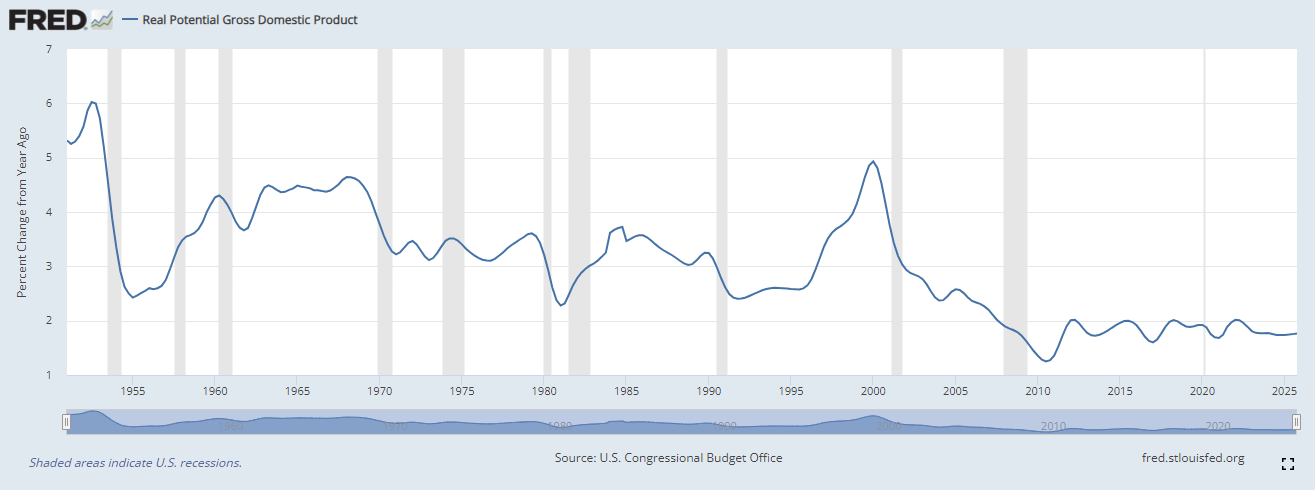
The trend is straightforward - over time, GDP growth has contracted, and since 2008, only under the Federal Reserve's Ample Reserves regime and consistent money printing has potential GDP been able to sit at 2.0%.
Here is the story these charts tell: creation of wealth was higher historically than it is today, and much of the wealth generated went to those who were already wealthy. In other words, in America, over time, it has become more difficult to create wealth, not easier. The shrinking middle class is to show for it.
"OK OK I GET IT - I've seen the wealth inequality charts and people are having less babies and GDP growth is lower - but I work in private equity"
Those on this forum also need to ask themselves how wealth in private equity is created. Fundamentally, it is through the securitization and financialization of the real American economy. While GDP growth rates were higher from 1950 - 2000 - the wealth was held by the owners of America's businesses. Private equity provided a pathway for owners of those companies to liquidate their holdings and diversify their wealth. Private equity purchased these businesses at discounted prices, institutionalized them, and then sold them.
A brief history of private equity is necessary to understand this. I will explain things in the simplest terms and encourage readers to dive more deeply into the literature. When private equity first became popular, the largest businesses were the first securitization candidates - multibillion dollar LBOs. Once the low hanging fruit was collected, the "middle market" space was devoured, and businesses of ~$B were acquired from American families and securitized, still at low multiples as the space was uncompetitive. As the space become more competitive, strategies were further developed, and private equity partners looked for less competitive markets, heading towards the "lower middle market" - a term which seems to have lost it's meaning and now encompasses business from $20mm TEV - $500mm TEV.
That is to say, securitization follows the path of least resistance and has almost made its way to America's mainstreet. One could argue it has made its way to Mainstreet with the launch of search fund entrepreneurship.
So how does these points connect to my earlier points regarding GDP growth and wealth creation?
The wealth was created during a high GDP growth period - and private equity has facilitated the securitization of that wealth, and a handful of partners got rich doing so.
Future generations in this industry need to be seriously asking themselves if they think these trends are going to reverse. Simple data demonstrates there will be no renaissance of American industry and growth, and the hunting grounds for private equity will become more crowded each year.
This is my way of saying - I think it's funny when people are excited to receive a buyside offer - when they become a PE associate and "make it". The road ahead is long, and you don't have any of your ancestors tailwinds. The environment is radically more competitive, and the opportunities fewer and fewer. Those signing to be associates today need to understand their positioning in the pecking order. If it takes 25 years to be a partner and that is one's goal - one has to ask - what is the deal landscape going to look like in 2050?
My guess is that after 40 years of 2% GDP growth and 70 years of private equity securitization, there won't be much left for the new partners to do.
This is the end of the history of finance and the alchemy of boomer magic.
Now get back to your spreadsheet and build some more wealth for your boomer partners on the fund's next HVAC acquisition - if they don't securitize it, someone else will - and they're not leaving it on the table for the 2050 partner cohort.






Well, you've certainly painted a vivid picture there! It's true that the landscape of finance and wealth creation has changed dramatically over the years. The boom times of high GDP growth and the golden age of private equity have indeed shifted.
The wealth that was created during high GDP growth periods has been largely securitized by private equity, making a select few very wealthy. But as you've pointed out, the opportunities for wealth creation in this manner are becoming increasingly scarce.
The competition in the private equity space is fiercer than ever, and the hunting grounds are becoming more crowded each year. This is especially true as we move towards the lower middle market and even Mainstreet.
For those just starting out in the industry, it's important to understand this changing landscape. The road to becoming a partner is long and the tailwinds that helped previous generations are no longer there.
Looking ahead to 2050, it's hard to say what the deal landscape will look like. But with decades of modest GDP growth and private equity securitization, it's possible that the opportunities for new partners will be few and far between.
So yes, it's back to the spreadsheets for now. But who knows? Maybe the future of finance will bring new opportunities we can't even imagine yet. After all, they don't call it the alchemy of finance for nothing!
Sources: What does an impending recession mean for students wishing to pursue a career in finance?, The End of an Era | The Daily Peel | 10/13/21, Musk Master of Misdirection | The Daily Peel | 7/11/22, https://www.wallstreetoasis.com/forum/private-equity/qa-non-target-top-bucket-ssg-private-creditdirect-lending?customgpt=1, https://www.wallstreetoasis.com/forum/investing/what-do-you-think-the-catalyst-for-the-next-recession-will-be?customgpt=1
Bump, enjoyed the read. Would love to hear a rebuttal to this from someone more knowledgeable than myself
Lol OP makes some good points but TDLR is: society is unequal and it’s harder to make money now compared to before. What else is new..
My point really is that people need to begin seriously thinking about whether or not it makes sense to continue working in the financial services industry. It's possible there are potentially better alternatives out there.
Unless definancialization becomes a thing, yes, america is rapidly devolving back into a feudal society
According to the boomers at my shop people have been calling the death of PE since the 90s. I’m currently making 6x what I did in my first internship and more than any of my friends, seems to be working ok for me so far.
I don't think anyone is calling for the death of PE, yesterday or today, but the outlook for the industry's capacity to generate wealth for its participants is certainly changing.
there's always an opportunity even in the worst scenarios, so the real question is who will be the smart guy that will find a way to exploit your thesis
First of all, thank you for writing this discussion, which is among the very most interesting I have read on this site in the last year.
In short, your view is mostly correct, albeit you would benefit from having a longer time horizon for thinking about the data. It is true that since the 1980s that the world has become more financialized and that the top decile and top 1% have gained more power. You say that the trend has run its course and that there isn’t more juice for the squeeze. I think history shows us plenty of examples of more unequal societies which will allow the 1% to continue to gain in power despite the levels we see today.
Turn-of-the-century France, Jane Austen’s Britain, Balzac’s France, the Gilded Age in America, and the pre-Great Depression period were all more lopsided than what prevails today. The top decile controlled 70-90% of assets at those times rather than the 60% or so they do in the US today. That’s the amount of runway the rich in America have before society takes their wealth away, either by nationalizing assets, engaging in confiscatory taxation, or deflating the purchasing power of their bonds through monetizing the US’ significant debt load.
In terms of the amount of capital in society, it depends on the savings rate of the society (adjusted for depreciation) divided by the real growth rate (calculated as per capita productivity + population growth). The savings rate is basically constant and is at like 15% in America. As productivity growth and population growth slow down in the world, capital becomes more important, not less important, because the denominator becomes smaller. So capital rises in society and becomes a larger claim on national income.
TLDR: Societies have been more unequal in the past and more financialized than even now, albeit largely based on government bonds. Demographic trends will increase the importance of capital in the coming decades, and PE has a ways to run, although a lot of portcos are poorly integrated pieces of crap.
Thanks for the feedback.
I agree PE has more runway. A point in my original post is that young investment professionals today need to be asking what the deal landscape will be like in 2040/50, which is when they will actually build wealth as partners. Does the industry have 20/30 years of 15%+ IRRs? I personally don't think the answer is yes and I think GP's understand the challenge ahead of them during the 20's at the very least.
Also agree - the wealth inequality will get worse - if it ever gets better at all. My base case is it continues to get worse but does not get meaningfully better. Portfolio diversification significantly complicates redistributing wealth. It is easy to contemplate nationalizing an oilfield owned privately by one person. Can the US govt nationalize Apple, which is in every single 401(k)? That is to be determined, but I think the answer will be no, and that goes for many securities.
Other alternatives for wealth redistribution include increasing the social safety net. This is a development American oligarchs are already readily embracing with UBI discussions. For the American aristocrats, UBI is a perfect solution if it can provide enough for average Americans to eat/sleep/rent/work without actually nationalizing or seizing the wealth generating assets.
I think many elite are imagining a world in which growth has slowed, their wealth is forever solidified, and a sub-class of workers are supported through low wage labor and UBI. It will be brought forward as something people look forward to as they will be getting something "for free", but it is truly dystopian - the concept a class of workers has no upward mobility and rely on state solutions while another class of aristocrats live in $40 million mansions in Miami, Jackson Hole and Martha's Vineyard.
Lol a lot of the smart college kids realized this starting from a decade ago and all pivoted to tech / SWE
Tech probably printed far more millionaires over the past 2 decades than finance did. We’re sitting here cranking on lbos and dcfs while run of the mill SWEs from big tech who started working in 2000 are probably sitting on millions in tech stock
This. Especially with the fact that looking at Tech LinkedIn profiles can be vague on how much that person is making especially with pre-IPO / large amount of stocks accumulated.
yes, but tech in 2000 was what finance was in 1980 - being at the right place at the right time
what is the equivalent nowadays? will AI in the next 20 years create the next millionaire/billionaire wave? I doubt it. There is a compounding factor in those that amassed wealth, that's what OP is trying to say, so those AI guys - assuming this is the next big trend - will fall short in terms of wealth vs people that are in finance since the 80s and tech guys from the 2000s.
As I said, the future belongs to those that can properly spot the next trend but also there is the luck factor, how can you be sure that your skills and expertise will be the precise skills and expertise that will be relevant for the next wealth-making wave? how relevant will those tech guys remain in the next decades? from a finance-practicioners standoint, another interesting scenario would be that those guys realize how lucky they've been in amassing their wealth so now they need to park those in "safe investments" aka Vanguard, bonds, etc. - will then some brokerage firms/banks/AM firms boom again? heck even PE with their low but stable returns due to increased competitions could still remain relevant because of this phenomen.
anyway, after we end up this discussion, then there comes next chapter, in other words once we opine on the next trend and how those will affect the economy/finance industry/prospective careers, the question would be "it is possible for all this wealth be transferred to other people, if yes, how will this wealth be transferred to other people? Interestingly almost 70% of 3rd generation kids coming from rich families (pick anyone from the Forbest lis) will probably lose money or would get used by other smart people (possible scenario: finance guys persuading a rich kid to put 20bln in their funds because they will be revolutionizing capitalism, etc.). Then there would be also a wealth distribution aspect and the money in the next century would probably be flowing in a vicious cycle.
Let's go even further and let's say that the IP rights/patent of products like Microsoft, Apple, etc. end up expiring in 30-50 years. New competitors appear replicating the same product which will reduce their revenue/turnover and thus impact the shareholders that are "wealthy" or the tech guys that work in FAANG. What's the next step for the tech sector? better yet, how would society's perspective on the products that different tech companies build will change? Apple builds expensive phones that bring no tangible value and are realesed every 1 year (and as you saw in the last iPhone this things is already becoming a reality, it is less expensive compared to past iPhones and it fell short on revenue expectations), also social media companies with their irrelevant content, etc. I mean, aren't economic trends a matter also of one's perception of what is valuable and what's not and doesn't this perception change from generation to generation?
it's an interesting discussion, speculative, but interesting
It is true some children of aristocrats lose their money. It is some threshold, however. The securitization of everything should provide enough diversification that people can protect wealth for many, many generations.
Somehow finance pay these days seems lower than what it was 20-40 years ago
It is significantly lower.
Where else in the world can people become rich like people in the US? I am from Latin America and think while it’s possible opportunities for building wealth may have been better historically in the US, they’re still better here than anywhere else
that's the premise of investing in Emerging Markets. If the US became saturated by investments, and this is a reality, because you just need to see how some companies backed up by PE keep pumping the value up and up with no real proof of increasing value, then the next logical step is to focus on markets that aren't yet exploited where increasing a company's revenue and its exit price would be attributed to delivering real value that can be reflected in the price, and not just a fictional value as it is in the US i.e. lower costs/cut employment/etc. --> insolvency/bankruptcy --> restructure it and increase its equity --> sell it --> the same cycle over and over again for the same company.
there are many basic needs that are still unfulfilled outside financial centers or big cities that allow one to really amass wealth in Emerging markets
You say you're from LatAm, and I want to point out to many people that went abroad in US/Europe/UK to study/work, and then they came back to their countries to implement things that they saw in 1st world countries and they became rich, but make no mistake, maybe there's no purpose in building a Tech Consulting company in Brazil because of lack of demand for such services in the country, but manufacturing/utilities and employing 1k+ locals would be an excellent business plan and also profitable as those companies often get Gov't support or tax deductions and probably you'll have a higher chance of becoming wealthier in Brazil than in the US.
Sed numquam voluptates magni ducimus iure fuga. Aliquid et modi rerum dignissimos eum dolores. Dolor qui dolorem non voluptate doloribus necessitatibus quod aut.
Ab fugit non occaecati aspernatur ut ea necessitatibus adipisci. Impedit a id aspernatur labore reprehenderit dolorum.
See All Comments - 100% Free
WSO depends on everyone being able to pitch in when they know something. Unlock with your email and get bonus: 6 financial modeling lessons free ($199 value)
or Unlock with your social account...