
Q&A - Woman Senior Analyst at HF


Saw the discussion on no women in HF and happy to do an AMA. Won't touch on specific investment strategy as it might be too identifying. Currently senior analyst at HF with own sector and PnL. Happy to talk about career progression, women-specific topics, etc. Will update in the evenings after work






It seems like you're referencing an AMA (Ask Me Anything) by a woman senior analyst at a hedge fund (HF). However, based on the WSO content available, there isn't specific information about this AMA or its details.
If you're looking for insights on career progression, women-specific challenges in finance, or hedge fund-related topics, feel free to ask more specific questions, and I'll do my best to assist based on the WSO dataset! If you're seeking the AMA itself, you might want to explore the WSO forums directly for the latest discussions.
Sources: L.E.K Ph.D Analyst Position - Career Progression?, BB Analyst Impacted By Layoffs - Looking for Insight, Year 1 in consulting - tips, tricks, advice, and unspoken rules., IB Comp Progression, IB Comp Progression
Which incel hit the original post with monkey shit?
How did you progress from research analyst to senior analyst managing your own sleeve? Do you still have someone above you that gets a say on your sleeve?
Are you at a SM or MM? How would you describe your relationships with your PM / CIO?
2. Relationship with PM is ok - he realize if he wants the same quality work he might have to pay more from an external party vs someone home grown
I would encourage women on this forum (to the extent you have questions) to post them here. Would like to be helpful where I can.
Lastly, can’t say I understand why this comment would get a bunch of monkey shits… oh wait actually I think I do understand…
Any advice you’d give to younger women in the HF industry?
Thoughts on the SM vs MM space today and where you’d recommend a younger version of yourself go?
Thanks!
On a macro level, AUM is flowing out of SM into MM. for my younger self, I would recommend doing the most technical aspect of banking, have a solid and transferable technical skill. Then I’d go to where you will have the best fundamental analyst training (aka not trading, not fast money, but really understand companies etc) - can even be PE. I’d try to have a stable 5-6 years stint at an SM or even AM where you really grow your investment thinking without changing environment so much. Then at mid senior level I’d consider MM. at some point, if you want to take mat leave: (1) never mention it to your firm before you pop - they don’t care and it just gives them leverage, (2) you need at least 1-2 years of good pnl at a place before you can do that.
deleted, I'm not going to bother arguing about this
Wtf??
This is so sexist I’m not going to give it a serious response; I’ll only give you a response that’s actually useful to the universe. If you are so concerned about incompetent junior women, i have a bigger target for you - incompetent men; perhaps you can write a few letters to hf managers who keep losing money and raising capital, and everyone who has a below tier 2 return on pitch book . I guarantee you - these managers are all men.
If you take off your sexism goggle - you might even start to see that these women are more competent than you. The competence was always there, the recognition much less so.
Noticed a spike in brand new accounts posting on the other women in HFs thread the last few hours, all pushing this same narrative.
Also, can you give us some tips on how to sift through mid level resumes / profiles/ interviews to sift out and eliminate candidates like you? High ego low intelligence is usually a bad combo for investment outcome. Thx
This is why I quoted your original comment so to keep a copy.
negative alpha detected
LMFAO WSO is just filled with MAGA incels. These new generations are fucked (fucked as in messed up, not fucked as in getting poon because you MAGA incels clearly get noooooo poon HAHAHAHA). Dude if you can't keep your personal sexless life separate from your job, maybe don't be in charge of hiring HAHAHAHA. Enjoy the chair at the corner of the room
del
Other aspects of the career path that younger women may not appreciate - (1) prestige of the fund is likely more important to you than it is to a guy. For a woman, you are assumed to be incompetent until you prove it over again and again. For a man, often they are given benefit of doubt esp if they are not minorities. You need the shield to stay in the game. (2) try to pick a strategy that has clear pnl and people can’t steal your credit as easily- that’s why when younger women ask me whether they should do public or private versions of an asset class, I always suggest public IF they have no preference. (3) sellside ER at reputable places are an overlooked path in terms of becoming MD. (4) you will face the up hill battle till you are pm and it doesn’t stop there, bc even there it involves a perceptions game. You can only really last if you truly love investing - the path is harder for women so those who are only lukewarm about the path likely gets washed out after PE sr associate level. If that’s the case, can always try cap markets / corp dev etc
thank you so so much!
You should also network with a group of women in your investment strategy - generally, they can tell you which funds are good to join vs problematic
Thanks for making this - helpful to get more clarity, especially given the other thread. For context, I'm currently an associate at a top MFPE program and the decision is slowly creeping on whether to exit to a SMHF (base case from previous cohorts), stay for the promotion (likely not attractive for reasons I won't get into), go downmarket into LMM/MMPE, or pivot towards something in AI/late-stage growth equity/crossover funds.
A few things I'd love your thoughts on.
I felt like I could have written this myself, especially on the motivation of why I want to move to public: I’d rather be stressed about eating what I kill than deal with incompetent PE men.
It’s not just credit stealing, it’s them pointing me at a buffalo that is clearly diseased and ordering that it get taken down for dinner anyway, and then blaming me when the rest of the pack (they don’t deserve the term “pride”) comes down with food poisoning.
Let me take your questions one by one:
I think this one is a harder question to answer - I think you will generally know if the process of investing is interesting to you. Passion is importantly in a public markets seat - the markets are too well covered for a career to work with out passion. You need to have both passion and discipline I think
Questions reproduced below :
How do you gain conviction in your own investment acumen/know when you're good enough to "hack it"? This is something everyone grapples with, but obviously skews harder for women given imposter syndrome and systemic barriers. I've done well in stock pitch competitions in college, get strong feedback in my current role, and feel that I know what "good investing" looks like, but I'm still unsure how to rate my own abilities. Generally I feel too risk-averse to make the jump to public markets without first building this conviction.
3. I’m not informed enough to answer that. Name’s James’ Bond, can reasonably assume I came from the FICC world :)
4. SM and MM are different risk models, true. I think MM is generally more volatile though . No one is a great investor from day one. For a young investor who’s a woman, you are learning to be a good investor while fighting a perception battle that we discussed above. Everyone needs a few years to become a solid investor. During those period, ideally you are not switching jobs all the time. It’s like a baby animal - if they have a solid/stable environment when they are young and vulnerable, they are more likely to survive. If you build yourself up as a good investor through this period of stability, you can fend for yourself better in a higher vol environment after you’ve grown hardened enough
Questions reproduced below:
Any thoughts on crossover funds/private vehicles in HFs (D1/Dragoneer/Altimeter/Addition)? Work-life balance, culture, etc. especially as a woman.
Q- What degree of politics/gender bias have you personally experienced (or anecdotally heard about) in HFs? One reason I'm considering making the jump to publics is the whole idea of "meritocracy, eat what you kill" instead of the endless slog of politics, bureaucracy, general "boys club" environment that you get in PE. But that other thread made me realize it's not all green pastures in the publics world - especially in SMs, seems like a lot of it still comes down to a perception game...
A- I would say politics is different from gender bias. Politics is a skill one needs to master to command AUM / become senior in almost any job. Gender bias can be mitigated to some extent but ultimately is not controlled by you. I think I have decent political skill but I’m not a political animal - I use it to reach my goal, but don’t get obsessed with it. That’s a learnable skill over 2-3 years. Just observe how the more politically savvy people at your job do it and understand the mechanics and the why. Gender bias is different in my opinion. I would say I experienced a decent amount of that, so have my peers in the same “vintage”. Beyond a certain age, you’ll start to find that 50%+ of your female friends have consulted with / used a gender discrimination/ employment lawyer.
I think publics is better than pure privates in terms of gender discrimination, but it’s not a 0%. The reason is that your PM is still a human not an AI… in publics, gender discrimination looks like this - you can have the best pnl and still many of your male coworkers will put in man made barriers to slow you down - be it gossips, back stabbing, harrasment, lying, I’ve experienced all of that. A successful man will attract much less hate from peers than a successful woman, and it’s up to you to navigate it. A guy who consistently loses money may still be given a second chance - I’ve found that even in public’s, when a guy failed people are prone to find excuses for him. Whereas the opposite exists for woman - when a woman succeeds, people will automatically start to find reasons why this is a coincident / just luck.
In one of my years I manned the largest sectors for my fund with great pnl - one of my peers told me and others all I do is pick strategic sectors and don’t know anything aside from that / am not old enough to be a senior analyst. That’s what bias look like on the public’s side - we have underperforming men that he is never paying attention to. I needed to expend my own energy to fight for what I deserve and even then guys are always happy to discredit you, esp those who lack skills and are insecure.
Anecdotally I’ve found that Jewish guys and guys from minority back grounds to be less biased than wasps, but I don’t have science to back this up
Interesting, I've found the exact opposite. Where I work people are eager to give women second chances as promotions/compensation are based on % women on the team, whereas men get fired w/ no second thought to their gender. Maybe that's just the difference between an ibank vs a hedge fund.
Also, you mention that 50%+ of women hire a discrimination lawyer at some point in their career. Can't you see how this makes the risk/reward of hiring a women inherently negative?
Finally, your comment about Jewish/minority guys being less biased than white ppl w/o any evidence is hilariously self-defeating for a thread made in response to a discriminatory thread. The previous thread was/is pure cringe and I'm defending it, but this is some serious irony.
Don’t know where you work. Where I work I got men who lost tens/hundreds of mm of dollars still employed on the regs. Can add up the whole gang of women investment professionals at my place (not that many) and total gross loss would be less than any one of those men. That appears to be not all that meritocratic to me (since so many ppl think hf has more men bc it’s meritocratic…)
Not sure why it’s hilarious - the logic is groups that have history of being marginalized will generally be better toward other minorities. The less experience a group has regarding marginalization the more potentially toxic they can be. Not social scientist so don’t have data on hand but logic makes sense to me.
Q-Do you see this career path as long-term sustainable for women who want to have a family and generally not be a completely absentee parent? What do you see as your long-term trajectory (feel free to skip if too personal) and what have you seen happen with other senior women in the industry?
A- I have seen it happen but you need to start thinking about how to plan your career paths and pick the right partner. I plan to be a good parent - happen to be product of absent parents myself so don’t want to do the same. You need to pick your companies/ plan your tenure carefully and find a partner who truly likes you as a human being, not just a tool to enable a life style for him. The better you are at your job and the earlier you know what you want to do, and the more pedigreed your CV, the better you can optimize for your life.
Q- Most important/surprising lessons you've learned in terms of surviving this industry? Both as a woman and also just as a person?
A- this is a great question and one always worth thinking about. I think the following are a few that I care about
1) learn for the sake of learning- some people try to learn enough to make money in the market, that will almost never work. It’s like trying to study just enough to cover the questions that might come up on an exam
2) know what you are great at and lean into that. Fix your weakness so it’s not stopping you but it will never become your strength
3) ability and skills are what gives you the option of being kind. If you can’t win, you can’t choose. My goal is to be both great at my job and a good person, but without ability you simply won’t survive, much less being able to choose how you survive
4) when a bird shits on you, don’t waste time chase the bird, bc it might shit on you again. - this is for women when they encounter assholes - document and hire a good lawyer but don’t waste your heart and soul on it too much
5) there is no free lunch in this world when it comes to investing. Every thing is paid for, you just may or may not know it yet
Thank you very much for the detailed answers - incredibly helpful and gives me a lot to reflect on. Even on an anonymous forum, it’s inspiring to see women like you who’ve thrived and built resilient careers in this industry (despite all the shit you went through) - while still caring about a healthy balance. Definitely something I aspire to. Cheers!
I’m glad I can be helpful! Every generation, we can make things a bit better.
Hi, thanks for doing this. Disregard title, I'm analyst at top credit shop (primarily private with some public distressed sprinkled in). Still deciding whether I want to go into HF recruiting. I have spoken to a couple people, analysts/PM's, all men.
Was hoping to get your perspective on a couple things:
I can definitely help on that, will respond this evening. In addition, please pm me I can give you a few more details on what/ where to avoid (you are anon I can’t pm you)
Yes I can definitely comment on that. Can you also DM me so I can give you some details on where/ what to avoid? You are anon so I can’t DM.
Not sure why my comments are deleted by mod…
Dang. they were quick
Hi, could you share some great resources for people to keep in touch with markets/ investing. Use the usual FT, WSJ but any nicher recommendations will be appreciated! Thanks in advance
Hey, how are you? i am new on here and i will be looking forward to talk to you.
Hey you sound like someone who I have worked with before in person as colleagues and the like. Just popping in to say thanks for doing this and good luck with your stuff. Or as my 1st year female banking staffer told me “keep doing what you’re doing” best wishes
🫡🙂🙏🏼🙂
Thank you
Not a woman but curious how women in high finance in general view men in the industry? Do these women seek to date/marry men in the same field or do you guys tend to prefer men outside of the industry?
Lmao bro sees a Q&A about women in finance and first question is "will you date me" be fr dawg
It’s not an unreasonable question, will answer in batch today.
Q- Previous comment; regarding your response re: conviction/investor mindset. The shop I'm at trains strong fundamentals and business acumen. What skillsets/experiences bridge the analyst --> investor mindset? I wanted to get your viewpoint on how much can be learned vs. a "risk-aversion ceiling" stopping me from making necessary decisions and judgement calls.
A- I think you are probably counting yourself short here. The worst risk takers are the ones who don’t think they can lose money. While there are no right answers and this is more like art than science, one thing that helps is to think probabilistically and know what’s the downside. The up / down ratio so to speak, and how much control you have of catalysts. I actually think it’s harder to form conviction on what’s happening with a business and what might happen next. I think reading history about the business or industry is helpful. In addition , personally I like to monitor my projections a few quarters to see where my projections differ from actual before I put something on. Not all firms can do that from an investment style perspective but I think it’s helpful to me.
Q- In your experience, how do women balance parenting and career in HF? The PM's I've spoken to have young children but had a strong PnL in place before having kids so they weren't fighting for their career and parenting at the same time (+ had supportive wife who is predominant caretaker). If I have offers for a analyst role at a SM or MM at age ~27 and options for a more relaxed route (corp dev/allocator/endowment), what are some major factors you'd weigh before deciding?
A- to be honest, I think it’s very hard. You probably need to have some good will at your firm (goodwill = pnl) before you can do that, is my realistic answer regardless of what the law says. I’ve seen people do it in a variety of way, including: rich spouse/ combined income with a lot of help; grandparents stay with the couple; be at a startup fund where each person is too indispensable (but this can back fire if they just fire you and get someone new to avoid the hassle); be at a fund with good culture (rare); have spouses that have wfh arrangements (tech, entrepreneurship, etc).
What you must understand is that at most funds, HR is not your friend. Don’t let them know until you have to.
Sorry, realized I forgot the second part of your question on Corp dev/ allocator /endowment. I think they are very different to each other but you should make sure you know the reality of each job. For example, while endowment and allocator jobs are very chill, they also pay less, are not meritocratic at all, and have high pint of politics involved. Some jobs I think are just set up to be a cog in a machine - for example some FoFs have jobs where they have people who focus on co investment- do you really think this is a job where one can “outperform”? These jobs tend to put one in a cost center role rather than a revenue generator role, which are not really reversible
Q- could you share some great resources for people to keep in touch with markets/ investing. Use the usual FT, WSJ but any nicher recommendations will be appreciated! Thanks in advance
A- I like pari passu newsletter and many firms cover it in continued education. I also like some niche substacks for my industry - I can’t mention what they are as it can be identifying, but I use X / twitter to source key opinion leaders I like and then I find their sub stacks to read. Investor letters of funds you gravitate toward (to the extent they publish) are also good. Some all weather investment firms with good contents - Blackstone, Apollo, Ruane cuniff. Less source able ones - h&f, new mountain. This is a matter of taste though, to each their own
Lily is that u
Q-Not a woman but curious how women in high finance in general view men in the industry? Do these women seek to date/marry men in the same field or do you guys tend to prefer men outside of the industry?
A- this is not an unreasonable question for a young person to worry about (your profile lists you as intern). But the more important question that underlies all of that is how does a woman (or a man) related to their careers when they work in “high finance”. I always chuckle at this term as “high finance” is really not as high as people think - AI folks, business owners, doctors etc can make much more esp these days.
How does a man or a woman relate to their jobs in this industry? You asked about woman so I’ll opine on that first. Everyone is different. Some believe career is a part of their identity but not all , then whether they date someone within this industry is completely unaffected. Some take it as a more all-encompassing part of their identity, then they sometimes prefer someone who can be richer/ better/ more suitable. It’s hard to generalize but if you want to understand how someone might be approaching this, you should first understand how they relate to their jobs, how you want to relate to your jobs, and most importantly how you want to relate to your partner
Also, there are some funds that one should just structurally avoid - happy to expand on how to sift through funds later
What kind of single manager funds to avoid? And what kind of multi manager PMs to avoid?
Do you feel like your paid commiserate with your peers at your firm? With others in the industry? Do you feel that its harder to get names in the book under your portfolio manager versus peers? Do you think you are at a firm with a supportive culture?
I would preface by saying I’m at a firm with known bad culture in my industry. But that’s more bad culture to everyone. I’m not sure if I’m paid in line with peers but I think my peers may believe they deserve to be paid more. Let’s say if we put paid x at my level; I have peers who believe they deserve x+200 despite lack of results and they will still verbalize it. I do not believe it helped them though.
I think I get less credit for my work than men at my firm. I can quantify it by looking at deployment per name - despite having the best pnl, my deployment per name is the lowest. Aka- my fund is literally losing money because of their bias bc they could’ve made a lot more pnl had they even just put the same amount per name per person. And it’s not about how risky my names are bc I can use back testing data now to show over a period of x years, my numbers were higher than others
Are you in a sector that is easy to scale (sounds like you are in credit)? Unfortunately sounds like you have a portfolio manager who has less conviction in your ideas which has led to less total P&L. And if you ask a few headhunters they are usually pretty in "the know" for what ranges should look like at your level.
Have you explored leaving given your P&L? Do you think that is reasonably doable or not at your level or what do you think the biggest impediment for that would be?
No related to gender, but curious how did you go about expanding your coverage? I currently work under a senior analyst who is a great guy that I learn a ton from, but I am coming to believe that I am never going to cover his sector as long as he stays at the firm (I think he will and I hope he will). Sounds like you were in a similar spot and broke out.
Why do you believe that? It takes 2-3 years to learn a sector, then you are somewhat on equal footing.
Sounds like your shop is large enough to allow multiple senior analysts cover one sector. Mine does not. I don’t want to outcompete my current senior analyst to win over the coverage
I will also write a reply on how to assess fund quality / longevity in general, overlaying some aspects specific to females but can be used for all
That’d be great
Three quick questions -
How to assess fund quality:
Here is a post on how to assess fund quality for both men / women, assuming that your goal is to become a good investor. You can have many jobs in this industry with the "investor" title, but some of them don't entail actual investing any more other than putting stuff into a fund structure and sell them.
For example, I would call many funds in the market (across industries) "beta wrappers" - these are funds, across strategies, that have no intention of really understanding the underlying investment b/c the goal is really to be "not bad enough" to keep selling it. They are offering their clients a way to access a market, and instead of trying to generate real risk adjusted return, they will try to make the outcome numbers look good enough through: where they mark assets (if private), allocating to beta, become a ETF like strategy, taking leverage. These are valid as well, but in general, investment professionals in "beta wrapper" funds have very limited professional leverage, as these instruments have long become more of a distribution play (this is a generalization, but largely true).
A career as an investment professional requires political skills and investment skills. In "beta wrapper" strategies, investment skills are not useful.
You may ask - how can I tell what's a "beta wrapper"? Am I safe if I choose to go to a "hedge fund"? Well, unfortunately, many "hedge funds" are actually beta wrappers too. Take the following illustrative examples:
So, how can you tell, if you are an associate / VP looking for your next role, whether a fund is actually good or not? Here are some methods:
And as to why it's important to avoid "beta wrapper" funds if you want to optimize your own career / life as an investor - do you really think they will pay you / treat you well if all it matters is distribution?
Answers to 3 questions below:
Questions pasted:
I will keep this Q&A open for another 2 weeks and then I will go back to my real world :) Feel free to post questions before that.
Also, while I’m happy to discuss general career information- I would love to / prefer to address questions from women regarding gender- specific career questions. Thanks
How have you been able to navigate dating? I fear many men think women in finance are ugly and too masculine (this is what i hear from my male friends) and they don't want to date other women in finance? Honestly I would prefer someone who makes more money than me or equal and has equal career success or else they would probably have an inferiority complex of some sort. Any advice/what's your experience been like?
Yes, that's what 90% of guys think in my friend circle. Most have dated / married women outside finance
I see you on every forum commenting negative stuff about women in finance. They weren't even asking you the Q. @WallStreetOasis.com this is getting excessive and should be reviewed.
A - I haven't had problems in dating. If I were to optimize my spouse selection for wealth / income, finance is probably only at the top 40% percentile but by no means the top industry choices. There are simply many more jobs / backgrounds that are more attractive from that perspective. Since I don't consider that pool a uniquely attractive spouse selection pool, I have not wondered about how they in particular would think about women. If you thought finance was the best path for wealth creation - you aren't bad at dating, you are bad at math.
Q-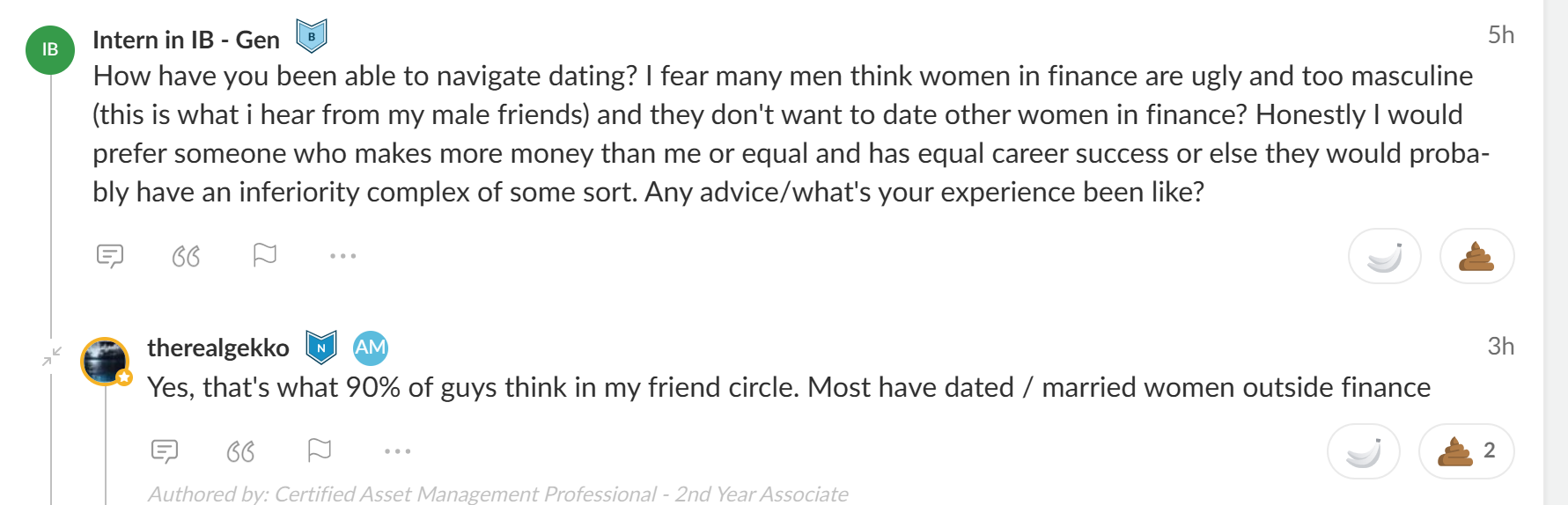
lol got a notification so had to dig out my password and reply to his…
No you dumbass I’m not single. And yes he makes more than you and went to a better school than you (I don’t need to know where you went to know that).
Honestly this is such a stupid comment it’s funny. Some guys are so incompetent but also insecure that they can not fathom that many people, men and women, can be more successful than them in both work and life
How do you manage relationships with male colleagues who are provoked by your intelligence to prevent them from engaging in politics against you? I noticed that men have a bigger issue with very intelligent women relative to other colleagues. In personal relationships, I noticed that men tend to be more protective of less intelligent / capable women. On the trading floor, I noticed that men tend to push back hard and more publicly against more intelligent / capable women, and then call the women "abrasive" or "toxic".
This is a great question and hit the nail on the head, will address
Building on the points around perception -in environments where idea discussions can be pretty direct, how did you learn to advocate for your views and challenge others early on in your career in a way that landed well and built credibility?
This is a great question, will address this and also prevent men from taking your credit
See post on how to identify good / bad funds below or DM with detailed questions
A - You gotta be able to hurt them, and don't hesitate if that's what you need to do. That being said, always do it where it can't be seen and not in the open, obviously. I always believe the motto - don't scream, just kill.
This is something that you will definitely encounter as a woman in investing, esp. if your focus is public market. You need to have teeth for them to treat you with respect, or else some of them never will. What are things that are like electric fences that you can use to defend yourself (and fend of the wild dogs)? A few things - (1) a network of people (PMs, other investors) who want to listen to you / hear your opinions because you are good, (2) a network of peers at good funds that they (the guys who want to make your life difficult) presumably want to recruit to, (3) allocators / LPs (surprisingly, a lot of women who start out in investing end up going into the allocation route because of how hard it is for women to stay in the industry), (4) internal dynamics, (5) observe his own mistakes and control the choke points that can hurt him.
Some of the above are self explanatory, but let me add a bit more details to each in case helpful. On (1), if you command knowledge, you can generally command more value than some dude who' just insecure, (2) - somewhat self explanatory - if they know your best buddies work at fund A B C that he might potentially want to recruit at, he probably will hesitate before he shows his full asshole state. Many roles in investing have shadow references - it's up to me if I introduce you to the right people, and make it clear that unless you treat me with respect, it's only he who loses. Conversely, you should feel very free to use your social capital to ding those who are like that. I have definitely not extended interviews, not passed along job openings, hinted at the opposite direction of how to think about an investment, to those I know that have this issue. On surface, they think I'm polite, but I'm not helping them to survive as their survival creates a more toxic environment for women. (3) when allocators / LPs who are your friends come and ask about fund XYZ, if you've heard several women suing them from your own network, what do you think you will say to them? Few funds have solid enough record for the other words of mouth to have 0 impact. (4) self explanatory. (5) many men who are the biggest terrirozers of women do what they do because they are terrified. They are insecure because they are not good at their jobs. Make keen obsevations of what can hurt his career, as if his skills are the bottleneck there sure will be a lot of attackable areas - control the components that can impact his career negatively, use where you can't be seen, and he will learn to stay away from you too.
Q- How do you manage relationships with male colleagues who are provoked by your intelligence to prevent them from engaging in politics against you? I noticed that men have a bigger issue with very intelligent women relative to other colleagues. In personal relationships, I noticed that men tend to be more protective of less intelligent / capable women. On the trading floor, I noticed that men tend to push back hard and more publicly against more intelligent / capable women, and then call the women "abrasive" or "toxic".
TBH, one of my favorite weapons of choice is to "nudge" known sexists into the wrong direction. I generally don't confront them directly; but as a function of having been in the industry, me and many women in the same vintage actually know exactly who are sexist (without even having worked with them before). When one of those people contact me to compare notes on a company / industry, or inquire about best ways to prepare for interviews for a particular role that I might have insights on, one can figure it out pretty quickly what they know, what they don't know, and nudge them into the wrong direction. This is a method that preserves one's own likeability, while systematically lowers the p(win) and p(survival) of sexist assholes.
Similar on the recruiting / LP front. On recruiting, once you hit mid level, headhunters will start ot inquire you about juniors, peers, and oftentimes seniors too. A hh reaching out to you for recommendation on a [role name] with [x background] and asking about whether person A is good from your experience working with him? Now is your chance! I would never say that so and so is a sexist though - that stuff HHs don't care about. I would generally ask them what they are looking for, and give some anecdotes on I'm sure this guy is fine but I heard he is not a good team player (if they want good team players) / has weak risk control (if hiring for a conservative firm) / etc add some rationale that's opposite to what the HH is recruiting for. Similarly this lowers the p(survival) of known assholes at no risk to me. For LP, similar gig - if someone reaches out to me and asks about fund X, I ask them what are the key things they are thinking about and supply business / commercial rationales to the opposite direction (layered with knowledge on the strategy), never discuss sexism on its own.
A- You can also be direct; direct doesn't mean tactless / rude though. I think your question is trying to address - how to be direct but also land well socially. If that's the case, I have an unconventional recommendation / short cut I've used myself - watch all the political TV shows you can find, and observe how the different female authoritive figures carry themselves / speak. None of them are trying to act like a guy (my personal opinion is that it doesn't work), but each of them use a combination of words and how they carry themselves to deliver authority. There are a few good characters you can observe in shows like Game of Thrones and West Wing, to name a few. It's hard to describe it accurately with words but if you see it, you can break it down into verbal / physical components and replicate where applicable.
Q- Building on the points around perception -in environments where idea discussions can be pretty direct, how did you learn to advocate for your views and challenge others early on in your career in a way that landed well and built credibility?
Thanks, that makes sense - maybe a more concrete version: was there a situation early on where someone else took or reframed your idea, and what did you do in that moment or after to handle it?
this is a good question. Let me think of examples of actions / solutions to commonly occurring challenges and then come back in the next two weeks
How do you go about building a network of relationships with investors / PMs at other funds and with LPs? Particularly given how male dominated the space is, is it awkward networking with older guys and how do you make the value exchange?
As a woman (trying very, very hard to make APM despite getting whacked over great performance) - just wanted to thank you for the very fair and honest answers.
Feel free to PM me specific fund / group names to diligence on vulture / sexism / performance if you think I’m knowledgeable on your strategy / asset class
Your mentioning of vulture aspects to the culture is very true. There are funds that prey on young female candidates thinking they aren’t as well connected in the industry and as knowledgeable about how to troubleshoot issues and can take lower comp and worse treatment.
Some of them even have extensive reviews / comments on WSO. If you see a fund with posts here that has a lot of deleted comments (and reviews on Reddit / Glassdoor that seem clearly bifurcated - aka some very bad ones written by employees X some clear fake ones written by hr), know that this is a place you should avoid. Usually they have pretty bad performance too but that’s a separate topic . Bad performance plus bad people usually exacerbates the issue. Hint- some of their partners/ PMs have their own legal issues, such as DUIs that you can find using a Google of their name and key word
Feel free to msg me directly to diligence on fund / group specific culture/ sexism/ performance if you think we are in the same asset class
sent you a dm
Are there any funds that are known / repeat offenders? How to spot them during interviews?
Yes. There are. MSG me and I’ll also write a post on it
I’m glad to see this post gaining more traction. As I said, ask me anything - I want the bad apples to have the reputation they deserve and more women succeeding / avoiding landmines :)
Reporting harassment - let’s see if @WallStreetOasis.com does anything about it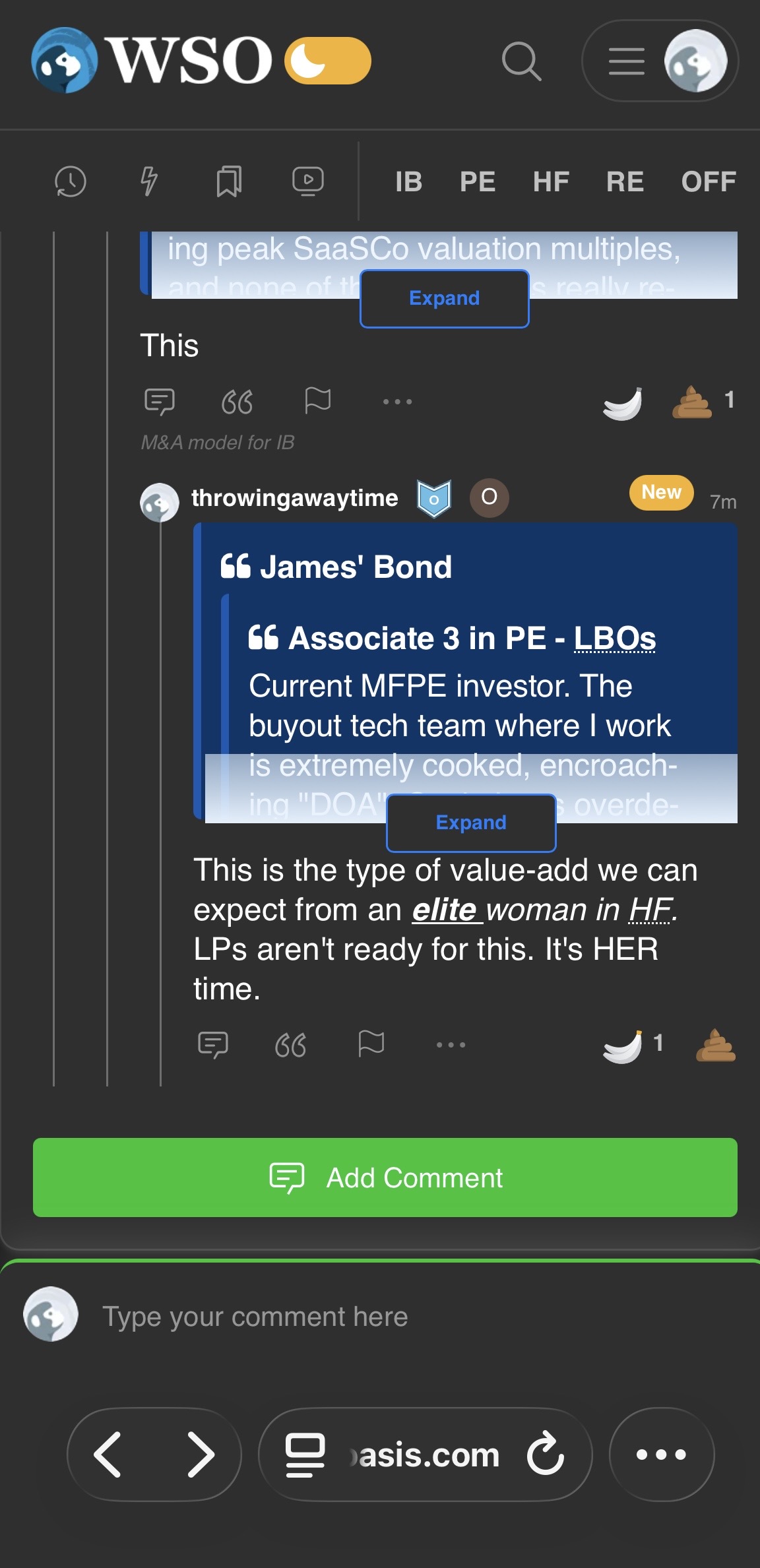
Would you be able to share more about your transition from FID to an investment role/HF? I'm a woman/senior in college about to start in FID at a BB in NYC- interned in s&t, didn't love the stratification and chose a secured lending role within FID, but don't have a clear picture of what I want my next steps to be. Also happy to PM if preferred. Thank you!!
A - Yes, happy to.
To transition from FID to a corporate finance role, one of the big hurdle you would need to overcome on your own time is financial modeling and analysis. For financial modeling, you would need to use your own time to get as many reps as possible. I recommend existing resources such as WSP where they have pretty robust modeling classes. I would recommend that you start from a blank Excel and get to a place where you can independently model without error a reasonable complicated 3-statement fully linked model within 4-5 hours (talking about having 3 years of historical data, 5 years of projection, all quarterly, with KPIs etc). Although having the mechanical skills alone doesn't make one a good investor, I think it is still a prerequisite of being a good investor - if you can't model well / fast / without errors, in the real life of day-to-day investing job, you wouldn't be able to have time to think diligence the business and think. I would recommend that you get the mechanical skills down cold, and then you can start to practice more of the investment skills by looking at pitches. For example, if you currently work in S&T, you probably have the list of watchlist companies that's sent to your client. If they have public financials, you should take advantage of that, make a full model of it, track your projections vs reality, see what you hit / what you miss, how you think something will turn out / how it turned out. When you have built enough reps, you will have become a decently strong analyst as well.
Many of the skills in this line of work is built on reps. I would say if you build 50 models from scratch, and practice on 50 pitches, you are pretty set to outperform your peers. Although it seems like a big number, if you commit to doing 1 rep per weekend, this is really only 2 years of time (not mentioning you can increase the load on long weekends, etc.)
Q- Would you be able to share more about your transition from FID to an investment role/HF? I'm a woman/senior in college about to start in FID at a BB in NYC- interned in s&t, didn't love the stratification and chose a secured lending role within FID, but don't have a clear picture of what I want my next steps to be. Also happy to PM if preferred. Thank you!!
In terms of exploring what type of investment roles you may want (vs how to build the skills for it), being in a S&T role is actually helpful. You can take a look at what type of investments you like to observe / can get comfortable on investing behind through your role, and when people ask it can be a natural answer that you observed these investments in your current seat and you want to do them yourselves. Questions to you during interviews might be more focused on whether you have the technical skills, which the previous thread addresses - if you tell any interviewer that you did 50 reps of modeling and 50 reps of pitches on your own time (and can show them), then I think that's an answer that anyone can respect.
Q - How do you go about building a network of relationships with investors / PMs at other funds and with LPs? Particularly given how male dominated the space is, is it awkward networking with older guys and how do you make the value exchange?
A- Happy to answer those.
How to build relationship with other investors / PMs
This is something that is more contingent upon your technical skills / mastery of your coverage industry and companies. As you can imagine, in the public market (and to some extent, even in the private market), if you are good at your job, you can effectively be viewed as a valuable addition to a homework group. What does being good at your job mean:
As you can imagine, if someone starts to talk to you in Q1 2026 and all the things you say to them that you think will happen in the next few quarters actually wound up happening in Q2/3/4 2026, you will be viewed as very good and people will want to keep in touch with you.
Conversely, I'm not a fan for someone who wants to network just for the sake of networking. You should always treat people with respect / not as a transaction but ultimately, very few investment professionals want to just "hangout" with someone who can't help them advance their careers
Q - How do you go about building a network of relationships with investors / PMs at other funds and with LPs? Particularly given how male dominated the space is, is it awkward networking with older guys and how do you make the value exchange?
A- Happy to answer those.
How to build relationship with people in the LP space
When I say building relationship with LPs, I don't mean people who are currently directly LPs of your current fund. I am talking more about building relationships with people who are in the broader LP space - that can include people at pensions, SWF, family offices, FoFs, etc. In general, these are helpful connections to make (even if they are not your current LPs) because: (1) when you diligence a job offer, you can ask them about how LPs view the particular fund you are looking to join, (2) eventually, if you want to raise your own fund, they are some of the more natural points to at least start learning about how LPs think.
There are a few natural ways to build relationship with them. To caveat, unlike the direct investing space, there are actually a lot more women in LP space because of all the obstacles facing women in the direct industry that we are discussing in this thread. For better or worse, LP space are generally more institutionalized and have less of a wild west dynamic that may make it harder for women in the direct investing space.
Natural pathways for you to build these relationships include:
On building relationship with other investors / PMs / LPs - any time you have an opportunity to serve as a knowledge expert in these knowledge ecosystems, you should take it. I have benefited a lot from "repeat inquirers" or their introductions. For example, I may have helped one LP to understand the different substrategies within a strategy type and how to decipher underwritten thesis / returns vs what's achievable; then they will introduce me to another one of their friends in the LP space who has questions on how to differentiate between good vs bad coinvestment deal flows they receive. If your knowledge if credible and helpful, these introductions will keep coming. I would say I now have close to 50-100 other investors I can talk to at any given time, and 20-30 high quality LPs (meanining they work in a reputable LP institute with large tickets) that I can diligence my own offers on should I need to
I think I’ve answered most outstanding questions. I’ll also write about outside in, how to identify funds that are more likely to be sexist, and people who are more likely to be sexist
Also will write a post on different sector coverages and those that are less averse to women
Non minus non ut quia. Ut expedita voluptates voluptas odio rerum omnis explicabo. Sit consequatur voluptas ab sapiente animi. Qui qui voluptas tempora. Voluptate quibusdam vitae blanditiis natus. Unde quo quis velit quis quia et aut.
Quod repudiandae et hic est nostrum nemo omnis fugit. Aut assumenda mollitia ut consequatur qui laborum. Ex ut qui unde sunt voluptatem.
Ab et soluta ut fugiat et. Dignissimos itaque placeat minus vel. Aut ut officia officia ipsa omnis. Temporibus molestiae quis harum voluptatem.
See All Comments - 100% Free
WSO depends on everyone being able to pitch in when they know something. Unlock with your email and get bonus: 6 financial modeling lessons free ($199 value)
or Unlock with your social account...
Veritatis a quibusdam voluptatum ratione nobis quia ipsum. Natus eum esse exercitationem aut quia sunt quis.
Qui sed inventore dolorum rerum praesentium itaque quaerat. Dolore deserunt nobis architecto sed.
Natus rerum modi occaecati voluptas. Et dicta debitis aut exercitationem. At ut rem aperiam adipisci distinctio necessitatibus eos.
Perferendis ut delectus autem tenetur est. Mollitia omnis dicta qui earum quibusdam mollitia sunt. Aut ullam quae commodi exercitationem. Unde incidunt eaque sequi.
Et vel ipsa non neque. Voluptatum sit porro est sunt sed ipsa. Dolor et aut ab sed.
Dignissimos impedit doloribus et omnis et sunt quaerat. Mollitia non amet voluptate voluptatem qui in. Consequatur neque autem error. Aut sit velit qui sed.
Excepturi odit iure reiciendis nemo natus enim consequatur. Cumque expedita debitis maxime eum laboriosam voluptas. Eos ea dolore expedita in dignissimos rem qui. Repellendus ea dolor cumque doloribus quae minima commodi eaque.
Ipsum ut vero dolor officia cum ea quam. Laudantium incidunt unde numquam vitae qui laudantium delectus. Rerum cum praesentium exercitationem ducimus et iure. Velit libero quia dolorem laboriosam. Corrupti esse maiores dicta magni nobis in. Nesciunt ut similique nemo rerum incidunt.
Quis ipsa ut libero molestiae repellat. Itaque optio aut itaque et.
Iure facilis totam iusto porro in expedita omnis. Ea dolorem repellendus similique aut rerum quis. Dolores deserunt repudiandae aspernatur quos accusantium tempore non. Tenetur rem voluptas voluptatem adipisci sed aperiam.
Perferendis ipsa quis quod eligendi voluptates autem. Cupiditate quo blanditiis rem accusantium odio qui. Ex et occaecati ea.