
Private Credit Interview Question and Answers
Prepare for your private credit interview with these top questions and expert answers. Includes technical, behavioral, and deal-related Q&A to help you stand out.

What Is Private Credit?
Private credit refers to non-bank lending where investment firms or credit funds provide loans directly to companies, bypassing traditional public markets. Unlike public debt, which involves bonds or loans traded on public exchanges, private credit deals are negotiated privately and are not publicly traded.
This asset class has grown significantly in recent years, driven by companies seeking flexible financing solutions and investors looking for higher yields compared to traditional fixed-income investments.
Private credit typically includes direct lending, mezzanine financing, distressed debt, and other bespoke credit arrangements. These loans are often used by middle-market companies that may not have access to public markets or prefer the tailored terms offered by private lenders.
The focus is on generating steady income through interest payments, making it an attractive option for institutional investors like pension funds, insurance companies, and endowments.
How to Prepare for a Private Credit Interview
Preparing for a private credit interview requires a mix of technical expertise, market awareness, and a clear understanding of the firm's strategy. Here are key steps to help you stand out:
1. Understand the Firm’s Strategy
Research whether the firm focuses on distressed debt, mezzanine financing, or direct lending. Tailor your preparation to align with their investment approach and be ready to discuss how you would evaluate opportunities within their specific strategy.
2. Brush Up on Accounting, LBOs, and Credit Metrics
Private credit interviews often test your understanding of financial fundamentals. Be comfortable with accounting concepts, leverage buyout (LBO) modeling, and key credit metrics like fixed-charge coverage, debt service coverage, and leverage ratios. These are critical for assessing the risk and return of credit investments.
3. Read Recent Deals the Firm Has Done
Familiarize yourself with the firm’s recent transactions. This will not only help you understand their investment style but also prepare you to discuss how you would approach similar deals. Knowing the trading levels, covenants, and pricing of these deals can give you an edge.
4. Practice Technicals and Case Studies
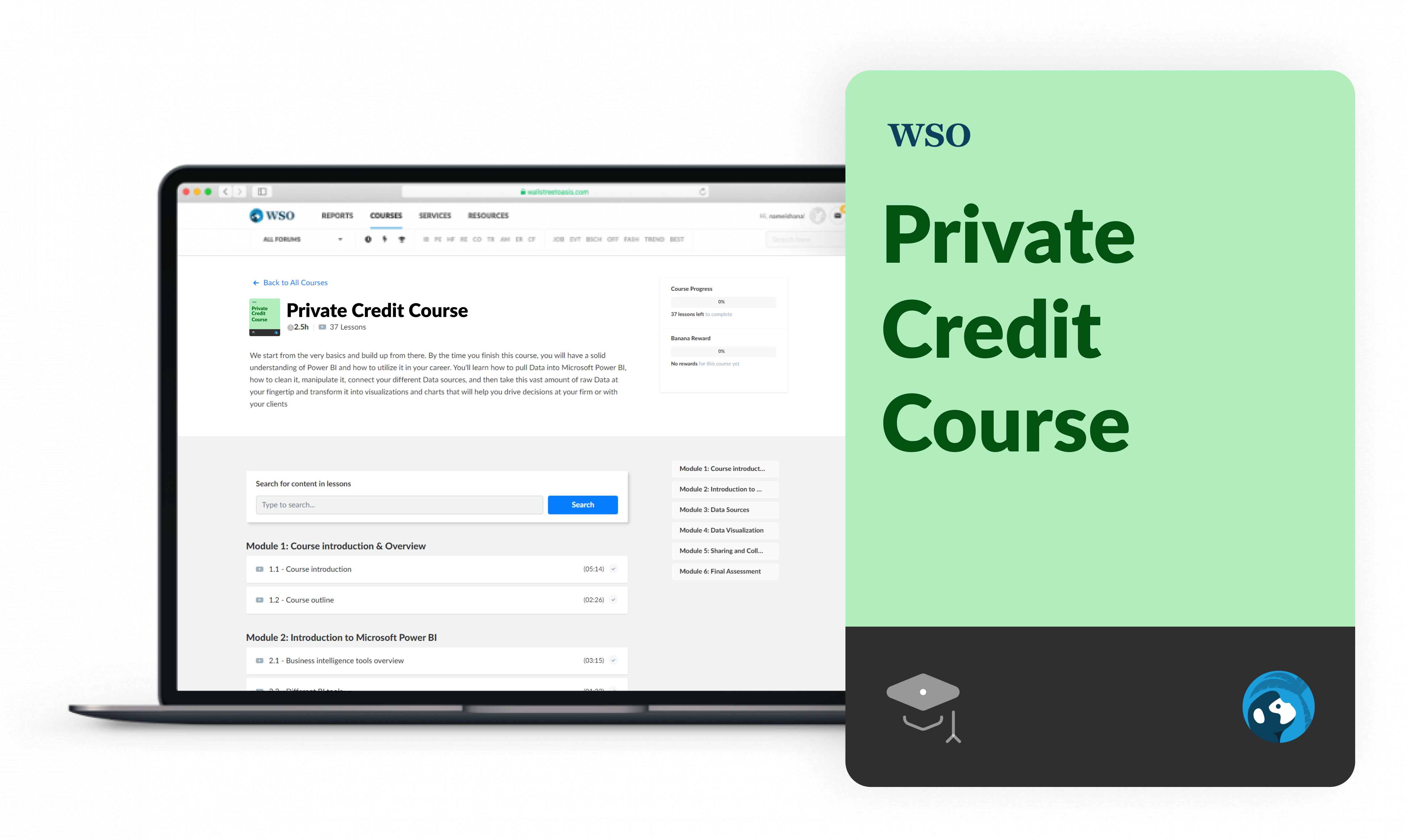
Case studies are a common component of private credit interviews. Expect to build a model (similar to an LBO but focused on credit stats rather than equity returns) and defend your assumptions. Be prepared to discuss debt structure, pricing, and downside risks. Practicing these scenarios will help you confidently navigate the technical portion of the interview. If you want access to step-by-step case walkthroughs, technical drills, and real interview prompts, check out our Private Credit Interview Prep Course.
By focusing on these areas, you’ll be well-prepared to demonstrate both your technical skills and your understanding of the private credit space.
Behavioral Questions
"I grew up with a strong interest in finance and problem-solving, which led me to pursue [insert degree, e.g., Finance/Economics] at [insert university]. During my time there, I gained foundational knowledge in financial analysis and developed a passion for understanding how businesses operate. My internships at [insert firm(s)] allowed me to work on [specific tasks, e.g., M&A deals, credit analysis], where I honed my skills in evaluating companies, analyzing financials, and understanding capital structures. Currently, I’m working as an analyst in [insert current role], where I’ve gained hands-on experience in [specific relevant experience, e.g., structuring debt, assessing risk, or working on leveraged deals]. I’m now looking to transition into private credit because I’m drawn to the opportunity to focus on downside protection, risk-adjusted returns, and building long-term relationships with borrowers."
"Private credit appeals to me because it combines the analytical rigor of investment banking with the relationship-driven nature of private equity, but with a unique focus on downside protection and risk management. Unlike private equity, where the focus is on operational improvements and equity returns, private credit requires a deep understanding of the capital structure and the ability to assess and mitigate risks while structuring deals that work for both the borrower and the lender. Compared to investment banking, private credit offers the opportunity to take a principal mindset, where I can directly influence investment decisions and see the long-term impact of those decisions. I’m particularly drawn to the challenge of evaluating businesses from a credit perspective, pricing risk appropriately, and structuring creative solutions that align with both parties’ goals."
"I attended [insert university] and majored in [insert major], where I developed a strong foundation in finance and accounting. During my time there, I completed internships at [insert firm(s)], where I worked on [specific tasks, e.g., financial modeling, credit analysis, or deal structuring]. For example, at [insert firm], I worked on [specific deal/project], where I [specific contribution, e.g., analyzed the capital structure, assessed credit risks, or built a financial model]. After graduation, I joined [insert current firm] as an analyst in [insert group, e.g., M&A, leveraged finance], where I’ve gained experience in [specific relevant experience, e.g., structuring debt, analyzing covenants, or working on leveraged buyouts]. These experiences have given me a strong understanding of credit metrics, risk assessment, and the importance of downside protection, which is why I’m excited to bring this expertise to a private credit role."
"My biggest weakness is that I can sometimes be overly detail-oriented, which can slow me down when working under tight deadlines. I’ve realized that while attention to detail is critical in finance, especially in credit analysis, it’s equally important to prioritize tasks and focus on the bigger picture. To address this, I’ve started using tools like checklists and setting time limits for certain tasks to ensure I stay efficient while maintaining accuracy. This approach has helped me balance my focus on details with the need to meet deadlines and deliver results."
Technical Questions
A leveraged loan structure typically involves a mix of debt instruments used to finance a company with a higher level of leverage. The structure is tiered based on seniority and risk:
- Senior Secured Debt: This is the most senior in the capital structure, secured by the company’s assets. It includes revolvers and term loans (e.g., Term Loan A, Term Loan B). These loans have the lowest risk and, therefore, the lowest interest rates.
- Subordinated Debt: This sits below senior debt in the structure and is unsecured. It carries higher risk and offers higher returns.
- Mezzanine Debt: Positioned below senior and subordinated debt, it often includes equity kickers like warrants to compensate for its higher risk.
- Equity: At the bottom of the structure, equity holders are the last to be paid in a liquidation scenario.
The goal of a leveraged loan structure is to optimize the company’s capital stack while balancing cost of capital and risk.
- Senior Secured Debt: This is the highest priority in the capital structure, secured by collateral. It has the lowest risk and cost of capital, with strict covenants to protect lenders.
- Mezzanine Debt: This is subordinated and unsecured, sitting below senior debt. It carries higher risk and offers higher returns, often including PIK interest or equity warrants as compensation.
- Unitranche: A hybrid structure that combines senior and subordinated debt into a single tranche. It simplifies the capital structure and offers a blended interest rate, but it’s more expensive than traditional senior debt.
To assess a company’s debt capacity, I focus on its ability to service debt under various scenarios:
- Cash Flow Analysis: Evaluate EBITDA and free cash flow to determine how much debt the company can support. Key metrics include:
- Leverage Ratio: Total debt/EBITDA.
- Interest Coverage Ratio: EBITDA/Interest expense.
- Fixed-Charge Coverage Ratio: EBITDA/(Interest + Fixed Charges).
- Industry Benchmarks: Compare the company’s leverage and coverage ratios to industry norms.
- Downside Scenarios: Stress-test the company’s financials to ensure it can meet obligations during downturns.
- Asset Base: Assess the quality and liquidity of the company’s assets for collateral purposes.
- Growth and Stability: Consider the company’s revenue predictability, margins, and competitive position.
- Cash Interest: This is paid in cash periodically (e.g., monthly, quarterly). It directly impacts the company’s cash flow and liquidity.
- PIK (Payment-in-Kind) Interest: Instead of cash, interest is accrued and added to the loan principal. It defers cash outflows but increases the debt burden over time. PIK is typically used in higher-risk situations or mezzanine debt.
Covenants are provisions in credit agreements designed to protect lenders by ensuring the borrower maintains financial discipline. They fall into two categories:
- Affirmative Covenants: Require the borrower to take specific actions, such as providing financial statements or maintaining insurance.
- Negative Covenants: Restrict the borrower from certain actions, like incurring additional debt, paying dividends, or selling assets without lender approval.
- Financial Covenants: These are performance-based and include:
- Maintenance Covenants: Require the borrower to maintain specific financial ratios (e.g., leverage ratio, interest coverage ratio).
- Incurrence Covenants: Trigger restrictions only when the borrower takes specific actions, like issuing new debt.
Covenants ensure the borrower remains creditworthy and provide early warning signs of financial distress.
If EBITDA drops by 20%, the impact on leverage and interest coverage would be significant. Here's how I would assess it:
- Leverage Impact: Leverage is typically measured as Total Debt / EBITDA. A 20% drop in EBITDA increases the leverage ratio because the denominator decreases. For example, if a company had $100M in debt and $50M in EBITDA, its leverage would increase from 2.0x to 2.5x after a 20% EBITDA drop ($100M / $40M).
- Interest Coverage Impact: Interest coverage is measured as EBITDA / Interest Expense. A 20% drop in EBITDA reduces the numerator, which lowers the interest coverage ratio. For instance, if EBITDA was $50M and interest expense was $10M, the coverage ratio would drop from 5.0x to 4.0x after the EBITDA decline.
- Analysis: I would also evaluate whether the company has sufficient liquidity (e.g., revolver availability) to manage the increased leverage and reduced coverage. Additionally, I’d assess covenant headroom to determine if the company risks breaching financial covenants.
- Revolver: A revolving credit facility is like a credit card for companies. It allows them to borrow, repay, and reborrow up to a certain limit as needed. It’s typically used for short-term liquidity needs, such as funding working capital or managing cash flow fluctuations. Interest is only paid on the amount drawn, and it often has a floating interest rate.
- Term Loan: A term loan is a fixed amount of debt borrowed upfront and repaid over a set schedule, either through amortization or a bullet payment at maturity. It’s used for long-term financing needs, such as acquisitions or capital expenditures. Interest is paid on the full principal amount, and it can have either a fixed or floating rate.
- Key Difference: The revolver provides flexibility for short-term needs, while a term loan is structured for long-term financing with a fixed repayment schedule.
Credit ratings are determined by a combination of quantitative and qualitative factors. Key considerations include:
- Financial Metrics:
- Leverage: Total Debt / EBITDA or Debt / Equity.
- Coverage Ratios: EBITDA / Interest Expense or Fixed-Charge Coverage Ratio (FCCR).
- Liquidity: Cash on hand, revolver availability, and free cash flow generation.
- Business Profile:
- Industry Risk: Cyclicality, competitive dynamics, and barriers to entry.
- Market Position: Scale, market share, and pricing power.
- Revenue Stability: Recurring revenue, customer concentration, and diversification.
- Management and Governance:
- Track record of financial discipline and operational execution.
- Transparency and quality of financial reporting.
- Macroeconomic Factors:
- Interest rate environment, regulatory risks, and geopolitical considerations.
- Covenants and Structural Protections:
- Strength of covenants and seniority of the debt in the capital structure.
To evaluate a sponsor’s equity cushion, I would:
- Calculate the Equity Contribution: Determine the percentage of the total capital structure funded by equity. For example, if the sponsor contributes $40M in equity for a $100M deal, the equity cushion is 40%.
- Assess the Cushion Relative to Risk:
- Leverage: Higher leverage requires a larger equity cushion to absorb potential losses.
- Volatility: For cyclical or high-risk industries, a larger equity cushion is critical.
- Analyze the Sponsor’s Track Record:
- Review the sponsor’s history of supporting portfolio companies during downturns.
- Evaluate their willingness to inject additional equity if needed.
- Consider the Exit Strategy:
- Assess whether the equity cushion provides sufficient downside protection to ensure debt repayment in a worst-case scenario.
Underwriting a private credit deal involves a structured process to assess risk and return. Here’s how I’d approach it:
- Understand the Business:
- Review the company’s industry, competitive position, and revenue drivers.
- Analyze historical financials to identify trends in revenue, margins, and cash flow.
- Analyze the Capital Structure:
- Evaluate the proposed debt structure, including seniority, covenants, and pricing.
- Assess leverage and coverage ratios to ensure they align with market norms.
- Evaluate the Sponsor and Management Team:
- Review the sponsor’s track record and alignment of interests.
- Assess the management team’s experience and ability to execute the business plan.
- Perform Downside Analysis:
- Stress test the financials to evaluate the company’s ability to service debt under adverse scenarios (e.g., EBITDA decline, interest rate hikes).
- Focus on downside protection, such as collateral value and covenant headroom.
- Review Legal and Structural Protections:
- Analyze the covenant package, security interests, and intercreditor agreements.
- Ensure the debt has sufficient protections to mitigate risk.
- Prepare a Credit Memo:
- Summarize the investment thesis, risks, mitigants, and expected returns.
- Highlight key credit metrics and downside scenarios.
- Make a Recommendation:
- Based on the analysis, recommend whether to proceed with the deal, adjust terms, or decline.
Pro Tip:
Preparing for these types of technicals is much easier when you’ve seen how professionals break them down. Our Private Credit Course includes a full technical interview guide, mock cases, and video walkthroughs to help you ace your interviews.
Questions to Ask Your Interviewer
"I’d love to understand more about the scale of the firm’s operations. Could you share the current AUM and the typical check size for deals? Additionally, are there any specific industries or deal sizes the firm tends to focus on?"
Why it works: This shows you’re interested in the firm’s strategy and scale, while also leaving room for the interviewer to elaborate on their niche or focus areas.
"Could you walk me through how performance is evaluated for junior investors? Are there specific metrics or qualitative factors that are emphasized, such as deal sourcing, execution, or portfolio monitoring? I’d also be curious to know how feedback is typically delivered and how the firm supports professional development."
Why it works: This demonstrates that you’re proactive about understanding expectations and value growth, while also showing you’re serious about excelling in the role.
"I’m very interested in understanding the level of deal exposure analysts typically get. Are analysts involved in the full lifecycle of a deal, from initial diligence to structuring and monitoring? Additionally, how much interaction do analysts have with senior team members and external stakeholders during the process?"
Why it works: This highlights your eagerness to gain hands-on experience and learn from the team, while also showing you’re thinking about the practical aspects of the role.
"I’d love to hear your perspective on the typical career trajectory for someone in this role. What are some of the common exit opportunities for analysts, and how does the firm support career progression, whether internally or externally?"
Why it works: This shows you’re thinking long-term about your career while also being open to internal growth opportunities. It’s a professional way to inquire about exit opps without sounding like you’re already planning to leave.
Final Tips to Nail Your Private Credit Interview
1. Come prepared with real deal stories to showcase your experience
When discussing your deal experience, focus on the following structure:
- Context: Briefly describe the deal, including the industry, size, and your role.
- Key Details: Highlight the capital structure, leverage levels, covenants, and any unique aspects of the deal.
- Your Contribution: Emphasize your specific role—did you analyze the creditworthiness, structure the debt, or assess the downside risks?
- Outcome: Share the result of the deal and what you learned.
Example Answer:
"One of the most interesting deals I worked on was a $500M leveraged buyout in the healthcare sector. I was responsible for analyzing the creditworthiness of the target, focusing on its recurring revenue streams and EBITDA margins. We structured the deal with a senior secured loan at 4x leverage and included covenants to ensure downside protection. My analysis identified potential risks, such as regulatory changes, and I proposed mitigants like tighter covenants and a higher interest coverage ratio. The deal closed successfully, and the company has since outperformed projections, validating our credit thesis."
2. Be clear on why you prefer credit over equity
Your answer should reflect a genuine interest in credit and an understanding of its unique aspects. Avoid generic responses like "credit is easier."
Example Answer:
"I prefer credit over equity because I enjoy the focus on downside protection and risk management. In credit, the goal is to ensure stable returns by structuring deals with strong covenants and understanding the borrower’s ability to service debt under various scenarios. I also appreciate the flexibility in private credit—being able to invest across the capital structure, whether it’s senior secured loans, mezzanine debt, or even taking a minority equity position when the opportunity is compelling. Additionally, the velocity of deals in credit allows me to analyze a broader range of businesses, which keeps the work dynamic and intellectually stimulating."
3. Demonstrate your understanding of risk and downside protection
Show that you can identify risks and propose mitigants effectively.
Example Answer:
"Risk assessment is at the core of private credit investing. When evaluating a deal, I focus on key risks such as industry cyclicality, customer concentration, and leverage levels. For example, in a recent deal, I identified a high customer concentration risk, with one client accounting for 40% of revenue. To mitigate this, we structured the loan with tighter covenants, including a minimum revenue diversification clause, and required the borrower to maintain a higher cash reserve. Additionally, I always analyze the placement in the capital structure to ensure we have sufficient downside protection, such as being in a senior secured position with strong collateral coverage."
4. Practice modeling and LBO-style questions to ensure you’re ready for technicals
Be ready to walk through an LBO model with a focus on credit metrics rather than equity returns.
Example Answer:
"In a private credit context, the LBO model is used to assess the debt capacity and creditworthiness of a business. When building the model, I focus on metrics like leverage ratios, fixed-charge coverage, and debt service coverage. For example, in a recent case study, I analyzed a company with $50M EBITDA and determined it could support 4x leverage, given its stable cash flows and low CapEx requirements. I priced the debt at 6% based on market comps and included covenants to ensure adequate downside protection. My assumptions were backed by sensitivity analyses to stress-test the business under various scenarios, such as a 20% revenue decline."
Want to level up your prep?
Whether you're targeting direct lending, distressed debt, or mezzanine roles, our Private Credit Interview Course is built by professionals with real deal experience. It includes practice questions, case walkthroughs, and everything you need to crush your interviews.
Free Resources
To continue learning and advancing your career, check out these additional helpful WSO resources:


or Want to Sign up with your social account?