
DCF vs. Relative Valuation
The two methods answer two different questions. A DCF is used to answer, “What’s a company worth?” Relative valuation is used to answer, “What does the market think it’s worth?”


Two analysts evaluate the same company on the same day; one says it's worth $40 a share, and the other says it’s worth $58. So, what happened? Who is right?
Maybe neither of them. They just used different methods, and each method depends on its own set of assumptions. Nudge the discount rate by just half a point or swap two companies out of the peer group, and either number can move by several dollars a share.
Analyst one built a DCF model. That's the standard approach: project the company's free cash flow (typically out 5-10 years), add a terminal value for everything beyond that, and then discount it all back to the present at a rate that reflects the initial risk. Analyst two went the relative valuation route: looked at what the comparables are trading for at the moment and applied those multiples (EV/EBITDA, P/E etc) to the target's own numbers.
Both numbers can be defended, and that tension is exactly why "Walk me through a DCF versus a comps analysis" comes up in so many banking interviews.
Interviewers aren't testing whether you can define the two methods. They want to know if you understand when each one is credible, where each one fails, and why a banker would put both on the same page.
This guide looks at how each method works, the actual differences between them, when to use which and how to discuss the trade-offs without sounding as though you've memorised the textbook.
What Is A DCF Valuation?
A DCF model values the business on the cash it's expected to generate. You start with the historical financials and forecasts. Peer trading prices don't determine the answer in the way they do in a comp. Market data does still come in, though. The discount rate will use market inputs (beta and equity risk premium), and one of the terminal value methods will take a multiple straight from the peers.

The logic comes from the time value of money. A dollar received ten years from now is worth less than a dollar today, partly because today's dollar can be invested and partly because the future one isn't guaranteed. The discount rate captures both, which is why riskier businesses get discounted more heavily.
The model has four working steps:
- Project unlevered free cash flow. Done by forecasting five to ten years of cash flow available to all capital providers, before interest payments. That means building out revenue growth, operating margins, taxes, D&A, capital expenditures (capex), and changes in working capital.
- Choose a discount rate. For unlevered free cash flow, this is the weighted average cost of capital (WACC), which combines the after-tax cost of debt and the cost of equity, each weighted by their share in the company’s capital structure.
- Estimate terminal value. This step captures the value of all cash flows beyond the forecast period. Analysts usually use either the perpetuity growth (Gordon Growth) method or the exit multiple method.
- Discount and sum. Discount each year's free cash flow and the terminal value back to today, then add them up. The result is enterprise value. To reach a share price like the $40 in our opening example, subtract net debt and other non-equity claims to get equity value, then divide by diluted shares outstanding.
The final product is called intrinsic value. It's what the business is worth based on its own economics, whether or not the market matches today.
That's the main benefit. A DCF doesn't care that biotech is running hot or that the sector just sold off. It only cares what the company will earn.
This is also its greatest weakness. Every input is a prediction, and a small change can swing the answer hard. Move the discount rate by half a percentage point, and your valuation can shift by several percentage points. The terminal growth rate moves it too, though not always by more — it depends on how big the change is and how close growth already sits to the discount rate.
Run the terminal value formula on $100M of cash flow at a 9% discount rate and 2.5% growth and you're at circa $1,538M. At 9.5% discount rate you're down to circa $1,429M (a 7.1% drop). At 3% growth you're up to circa $1,667M (an 8.3% increase). That's the reason bankers build a full sensitivity table around that pair of inputs rather than just give you one output figure.
- A DCF estimates what a business is worth based on its own cash flows. It leans far less on current market sentiment than comps do, although market data still feeds the discount rate. The output is only as reliable as the forecast behind it.
- Relative valuation shows what the market is paying right now. It's quick and grounded in actual prices. If the whole sector is overpriced, your valuation inherits that.
- Stable, forecastable cash flows usually point toward a DCF. Comps tend to be more useful when cash flows are hard to predict, and a solid peer group exists. A company with no real peers sends you back to the DCF, and on most live deals bankers run both.
- A DCF’s majority of the value is derived from terminal value, as it comprises 60-80% of the business’ projected and discounted value.
- Trading comps and transaction comps are driven by the peer group the company belongs to. Entire relative valuation is dependent on the current and historical key metrics and previous deals they were involved in.
- Trading and transaction comparables measure the same inputs. A calculated multiple shows the market's view of growth, cash conversion, and durability, which is exactly what a DCF models explicitly.
What Is Relative Valuation?
Relative valuation comes at the question from the other direction. A DCF works outward from the company's own cash flows. Relative valuation starts with the market and asks what investors are currently paying for businesses like this one.

Find comparable businesses. Look at multiples like EV/EBITDA, EV/Revenue, or P/E, whichever fits how the company makes money. Then apply those multiples to your target's own numbers.
The most common version you will use is comparable company analysis, often just called comps or trading comps for short. The process is simple:
- Pick the peer group. Same industry, similar size, similar growth, similar margin trends. This step decides your output.
- Pull up the multiples. EV/EBITDA and EV/Revenue pair enterprise value with a metric available to every capital provider, so applying them hands you enterprise value. P/E works differently — it pairs equity value with a metric left over for shareholders alone, so it produces equity value directly. Keep track of which kind you're using, because mixing them up gets you the wrong number entirely.
- Line up the mean, median, high, and low across the peer set. The mean gets swayed by outliers, so most bankers lean on the median, but the real output is a range — usually the 25th to 75th percentile — nudged up or down if the target deserves a premium or a discount.
- Apply it to your target's own metric, and you have a valuation range, not a single number.
Say your target generates $200 million of EBITDA and the peer median sits at 10x. That's $2.0 billion of enterprise value. Subtract net debt, say $500 million, and you're at $1.5 billion of equity value. Divide by 26 million diluted shares, and you land at roughly $58 a share — the same number from this article's opening.
The mechanics are simple. The judgment isn't. Before any multiple is usable, you strip out one-time items, line up fiscal years that end in different months, and make sure every peer's EBITDA means the same thing. Even so, you can build a solid comps set in a day or two. A full DCF usually takes longer.
The second form of relative valuation is precedent transactions. Instead of today's trading prices, you look at the multiples acquirers paid for comparable companies in past M&A deals. Those multiples usually come in higher than trading comps because they include a control premium, which is the extra amount a buyer pays to own the whole business. They can also reflect synergies that only that buyer expected to capture. Precedents matter most when you're advising on a sale. The catch is that deal data ages quickly, and a multiple paid in a 2021 market may say little about 2026.
The power of relative valuation lies in its real price basis. Your 2032 revenue forecast doesn't need belief from any individual.
The weakness is the flip side. If the entire sector is overpriced, your comps analysis will be too. It tells you what the market thinks a business is worth, not what it's actually worth.
DCF vs. Relative Valuation: Differences And Trade-Offs
The two methods answer two different questions. A DCF is used to answer, “What’s a company worth?” Relative valuation is used to answer, “What does the market think it’s worth?”
The two differ fundamentally, and that distinction follows everything else.
| DCF | Relative Valuation | |
|---|---|---|
| Question it answers | What is the business worth on its own fundamentals? | What are investors paying for similar businesses? |
| Type of value | Intrinsic | Relative (market-based) |
| Built from | Projected unlevered free cash flow and a discount rate | Trading comps and precedent transaction multiples |
| Typical output | Enterprise value, shown as a range from a sensitivity table | Enterprise or equity value, shown as a range across the peer set |
| Time to build | Longer; a full model can take several days | Faster once peer data is cleaned |
| Most sensitive to | Discount rate and terminal value assumptions | Peer selection and choice of multiple |
| Main blind spot | Can drift away from what buyers will actually pay | Inherits any sector-wide mispricing |
| Works best when | Cash flows are stable and forecastable | A genuine peer group exists |
So which one is correct? $40 or $58? Neither is wrong, and neither is in any sense definitive. The DCF tells you the business is worth $40 on the basis of what it will actually generate over time. Relative valuation tells you the market is currently paying $58 for businesses of that type. Both can be true at the same time. A business can be worth less than the price the market is currently paying for it, particularly in a hot sector.
The real trade-off is what each of those numbers can and can't tell you. A DCF forces you to defend your own assumptions about growth and risk and is honest about whether a sector is over or underpriced. Relative valuation gives you a number today which is rooted in actual transactions, but it takes on whatever mispricing the market is currently running on. They don't replace each other, and that's why bankers build both before they come to a range.
Where A DCF Breaks?
The Terminal value usually controls 60 to 80 percent of the total. This is the least defensible part of the model, doing most of the work.

The inputs also move together, and when they move in the same direction, they don't cancel out, they compound. Lower the discount rate by a percentage point and raise the long-term growth rate by a percentage point at the same time, and the spread between them shrinks by two full points. Run that against the same $100M cash flow: dropping from a 6.5-point spread to a 4.5-point spread pushes the value from about $1,538M to roughly $2,222M, a 44 percent jump. That's the real danger. Two analysts using inputs that each sound reasonable on their own can land 40-plus percent apart.
It also needs future cash flows to predict. A pre-revenue biotech or a start-up software development firm has no steady streams of income for a DCF valuation analyst to project. It can come up with a number, but not a convincing answer.
The DCF pros and cons are worth knowing about the cold. You'll almost certainly be asked to walk through the mechanics, but the follow-ups about where a DCF falls apart are often what separate strong candidates.
Where Does Relative Valuation Break?
It goes off whatever the market believes. If the whole sector trades at 30x earnings because rates are low and money is cheap, your comps will say 30x. It has no way to tell you that's expensive.
The peer sets do the most work, and those peer sets are the judgment calls. Swap two comps and the median moves. A banker who wants a higher valuation can very easily find a defensible reason to include the richest peers.
There's another deeper problem too in that a multiple completely flattens the differences between companies. A multiple is really shorthand for growth, return on capital, and risk, so two companies at the same EBITDA multiple can be very different in terms of their growth trajectories, their capex requirements, and the actual length of time their competitive advantage is likely to last.
Comps also break outright in a few common cases. A company with no true peer group has nothing clean to measure against. Negative or distorted earnings knock out P/E entirely, pushing you toward EV/Revenue, which says nothing about whether the business is even profitable. And “adjusted EBITDA” rarely means the same thing from one company to the next, so the multiple you're comparing may not be comparing like for like.
Precedent transaction analysis has the same problem with an extra caveat. Deal multiples come from specific moments, and a transaction priced during a boom tells you little about today.
Neither method is wrong. Each is a different kind of approximation, and each fails differently.
When To Use DCF and Relative Valuation Methods?
When using valuation methods, start with a rough rule of thumb: predictable cash flows lean toward a DCF, and a clean peer group leans toward comps. It's a starting point, not a conclusion; the list below shows plenty of exceptions on both sides.
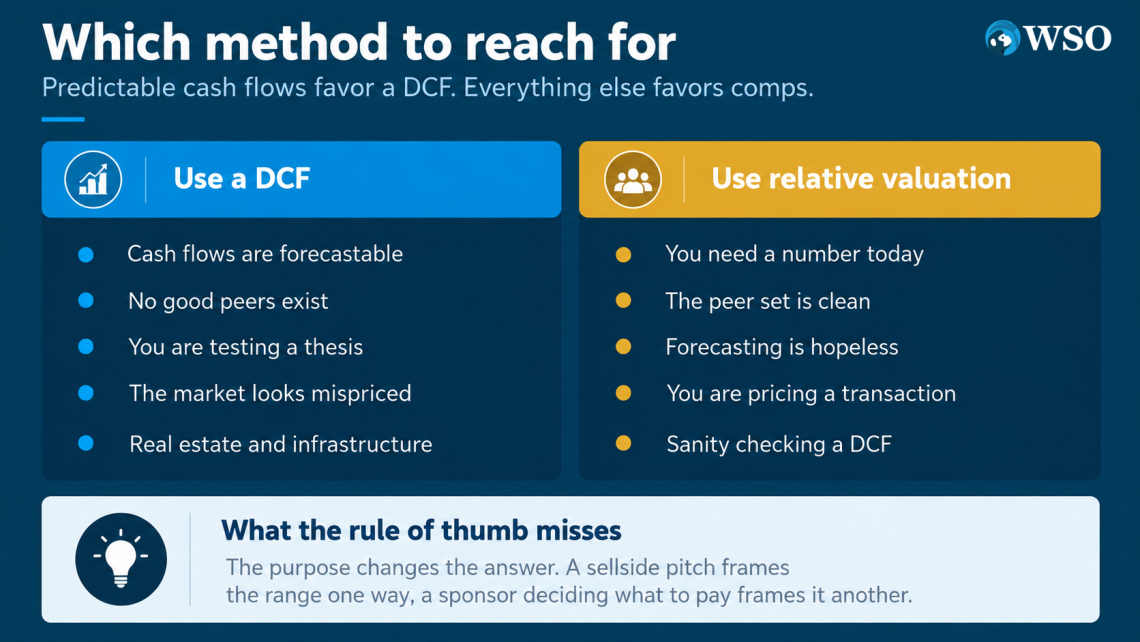
To arrive at an appropriate valuation range, bankers use both valuation approaches on most live deals. The real question isn't which method to use; it's how much weight each one gets once you're in the room.
Do a DCF when:
- The cash flows are predictable. Mature businesses with stable margins and visible demand. Utilities, consumer staples, established industries.
- There are no good peers to compare. A company with an unusual business model has nothing clean to measure against, so you depend more on its own numbers. Though precedent deals or a sum-of-the-parts view can still help fill the gap.
- You're testing a thesis. A discounted cash flow analysis rests on assumptions and pushes users to state what they believe about the company’s growth and margins. Comparables are built on market data, and they don't avoid that assumption.
- The market looks mispriced. If you think a sector is overheated or underpriced, a DCF gives you a read that doesn't just borrow the market's own bias back. Though an LBO analysis or a dividend discount model can make a similar case.
- Cash flows are long-dated and contracted. That's why infrastructure leans so heavily on DCFs. Real estate uses them too, alongside cap rates drawn from comparable property sales.
A DCF model template is a fast way to see how sensitive an output is to each input.
Turn towards relative valuation when:
- The peer set is clean. Plenty of similar public companies means the multiples are reliable.
- Trying to predict is hopeless—cyclicals at a turning point, early-stage companies, anything commodity-related.
- You're pricing a transaction. What buyers actually paid matters more than the theoretical value when you're negotiating.
Trading multiples also act as a good sanity check on a DCF you've already built.
Principle guide: you can start with the initial guidance, but the purpose of the analysis determines the weighting. A sell‑side banker running an auction wants a case for a high price, so precedents and a well‑supported DCF get the spotlight. A private equity buyer works from the side. An LBO analysis shows how much it can pay and still hit its target return, and that number often limits the bid regardless of what comps say. A fairness opinion sits in between and normally weighs DCF comps and precedents during the analysis. The analysis remains central to every decision.
A sell-side banker pitching a company frames the range one way. A sponsor deciding what actually to pay frames it another way. Same company, same data, different emphasis.
So the honest answer to "which one is better?" comes down to... Well, the question they're paying you to answer.
Why Bankers Use DCF And Relative Valuation
Open any sell-side pitch deck, and you'll find a football field. It's a horizontal bar chart with a valuation range from each method stacked on top of each other. These include DCF, trading comps, precedent transactions, and sometimes an LBO analysis.
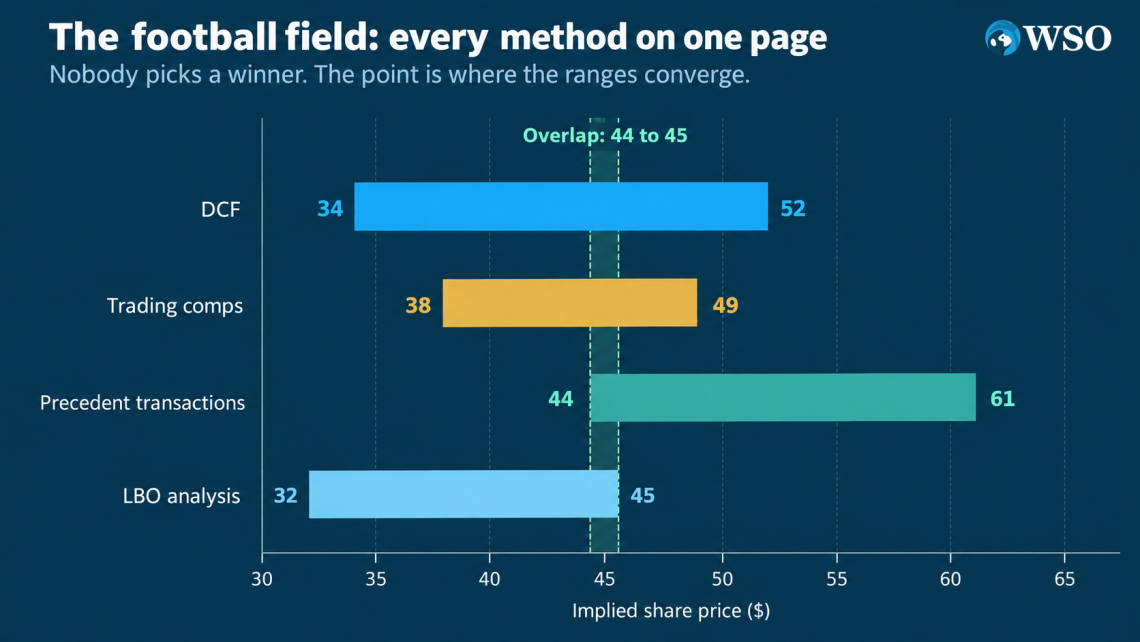
The goal isn’t to pick the best one; it’s to evaluate the overlaps.
Where the ranges meet is where a banker gets a defensible number. Where they diverge, however, means something is worth explaining, and that explanation is usually the fun part.
But there's a deeper reason as to why the two methods are found on the same page, and it's the thing most candidates miss.
They're measuring the same drivers.
A multiple isn't arbitrary. A company trades at 15x EBITDA instead of 8x because of growth, cash conversion, leverage, and how durable the business appears. Those are the exact inputs that drive a DCF.
Analysts on the WSO forum make this point clear: relative valuation is a shortcut to getting to a DCF value. The multiple we use is just the market's judgment about the same variables you'd model out anyway.
You can't even build a DCF without comps.
This is the part that tricks people. To discount cash flows, you need a discount rate, and to get a discount rate, you need a beta and a capital structure. Where do those come from? Peer companies.
So the "independent" method actually depends on the market-dependent one. A DCF built with no references to comparable companies has no defensible cost of capital.
That changes the whole question. DCF and relative valuation aren't rivals. They are two views of the same underlying stories, one built explicitly, and one read off a price.
This is why a banker who only ran with one is actually doing half the work.
How To Answer This In An Interview
Interviewers ask this question in multiple ways. All of them are testing the same thing.
- "Which valuation method is best?" Answer with a question of your own: best for what? Then commit. Each method is an approximation, bankers run several, and you can say which one you'd weight more heavily for the company in front of you and why.
- When would you use a DCF over comps? The direct version. They want to hear the decision rule and a reason.
- "Why does your DCF give a higher value than your comps?" Work backward. Work back to the multiple your DCF implies and compare it to the peer median. If your DCF implies 12x and the peers trade at 9x, either your growth and margin assumptions sit above what the market is pricing in, or the sector is trading below where fundamentals suggest it should.
- Which method gives the highest valuation? Usually precedent transactions, because of the control premium baked into every deal price. LBO analysis usually lands lowest, since a sponsor's required return caps what it can pay. That's why it often acts as the floor. None of this is fixed, though. Precedents struck in a hot market can look stale against today's trading comps, and a DCF built on aggressive growth assumptions can come in above everything else.
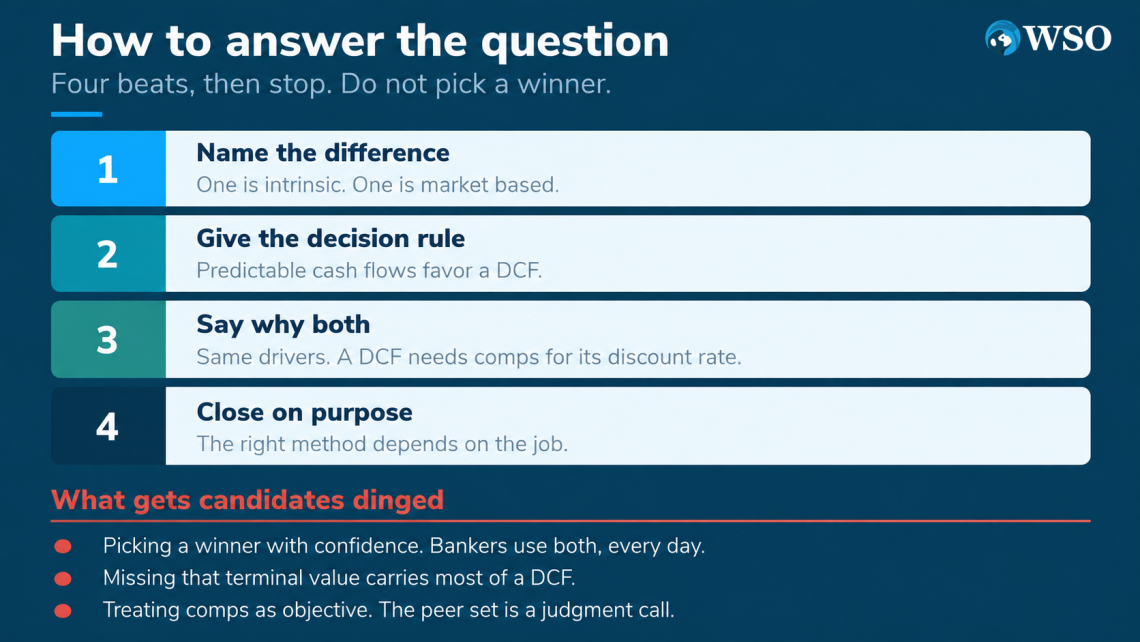
The answer must reflect structure and confidence.
- Name the difference. One is intrinsic, one is market-based. That’s the core; then move on. Don't spend your answer searching for definitions.
- Give the decision rule, with its exception. Stable, forecastable cash flows lean toward a DCF, and a clean peer group leans toward comps. A company with no real peers pushes you back to the DCF regardless.
- Say why both. This is what separates you from the rest. The methods measure the same inputs, and a DCF needs comps to derive its own discount rate.
- Close it out with purpose. The right method depends on the analysis's purpose. A sell-side pitch and a sponsor's bid are completely different jobs.
Three things that get candidates dinged:
- Picking a winner with confidence. Bankers use both every day. Choosing one signals you don't know either.
- Missing that terminal value controls a DCF. If you defend a DCF as rigorous without mentioning that most of the answer lies in the terminal value, you've over-claimed.
- Treating comps as an objective. The peer set is a judgment call, and pretending otherwise is worse than admitting it.
If you're rusty on the mechanics, the walk me through a DCF walkthrough covers the entire build. But the mechanics are table stakes. The trade-off is what people remember, and it sits at the center of how valuation actually works.
DCF Vs. Relative Valuation FAQs
Discounted Cash Flow (DCF) valuation technique uses the intrinsic value to form the base of valuation by projecting the future cash flows of the organization/business, and discounting them back to the present.
And, relative valuation uses multiples like (PE, PS, PEG, EV/EBITDA) to form base for the organization’s/business’ valuation.
A DCF valuation or analysis is dependent on the internal data provided by the company’s management and analysts, and has little to do with market sentiments.
Discounted Cash Flow (DCF) analysis and valuation is intrinsic. The valuation is derived from the organization’s own historical financial information, from which we calculate the projected future cash flows that are discounted at a rate built from market inputs.
Avoid a DCF when cash flows can't be reasonably forecasted. Pre-revenue companies, early-stage startups, and cyclicals at a turning point all produce a number without producing a reliable answer.
Terminal value dominates the formula, often 60 to 80 percent of total value. That means most of the answer lies in the least defensible assumption in the model.
They're related but not the same. Both discount future cash flows to present value. NPV goes one step further by subtracting the upfront cost, so it answers whether an investment is worth making: a positive NPV clears the hurdle. A DCF valuation discounts a company's projected cash flows to arrive at enterprise value, without netting out a purchase price. NPV is typically used on individual projects, while a DCF is usually applied to a whole business.
Relative valuation is also called multiples valuation or market-based valuation. It covers two main forms: comparable company analysis (trading comps), which uses what similar public companies trade for today, and precedent transactions, which uses the multiples acquirers paid in past deals. In conversation, people often say "comps" when they mean trading comps specifically.
Precedent transactions usually run the highest because acquirers pay a control premium above where a company trades. Trading comps and a DCF typically land lower and closer together.

Free Resources
To continue learning and advancing your career, check out these additional helpful WSO resources:


or Want to Sign up with your social account?